
Healthcare professionals dedicate their careers to patient care, yet an alarming portion of their time gets consumed by documentation. From detailed clinical notes to complex billing codes, the paperwork burden in modern medicine is real and growing. That is exactly where professional medical transcription services step in — transforming the way clinics manage records, streamline workflows, and ultimately serve their patients better.
Whether you run a solo practice, a specialty clinic, or a multi-physician group, investing in accurate and secure transcription solutions is no longer optional. It is a strategic decision that directly impacts clinical outcomes, operational efficiency, and revenue cycle performance.
What Are Medical Transcription Services?
Medical transcription services involve converting voice-recorded dictations from physicians and other healthcare providers into written, formatted clinical documents. These documents include:
- Patient history and physical examination reports
- Operative notes and procedure summaries
- Discharge summaries
- Radiology and pathology reports
- Consultation letters and referral notes
- SOAP (Subjective, Objective, Assessment, Plan) notes
Traditionally handled in-house, transcription has evolved dramatically. Today, clinics partner with specialized vendors who combine trained human transcriptionists with advanced speech recognition technology to deliver fast, accurate, and HIPAA-compliant documentation.
The Real Cost of Poor Documentation
Before exploring the benefits of outsourcing, it is worth understanding what poor documentation actually costs a clinic.
A 2023 AMA survey found that physicians spend nearly two hours on administrative tasks for every hour of direct patient care. Much of this time goes toward dictating, reviewing, and correcting clinical notes. When documentation is inaccurate or delayed, the ripple effects extend far beyond the medical record itself.
| Problem | Downstream Impact |
|---|---|
| Incomplete clinical notes | Missed diagnoses, care continuity gaps |
| Transcription errors | Incorrect treatment decisions |
| Delayed documentation | Billing backlogs, claim denials |
| Non-compliant records | Audit risks, legal exposure |
| Physician burnout | Staff turnover, reduced patient throughput |
Poor documentation is not just a cleanliness problem — it is a financial and safety problem. This is why a growing number of clinics are turning to professional transcription partners that also integrate with their medical billing service workflows.
Key Benefits of Professional Medical Transcription Services
1. Improved Accuracy and Clinical Quality
Professional transcriptionists are trained in medical terminology, anatomy, pharmacology, and specialty-specific language. Unlike generic voice-to-text tools, they understand context. A cardiologist dictating a stress echocardiography report uses a very different vocabulary than a neurologist documenting a cognitive assessment — and an experienced transcriptionist knows the difference.
Accuracy rates from reputable medical transcription companies routinely exceed 99%, which is the benchmark expected in clinical environments. When your records are accurate, your care decisions are grounded in reliable information.
2. Faster Turnaround Times
Clinics operating with in-house transcription often face backlogs, especially during peak periods or when staff call out. A professional transcription partner offers guaranteed turnaround times — typically 12 to 24 hours for standard reports and as little as 4 hours for STAT requests.
Faster documentation means faster care coordination, quicker discharge processing, and more timely claim submissions through your medical billing service.
3. Seamless Integration with Medical Billing
Accurate clinical documentation and medical billing are two sides of the same coin. When transcription errors occur — a wrong diagnosis code, a missing procedure detail, or an incomplete note — billing suffers. Claims get denied, reimbursements are delayed, and the revenue cycle stalls.
Professional transcription services that integrate with your medical billing service create a continuous, error-reduced flow from clinical encounter to billing submission. Many vendors offer:
- Direct EHR/EMR integration
- Structured data output compatible with ICD-10 and CPT coding workflows
- Real-time flagging of incomplete or ambiguous dictations
This tight connection between transcription quality and billing accuracy is one of the most compelling reasons clinics choose to outsource both functions to specialized healthcare partners.
4. HIPAA Compliance and Data Security
Patient data is among the most sensitive information in existence. A breach does not just carry regulatory penalties — it destroys patient trust. Reliable medical transcription services are built from the ground up with HIPAA compliance in mind. Look for vendors that offer:
- Business Associate Agreements (BAAs)
- End-to-end encryption for all transmitted data
- Role-based access controls
- Secure cloud storage with audit trails
- Regular staff training on privacy protocols
When you entrust a vendor with your patients’ health information, you need more than a promise. You need demonstrable compliance infrastructure.
5. Physician Time Savings and Reduced Burnout
Burnout among physicians is at an all-time high. Documentation overload is one of the primary drivers. When doctors can dictate naturally — in their own words, at their own pace — and trust that a professional team will produce a clean, formatted record, they reclaim hours every week.
Those hours translate into more patient appointments, better work-life balance, and higher staff retention. The return on investment from transcription services often shows up first in physician productivity metrics.
How Medical Transcription Supports the Revenue Cycle
The connection between clinical documentation and financial performance is direct. Here is how reliable transcription services strengthen every stage of the revenue cycle:
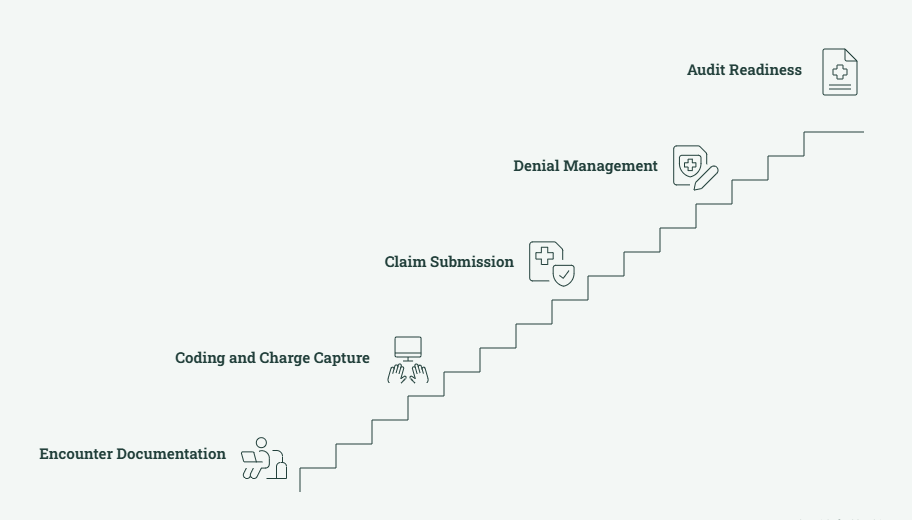
Stage 1 — Encounter Documentation: Physician dictates immediately after the patient visit, capturing all relevant clinical details while memory is fresh. Transcription turnaround ensures the record is finalized quickly.
Stage 2 — Coding and Charge Capture: Complete, accurate transcribed notes give medical coders the full clinical picture needed to assign correct diagnosis and procedure codes. This reduces under-coding (lost revenue) and over-coding (compliance risk) simultaneously.
Stage 3 — Claim Submission: Well-documented encounters result in cleaner claims. When your medical billing service receives accurate clinical information, first-pass acceptance rates improve significantly.
Stage 4 — Denial Management: Denied claims often trace back to insufficient documentation. With professional transcription, the supporting clinical evidence is already in place, making appeals faster and more successful.
Stage 5 — Audit Readiness: Whether facing a routine payer audit or a regulatory compliance review, complete and accurate transcribed records are your best defense. They demonstrate medical necessity and clinical appropriateness.
Choosing the Right Medical Transcription Partner
Not all transcription vendors are created equal. When evaluating options for your clinic, consider these critical factors:
Experience and Specialization
Does the vendor have proven experience in your specialty? Orthopedic transcription differs significantly from behavioral health or oncology. Ask for case studies, sample reports, and client references in your area of practice.
Technology Infrastructure
Modern transcription combines human expertise with AI-powered speech recognition. The best vendors use technology to increase speed while relying on trained professionals for accuracy, context, and quality assurance.
Turnaround Guarantees
Confirm the vendor’s standard and STAT turnaround times in writing. Understand their escalation process when urgent documentation is needed.
EHR Compatibility
Your transcription service must work seamlessly with your existing electronic health record system. Confirm compatibility with platforms like Epic, Cerner, Athenahealth, eClinicalWorks, or whichever system your clinic uses.
Pricing Transparency
Medical transcription services are typically priced per line, per minute of audio, or per report. Understand exactly what you are paying for and whether there are additional fees for rush requests, corrections, or EHR integration.
| Evaluation Criteria | What to Look For |
|---|---|
| Accuracy rate | 99% or above |
| Turnaround time (standard) | 12 to 24 hours |
| Turnaround time (STAT) | 2 to 4 hours |
| HIPAA compliance | BAA + documented security controls |
| EHR integration | Compatible with your existing platform |
| Specialty experience | Proven track record in your specialty |
| Pricing model | Transparent, no hidden fees |
The Case for Outsourcing vs. In-House Transcription
Many clinic administrators wrestle with the build-versus-buy question. Here is an honest comparison:
In-House Transcription Managing transcription internally means hiring, training, and retaining specialized staff. You also absorb the cost of benefits, equipment, software licenses, and management overhead. During staff absences or high-volume periods, quality and turnaround can deteriorate quickly. For smaller clinics, especially, the economics rarely favor keeping transcription in-house.
Outsourced Medical Transcription Services. Outsourcing converts a fixed overhead cost into a scalable, variable expense. You pay for what you use, gain access to specialized expertise across multiple specialties, and benefit from redundant staffing that ensures consistent service even during holidays or surges. Additionally, your vendor assumes responsibility for technology upgrades and compliance training.
For most clinics, the decision becomes clear once you calculate the true total cost of in-house operations.
Integrating Transcription with Your Medical Billing Service
The most forward-thinking clinics are moving toward integrated documentation and billing ecosystems. When your transcription vendor works in concert with your medical billing service, the result is a synchronized revenue cycle that reduces friction at every handoff.
Look for partners who offer end-to-end solutions or who have established integration workflows with leading billing platforms. This eliminates manual re-entry of data, reduces transcription-to-billing lag time, and ensures that clinical nuance captured in the transcribed record is preserved through the coding and claim submission process.
Some vendors now offer “transcription-assisted coding,” where trained coders review transcribed documents alongside automated coding suggestions, producing higher accuracy and faster billing cycles without additional burden on clinical staff.
Final Thoughts
The demands on today’s clinics are greater than ever. Patients expect attentive care. Payers demand accurate documentation. Regulators require strict compliance. And physicians need space to practice medicine rather than navigate paperwork.
Professional medical transcription services address all of these pressures simultaneously. They improve clinical record quality, support an efficient medical billing service workflow, protect patient data, and free your physicians to do what they are trained to do: care for patients.
Investing in the right transcription partner is not a back-office decision. It is a strategic commitment to the clinical and financial health of your practice — and ultimately, to the patients who depend on you every day.