

Medical practices today face a perfect storm: rising operational costs, increasingly complex payer requirements, and tighter reimbursement timelines. At the center of this challenge sits the revenue cycle, and the most critical component within it is accurate, compliant medical coding. A professional medical coding service does far more than assign alphanumeric codes to diagnoses and procedures. When implemented strategically, it fundamentally transforms the entire medical billing workflow, from patient encounter to final payment.
The Hidden Cost of Coding Errors in Medical Billing
Before understanding the solution, it helps to understand the scope of the problem. According to industry estimates, claim denial rates across healthcare practices average between 5% and 10%, with coding errors accounting for a significant share of those denials. Each denied claim costs a practice additional administrative time, delays cash flow, and in some cases results in permanent revenue loss when appeals are not pursued.
Common coding-related billing problems include:
- Upcoding or downcoding due to coder inexperience
- Mismatched diagnosis and procedure codes (ICD-10 and CPT misalignment)
- Failure to apply correct modifiers
- Outdated codes used after annual code updates
- Insufficient documentation to support the billed level of service
Each of these issues directly impacts the medical billing service workflow, creating bottlenecks that slow reimbursement and strain staff resources. The solution is not simply hiring more billing staff. It is integrating precise, expert-level medical coding at the front end of the revenue cycle.
What a Professional Medical Coding Service Actually Does
A qualified medical coding partner provides far more than code assignment. The best services operate as an extension of your practice, deeply embedded in your clinical documentation and billing workflow.
Core Functions of a Medical Coding Service
| Function | Impact on Billing Workflow |
|---|---|
| Accurate ICD-10/CPT/HCPCS assignment | Reduces claim denials at payer level |
| Modifier application | Ensures appropriate reimbursement for complex procedures |
| Query management with providers | Improves documentation quality over time |
| Coding audits and compliance checks | Minimizes risk of payer audits and penalties |
| Real-time code updates | Keeps claims aligned with current payer policies |
| Specialty-specific coding expertise | Maximizes revenue in high-complexity specialties |
When these functions are executed with consistency and expertise, the downstream effects on medical billing are measurable and significant.
5 Ways Medical Coding Transforms Your Billing Workflow
1. Fewer Claim Denials, Faster Reimbursement
The most immediate impact of professional medical coding is a reduction in claim denials. When codes are assigned the first time accurately, claims move through the payer adjudication process without interruption. Clean claims typically reimburse within 14 to 21 days, compared to 45 to 90 days or more when denials and resubmissions are involved.
A multi-physician orthopedic group that partners with a specialized coding service, for example, may see their first-pass claim acceptance rate climb from 78% to over 96% within the first six months. That improvement directly accelerates cash flow without requiring any changes to clinical operations.
2. Optimized Revenue Through Accurate Code Selection
There is a meaningful difference between compliant coding and optimized coding. Many practices unknowingly undercode, billing lower-complexity evaluation and management (E&M) codes out of excessive caution. A professional medical coding service ensures that the complexity of every encounter is fully and accurately reflected in the codes submitted.
This is not about inflating claims. It is about ensuring that the clinical documentation supports the appropriate level of service and that coders have the expertise to recognize and capture it. For practices with high volumes of complex patients, this distinction can represent hundreds of thousands of dollars in recovered revenue annually.
3. Reduced Administrative Burden on Billing Staff
When coding is handled by dedicated experts, your in-house billing team is freed from the time-consuming work of code research, modifier lookups, and payer-specific rule interpretation. They can focus on what they do best: managing accounts receivable, handling patient inquiries, and following up on outstanding claims.
This division of labor is one of the most underappreciated benefits of outsourcing or partnering with a medical billing service that includes robust coding support. The result is a leaner, more efficient revenue cycle team that handles higher volume without increased headcount.
4. Improved Compliance and Reduced Audit Risk
Healthcare compliance is not optional, and the consequences of coding errors extend beyond denied claims. Patterns of upcoding, unbundling, or unsupported billing can trigger payer audits, OIG investigations, and in serious cases, civil monetary penalties under the False Claims Act.
A reputable medical coding service builds compliance into every layer of the workflow:
- Regular internal audits of coded claims
- Ongoing coder education on regulatory changes
- Documentation improvement programs for providers
- Alignment with CMS guidelines and specialty society recommendations
This layer of compliance protection is especially valuable for high-volume practices, hospital outpatient departments, and specialty groups in high-scrutiny areas such as oncology, cardiology, and pain management.
5. Scalability Without Proportional Cost Increases
One of the most practical advantages of a professional coding partner is scalability. Whether your practice is expanding to new locations, adding providers, or experiencing seasonal volume fluctuations, an outsourced medical coding team can scale with you without the delays and costs associated with hiring and training new staff.
This is particularly relevant for growing group practices and health systems that need coding capacity that keeps pace with clinical expansion, without sacrificing accuracy or turnaround time.
Medical Coding and Billing: Understanding the Relationship
Medical coding and medical billing are often discussed as if they are a single function. In reality, they are two distinct but deeply interdependent disciplines within the revenue cycle.
Medical coding is the clinical translation process: converting physician documentation of diagnoses, procedures, and services into standardized codes (ICD-10-CM, CPT, HCPCS Level II).
Medical billing is the financial transmission process: submitting those coded claims to payers, managing the adjudication process, posting payments, and pursuing unpaid balances.
The quality of billing outcomes is directly dependent on the quality of coding inputs. Think of it as a pipeline: even the most skilled billing team cannot reliably recover revenue from inaccurate or incomplete codes. When a high-performing medical coding service feeds accurate, well-documented claims into the billing workflow, the entire revenue cycle operates at a higher level.
Specialty-Specific Coding: Why It Matters
Not all medical coding is created equal. Specialties such as neurosurgery, interventional radiology, radiation oncology, and behavioral health have highly specific coding requirements that generalist coders often do not fully understand.
Examples of Specialty Coding Complexity
| Specialty | Key Coding Challenge |
|---|---|
| Cardiology | Distinguishing between diagnostic and interventional catheterization codes |
| Orthopedic Surgery | Laterality modifiers and bundling rules for arthroscopic procedures |
| Behavioral Health | Psychotherapy add-on codes and time-based E&M documentation requirements |
| Oncology | Chemotherapy administration codes and drug billing under Medicare Part B |
| Emergency Medicine | Split/shared visit coding and provider-based billing requirements |
Choosing a medical coding service with verified expertise in your specialty is not a luxury. It is a prerequisite for optimized, compliant billing outcomes.
What to Look for in a Medical Coding Service Partner
If you are evaluating a medical coding partner for your practice or health system, these are the criteria that matter most.
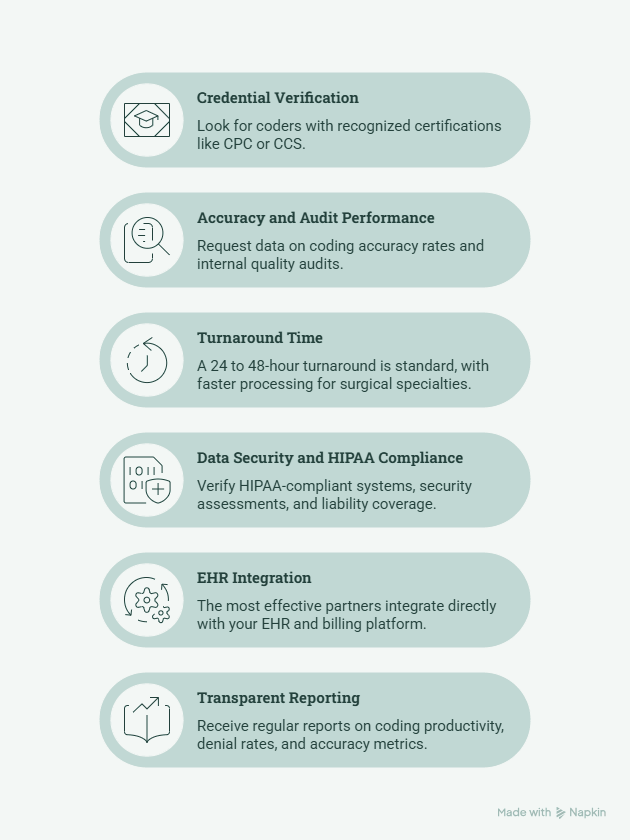
Credential Verification Look for coders who hold recognized credentials such as CPC (Certified Professional Coder), CCS (Certified Coding Specialist), or specialty-specific certifications from AHIMA or AAPC.
Accuracy and Audit Performance Request data on coding accuracy rates and ask how the service handles internal quality audits. Top-tier services maintain accuracy rates of 95% or higher.
Turnaround Time For most practices, a 24 to 48-hour turnaround on coded records is the standard. Surgical specialties or high-volume emergency departments may require faster processing.
Data Security and HIPAA Compliance Any medical coding service you engage with will have access to protected health information (PHI). Verify that they maintain HIPAA-compliant systems, conduct regular security assessments, and carry appropriate liability coverage.
Integration with Your EHR and Billing Platform The most effective coding partners integrate directly with your existing electronic health record and medical billing service platform, minimizing manual data transfer and reducing the risk of transcription errors.
Transparent Reporting You should receive regular reports on coding productivity, denial rates attributable to coding, and coding accuracy metrics. Transparency is a hallmark of a trustworthy partner.
The ROI of Investing in Professional Medical Coding
The financial case for professional medical coding is compelling when examined against the true cost of coding errors and inefficiency.
Consider a practice billing $3 million annually with a denial rate of 8%. That represents $240,000 in initially rejected revenue. If 30% of those denials are ultimately unrecovered (a common industry figure), the practice is leaving $72,000 on the table every year, before accounting for the administrative cost of managing those denials.
A professional medical coding service that reduces the denial rate to 3% and improves first-pass acceptance would recover the majority of that revenue, often far exceeding the cost of the service itself. When combined with optimized code selection that captures previously undercoded encounters, the return on investment becomes even more significant.
Building a High-Performance Revenue Cycle
Transforming your medical billing services workflow is not a single-step process. It requires a coordinated approach that aligns clinical documentation, coding accuracy, payer-specific billing rules, and accounts receivable management into a seamless system.
A professional medical coding service is the linchpin of that system. When coding is accurate, compliant, and specialty-appropriate, every downstream function of the revenue cycle operates more efficiently. Claims go out clean. Payments come in faster. Denials become the exception rather than the rule. And your team spends less time chasing revenue and more time serving patients.
For practices ready to take their revenue cycle to the next level, the starting point is always the same: invest in the quality of your coding, and the billing outcomes will follow.
Final Thoughts
The relationship between medical coding and medical billing is not incidental. It is foundational. Every element of your revenue cycle, from claim submission to final payment, depends on the accuracy and completeness of the coding that initiates the process.
Partnering with a professional medical coding service is one of the highest-leverage decisions a practice administrator or revenue cycle leader can make. It reduces denials, improves compliance, accelerates cash flow, and gives your billing team the clean inputs they need to perform at their best.
In an era where every dollar of reimbursement matters, accurate medical coding is not overhead. It is your most important revenue protection strategy.