
Introduction
In today’s fast-paced healthcare environment, accuracy and efficiency are not just goals, they are non-negotiable standards. Medical transcription services play a pivotal role in ensuring that every patient interaction, clinical note, and diagnostic report is captured, documented, and stored with precision.
Whether you are a hospital administrator, a solo practitioner, or a healthcare network executive, understanding how medical transcription works, and how it integrates with your medical billing service can directly impact the quality of patient care, compliance standards, and your organization’s bottom line.
This comprehensive guide explores what medical transcription services are, how they function, why they matter, and how they connect to the broader ecosystem of healthcare documentation and revenue cycle management.
What Are Medical Transcription Services?
Medical transcription services refer to the professional process of converting voice-recorded medical reports dictated by physicians, nurses, surgeons, and other healthcare providers into accurate, structured written documents.
These documents include:
- SOAP notes (Subjective, Objective, Assessment, Plan)
- Discharge summaries
- Operative and procedure reports
- Radiology and pathology reports
- Consultation and referral letters
- History and physical (H&P) examination records
- Emergency room documentation
Traditionally performed by trained human transcriptionists, today’s medical transcription industry leverages a powerful combination of artificial intelligence (AI), speech recognition technology, and human editing to deliver fast, accurate, and HIPAA-compliant documentation.
How Do Medical Transcription Services Work?
Understanding the transcription workflow is essential for any healthcare organization looking to optimize its documentation process. Here is a step-by-step breakdown:
Step 1: Physician Dictation
A healthcare provider dictates patient encounter notes using a digital dictation device, smartphone app, or EHR-integrated voice tool. This dictation may happen in real time during the patient visit or immediately afterward.
Step 2: Audio File Transmission
The recorded audio is securely transmitted to the transcription service provider via encrypted, HIPAA-compliant channels. Data security at this stage is paramount — top-tier providers use end-to-end encryption and role-based access controls to protect sensitive patient information.
Step 3: Transcription — AI-Assisted or Human
Depending on the service tier, the audio is processed by:
- Automatic Speech Recognition (ASR): AI-powered engines that convert speech to text in near real-time.
- Medical Language Specialists (MLS): Trained human transcriptionists who review, edit, and finalize AI-generated drafts for maximum accuracy.
- Hybrid Models: The most common approach — AI handles the initial transcript, and a certified MLS performs quality assurance (QA) review before delivery.
Step 4: Quality Review and Formatting
Every transcribed document goes through a multi-level quality review process. This ensures medical terminology is accurate, formatting adheres to facility-specific templates, and all clinical details are correctly captured.
Step 5: Secure Delivery and EHR Integration
Completed transcripts are delivered directly into the healthcare provider’s Electronic Health Record (EHR) system or document management platform. Leading services offer seamless integration with systems such as Epic, Cerner, Athenahealth, and eClinicalWorks.
Why Medical Transcription Services Are Essential
Accuracy in Clinical Documentation
Every word in a medical record matters. A transcription error can lead to misdiagnosis, incorrect treatment, or patient safety incidents. Professional healthcare transcription services ensure clinical accuracy through specialized training in medical terminology, anatomy, pharmacology, and clinical workflows.
Compliance and HIPAA Protection
Reputable medical transcription providers are fully HIPAA-compliant, maintaining Business Associate Agreements (BAAs) with all healthcare clients. They employ:
- Secure, encrypted data transfer protocols
- Strict access controls and audit trails
- Regular staff training on data privacy standards
- Disaster recovery and data backup systems
This level of security is non-negotiable in today’s regulatory environment — and it is what separates premium transcription services from generic solutions.
Physician Efficiency and Reduced Burnout
Studies consistently show that administrative burden is a leading cause of physician burnout. By outsourcing clinical documentation to professional transcription services, physicians can:
- Spend more time with patients
- Reduce after-hours documentation time
- Improve the accuracy and depth of their clinical records
- Focus on medical decision-making rather than typing
The Link Between Medical Transcription and Medical Billing Service
One of the most strategically important yet often overlooked connections in healthcare administration is the relationship between medical transcription services and medical billing service operations.
How Transcription Feeds the Revenue Cycle
Accurate clinical documentation is the foundation of successful medical billing. Here is how the two are directly connected:
- Coding Accuracy: Medical coders rely on transcribed physician notes to assign correct ICD-10, CPT, and HCPCS codes. Vague or incomplete documentation leads to claim denials.
- Claim Submission: A well-transcribed operative report or consultation note supports a clean claim submission, reducing the risk of payer audits.
- Reimbursement Optimization: Detailed, physician-specific documentation captures the full complexity of care delivered — supporting higher acuity codes where clinically appropriate.
- Audit Defense: In the event of a payer audit or compliance review, thorough transcribed records serve as evidence of the care provided.
Key Insight: Healthcare organizations that integrate their medical transcription service with their medical billing service consistently report lower claim denial rates, faster reimbursement cycles, and stronger compliance posture.
Choosing an Integrated Documentation and Billing Partner
Many leading healthcare service companies now offer end-to-end solutions that combine transcription, coding, and billing under one umbrella. This integration eliminates the risk of documentation gaps, reduces administrative handoffs, and creates a single accountable partner for the entire revenue cycle.
Types of Medical Transcription Services
Not all transcription services are created equal. Understanding the available models helps healthcare organizations choose the right fit:
1. Offshore Transcription Services
Historically popular for cost savings, offshore services route audio files to transcriptionists in countries like India or the Philippines. While cost-effective, they may carry risks related to data sovereignty, accent comprehension, and turnaround time.
2. Domestic (Onshore) Transcription Services
U.S.-based transcription services offer native English fluency, domestic data storage, and easier regulatory compliance. They are often preferred by high-profile health systems and specialty practices that prioritize quality and security.
3. AI-Powered Transcription Platforms
Platforms such as Nuance DAX, Suki AI, and Ambience Healthcare use ambient AI to passively capture physician-patient conversations and generate structured clinical notes automatically. These represent the cutting edge of healthcare documentation technology.
4. Specialty-Specific Transcription
Certain medical specialties, including radiology, cardiology, orthopedics, and behavioral health require transcriptionists with deep specialty knowledge. Specialized services deliver faster, more accurate results for complex clinical language.
Key Features to Look for in a Medical Transcription Service
When evaluating providers, healthcare leaders should assess the following criteria:
| Feature | Why It Matters |
|---|---|
| HIPAA Compliance | Protects patient data and your organization’s liability |
| Turnaround Time (TAT) | Standard TAT is 24 hours; STAT is 4–6 hours |
| Accuracy Rate | Top providers guarantee 98–99%+ accuracy |
| EHR Integration | Seamless delivery into your existing systems |
| Specialty Expertise | Matched transcriptionists for complex specialties |
| Scalability | Ability to handle volume spikes during peak periods |
| QA Processes | Multi-level review for consistent quality |
| Customer Support | Dedicated account management and 24/7 support |
Medical Transcription vs. Medical Scribing: What’s the Difference?
A common point of confusion is the distinction between medical transcription and medical scribing:
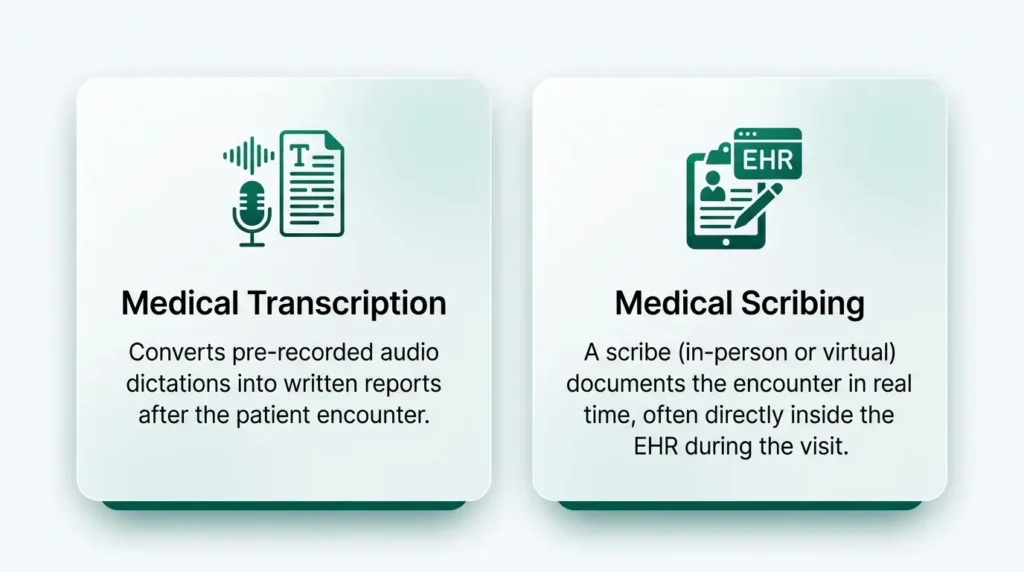
Both serve the same ultimate goal — accurate, timely clinical documentation — but differ in workflow, technology, and use case. Many organizations use both, depending on the care setting and physician preference.
Industry Trends Shaping Medical Transcription in 2024 and Beyond
The medical transcription industry is evolving rapidly. Key trends include:
Ambient Clinical Intelligence
Tools like Nuance Dragon Ambient eXperience (DAX) passively listen to physician-patient conversations and auto-generate structured SOAP notes. This represents a paradigm shift from dictation-based transcription to AI-powered ambient documentation.
Natural Language Processing (NLP) in Healthcare
Advanced NLP algorithms can now extract structured data (diagnoses, medications, procedures) from unstructured narrative text. This bridges the gap between clinical transcription and medical coding and billing workflows.
Voice-First EHR Integration
Leading EHR platforms are embedding voice-enabled documentation directly into clinical workflows, reducing friction and driving adoption of transcription at the point of care.
Interoperability and HL7 FHIR Standards
Modern transcription services are aligning with HL7 FHIR interoperability standards, enabling seamless data exchange across healthcare systems, payers, and analytics platforms.
Case Study: How Accurate Transcription Improved Billing Outcomes
Scenario
A multi-specialty group practice with 40 physicians was experiencing a 16% claim denial rate, primarily attributed to incomplete or inaccurate clinical documentation.
Solution
The practice partnered with a specialized medical transcription service that offered real-time quality audits and direct integration with their medical billing service provider.
Results after 6 months:
- Claim denial rate reduced from 16% to 4.2%
- Average reimbursement per encounter increased by 11% due to improved documentation specificity
- Physician documentation time reduced by 35 minutes per day per provider
- Zero HIPAA incidents related to transcription data handling
This real-world example illustrates the direct, measurable impact that high-quality transcription services can have on both clinical operations and financial performance.
How to Choose the Right Medical Transcription Partner
Selecting the right service provider is a strategic decision. Here are the most important steps:
- Define your documentation volume and specialty mix — understand your average daily dictation volume and any specialty-specific needs.
- Assess EHR compatibility — confirm the provider integrates natively with your EHR platform.
- Request a HIPAA Business Associate Agreement (BAA) — this is non-negotiable for any compliant engagement.
- Pilot test before full deployment — run a 30-day pilot to evaluate accuracy, TAT, and workflow fit.
- Evaluate billing service alignment — if you use an external medical billing service, confirm the transcription provider can deliver documentation in formats optimized for your billing workflow.
- Review SLAs and escalation protocols — understand what guarantees are in place for accuracy, turnaround, and issue resolution.
Conclusion
Medical transcription services are far more than a clerical function — they are a critical infrastructure component of modern healthcare delivery. From enabling physician efficiency and protecting patient safety to powering the accuracy of your medical billing service and revenue cycle, the right transcription partner delivers value at every level of your organization.
As healthcare continues to evolve with AI, ambient documentation, and interoperability standards, the organizations that invest in high-quality, HIPAA-compliant clinical documentation will be best positioned to thrive — clinically, operationally, and financially.
Whether you are evaluating your first transcription vendor or upgrading an existing solution, prioritize accuracy, security, specialty expertise, and seamless integration with your billing infrastructure. The returns — in efficiency, compliance, and reimbursement — will be immediate and lasting.