

In today’s rapidly evolving healthcare landscape, medical credentialing services play a foundational role in ensuring that healthcare providers can legally and efficiently receive reimbursement for their services. Without proper credentialing, even the most skilled physician cannot bill insurance companies — making it one of the most critical yet often overlooked components of a successful medical billing service.
Whether you are a solo practitioner, a growing clinic, or a multi-specialty hospital, understanding what medical credentialing is, how it works, and why it matters to your revenue cycle can help you avoid costly delays, claim denials, and compliance risks.
What Is Medical Credentialing?
Medical credentialing is the formal process of verifying a healthcare provider’s qualifications, education, training, licensure, and professional history. It is the mechanism through which insurance companies, hospitals, and government health programs confirm that a provider meets the necessary standards to deliver patient care and receive insurance payments.
Think of it as a professional background check — one that must be completed before a physician or healthcare professional can be enrolled with insurance payers such as Medicare, Medicaid, or commercial insurers like Aetna, Cigna, or BlueCross BlueShield.
The credentialing process typically involves verifying:
- Medical school education and postgraduate training
- Board certifications and specialty qualifications
- Active state medical licenses
- Malpractice insurance coverage and history
- Work history and professional references
- DEA registration (for prescribers)
- National Provider Identifier (NPI) number
Once verified, the provider is formally enrolled with insurance payers, allowing the medical billing service to submit claims on their behalf and receive reimbursements.
Why Medical Credentialing Is Essential to Medical Billing
Medical credentialing and medical billing are deeply intertwined. A provider who is not credentialed with an insurance payer cannot submit claims to that payer — and even if claims are submitted, they will be rejected outright.
Here is why credentialing matters so much to the overall billing process:
1. Prevents Claim Denials Insurance companies will deny claims submitted by providers who are not enrolled in their networks. Credentialing ensures that your practice is recognized as an approved provider, eliminating this common source of revenue loss.
2. Enables Network Participation Being credentialed allows providers to join insurance networks, making them accessible to a broader patient population who are covered by those plans. Patients prefer in-network providers due to lower out-of-pocket costs.
3. Protects Revenue Flow Gaps in credentialing directly lead to gaps in revenue. When a new provider joins a practice, delayed credentialing means they cannot bill for services rendered during that period — resulting in lost revenue that is difficult or impossible to recover.
4. Ensures Regulatory Compliance Healthcare is one of the most regulated industries in the world. Proper credentialing keeps providers in compliance with federal and state regulations, including CMS requirements for Medicare and Medicaid participation.
5. Builds Patient Trust When a provider is credentialed and part of a recognized insurance network, it signals professionalism and accountability to patients and referring physicians alike.
How Medical Credentialing Services Work
Professional medical credentialing services manage the entire credentialing process on behalf of healthcare providers, allowing clinical staff to focus on patient care rather than administrative paperwork.
Step 1: Initial Application and Data Collection
The process begins with gathering comprehensive information about the provider. This includes personal identification, educational background, residency and fellowship records, board certifications, malpractice history, and current licensure. A credentialing specialist compiles this into a standardized application.
Step 2: Primary Source Verification (PSV)
This is the most critical step. Every credential is verified directly from the original issuing source — medical schools, licensing boards, certifying bodies, and malpractice carriers. This eliminates reliance on provider-submitted copies and ensures data integrity.
Step 3: Payer Enrollment Applications
Once verification is complete, the credentialing team submits enrollment applications to each insurance payer the provider wants to join. Each payer has its own application portal, forms, and timelines. This is where expertise becomes invaluable — experienced credentialing specialists know payer-specific requirements and can navigate complex enrollment systems efficiently.
Step 4: Follow-Up and Status Tracking
Payer enrollment is rarely a one-step process. Insurance companies may request additional documentation, clarification, or updated information. A dedicated credentialing team monitors application status and proactively follows up to prevent delays.
Step 5: Approval and Effective Date Confirmation
Once the payer approves the application, they issue a provider number and an effective date. The credentialing team confirms this information and communicates it to the billing department so claims can be submitted immediately.
Step 6: Re-Credentialing and Ongoing Maintenance
Credentialing is not a one-time event. Most insurance payers require re-credentialing every two to three years. Additionally, licenses, certifications, and malpractice coverage must be monitored continuously to ensure nothing lapses. A professional credentialing service keeps track of all expiration dates and initiates renewals proactively.
How Long Does Medical Credentialing Take?
One of the most common frustrations healthcare providers face is the time it takes to complete credentialing. On average, the process can take anywhere from 60 to 180 days, depending on the payer and the completeness of the provider’s documentation.
Factors that affect credentialing timelines include:
- Payer-specific processing times (some commercial payers move faster than government programs)
- Completeness and accuracy of the initial application
- Responsiveness of verifying sources such as medical schools and licensing boards
- Whether the provider has any gaps in work history, malpractice claims, or disciplinary actions
Working with an experienced medical credentialing service can significantly reduce delays by submitting accurate, complete applications from the start and managing follow-up communications proactively.
The Cost of Ignoring Credentialing in Medical Billing
Practices that underestimate the importance of credentialing often pay a steep price. Consider the following real-world scenarios:
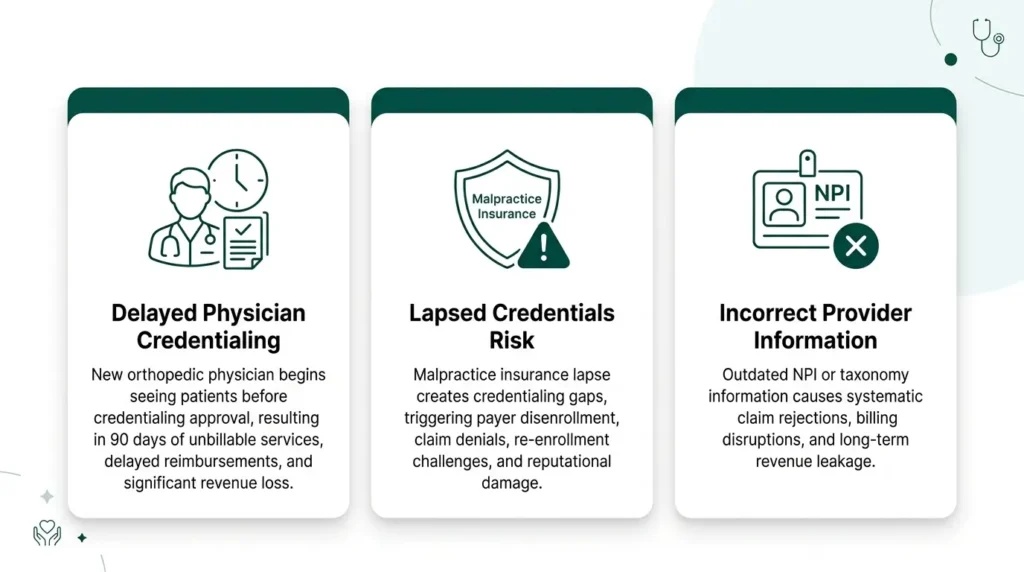
These scenarios illustrate why outsourcing credentialing to a dedicated medical billing service with credentialing expertise is a wise investment.
Benefits of Outsourcing Medical Credentialing Services
More healthcare organizations are turning to professional credentialing partners rather than managing the process in-house. Here is why:
Specialized Expertise Credentialing specialists are trained professionals who understand payer requirements, CAQH ProView management, hospital privileging processes, and regulatory standards. Their expertise translates directly into faster approvals and fewer errors.
Time and Resource Savings Credentialing is a labor-intensive process. Managing it internally requires dedicated staff, ongoing training, and significant administrative overhead. Outsourcing frees up your team to focus on clinical operations.
Reduced Errors and Denials Professional credentialing services use standardized processes and quality checks that significantly reduce the likelihood of application errors — the leading cause of credentialing delays.
Scalability Whether you are onboarding one new provider or expanding a multi-site practice with dozens of physicians, a credentialing service can scale to meet your needs without disruption.
Proactive License and Certification Monitoring Expiration tracking is often overlooked in-house until it is too late. A credentialing partner maintains a calendar of all key dates and initiates renewals well in advance, protecting your billing continuity.
Confidentiality and Data Security Credentialing involves sensitive provider information. Reputable credentialing services maintain strict data security protocols, HIPAA-compliant systems, and confidentiality standards that safeguard provider privacy at every stage.
Credentialing vs. Privileging: Understanding the Difference
These two terms are often confused but serve distinct purposes:
| Aspect | Credentialing | Privileging |
|---|---|---|
| Purpose | Verifies qualifications for payer enrollment | Authorizes specific clinical activities |
| Who Does It | Insurance payers and credentialing bodies | Hospitals and healthcare facilities |
| Scope | Billing and insurance participation | Clinical scope of practice |
| Timeline | 60 to 180 days typically | Varies by institution |
Both processes are necessary for providers working in hospital settings, and many professional credentialing services manage both simultaneously to streamline the onboarding experience.
CAQH ProView and Its Role in Credentialing
The Council for Affordable Quality Healthcare (CAQH) ProView is a centralized provider data repository used by most major insurance companies in the United States. Providers submit their credentialing information once to CAQH, and participating payers can access and verify it directly — reducing duplicated paperwork and speeding up enrollment.
Key benefits of CAQH ProView include:
- One application, accessible by hundreds of payers
- Self-attestation every 120 days to keep data current
- Secure, standardized data sharing
- Integration with hospital credentialing systems
A professional medical credentialing service will manage your CAQH profile on your behalf — ensuring data is accurate, complete, and up to date at all times.
How to Choose the Right Medical Credentialing Service
Selecting a credentialing partner is an important decision. Here are the key factors to evaluate:
Experience and Track Record Look for a company with a proven history of successful enrollments across multiple payer types, including Medicare, Medicaid, and major commercial insurers.
Transparency and Communication You should always know the status of your applications. Choose a service that provides regular updates and a dedicated point of contact.
Technology and Systems Modern credentialing services use software platforms to track applications, store documents securely, and automate renewal reminders. Ask about the tools they use.
Compliance Standards Ensure the service follows HIPAA guidelines and maintains rigorous data privacy practices. Provider data is highly sensitive and must be protected.
Integration with Medical Billing The best outcomes come when credentialing and billing work together seamlessly. Many full-service medical billing companies offer credentialing as part of an integrated revenue cycle management solution.
Conclusion: Credentialing Is the Foundation of Successful Medical Billing
Medical credentialing services are not just a regulatory formality — they are the backbone of a healthy revenue cycle. Without proper credentialing, no amount of coding accuracy or billing expertise can recover the revenue your practice deserves.
When credentialing is managed proactively and professionally, it ensures that every provider in your organization can bill from day one, remain continuously enrolled with all relevant payers, and avoid the costly disruptions that come from credential lapses or application errors.
Whether you are launching a new practice, hiring additional providers, or simply looking to optimize your existing medical billing service, investing in expert credentialing support is one of the highest-return decisions you can make for your organization’s financial health.