

Medical credentialing is the backbone of patient safety and healthcare quality assurance. Yet for many healthcare organizations, it remains one of the most underestimated — and misunderstood — administrative processes in the industry. Whether you are a hospital administrator, a private practice owner, or a healthcare executive, understanding what medical credentialing is and why it matters is not optional. It is essential.
This article breaks down the entire concept of medical credentialing — from its definition and key steps to the critical role of professional medical credentialing services — and explains why getting it right can make or break your organization’s reputation, compliance standing, and revenue cycle.
What Is Medical Credentialing?
Medical credentialing is the formal process of verifying that a healthcare provider — whether a physician, nurse practitioner, dentist, or allied health professional — has the qualifications, training, licensure, and clinical competency required to deliver safe and effective patient care.
The credentialing process typically involves verification of:
- Medical education and training (degrees, internships, residencies, fellowships)
- Board certifications and specialty qualifications
- State licensure and any disciplinary history
- Malpractice history and insurance coverage
- Hospital privileges at affiliated institutions
- Work history and professional references
- DEA registration (for providers with prescribing authority)
- National Practitioner Data Bank (NPDB) queries
This isn’t a one-time exercise. Credentialing is a continuous, cyclical process — most organizations require re-credentialing every two to three years to ensure ongoing compliance and competency.
Medical Credentialing vs. Medical Privileging: What’s the Difference?
These two terms are often used interchangeably, but they are distinct concepts.
| Aspect | Medical Credentialing | Medical Privileging |
|---|---|---|
| Definition | Verifying a provider’s qualifications and background | Authorizing a provider to perform specific clinical procedures |
| Focus | Who the provider is | What the provider is allowed to do |
| Scope | Organization-wide | Facility-specific |
| Example | Verifying a surgeon’s board certification | Approving that surgeon to perform laparoscopic procedures |
Credentialing comes first — privileging is built upon it. Without verified credentials, no clinical privileges can be granted.
Why Does Medical Credentialing Matter?
Medical credentialing is not just bureaucratic paperwork. It serves several mission-critical functions for healthcare organizations and patients alike.
1. Patient Safety Is Non-Negotiable
At its core, credentialing exists to protect patients. When a provider’s qualifications are thoroughly verified, the risk of incompetent or fraudulent practitioners reaching patients is dramatically reduced. Consider this: unverified or improperly credentialed providers have been linked to preventable medical errors, malpractice claims, and in some cases, criminal prosecution.
2. Legal and Regulatory Compliance
Healthcare organizations are legally obligated to credential their providers. Regulatory bodies such as The Joint Commission (TJC), the Centers for Medicare & Medicaid Services (CMS), and state health departments all mandate credentialing as a condition of accreditation and participation in federal reimbursement programs.
Failure to comply can result in:
- Loss of accreditation
- Exclusion from Medicare and Medicaid programs
- Civil liability and lawsuits
- Significant financial penalties
3. Insurance Reimbursement Depends on It
Many healthcare providers and practice administrators don’t realize that insurance credentialing — the process of enrolling a provider with insurance payers — is a direct extension of medical credentialing. If a provider is not properly credentialed with insurers like Aetna, UnitedHealthcare, or Blue Cross Blue Shield, the practice cannot bill for services rendered.
4. Organizational Reputation and Trustworthiness
Healthcare is a trust-based industry. Patients choose providers and facilities based on perceived competence and safety. A credentialing failure that reaches the public — through a media report, lawsuit, or regulatory action — can permanently damage an organization’s reputation.
Conversely, a well-maintained credentialing program signals to patients, partners, and payers that your organization holds itself to the highest professional standards.
5. Risk Management and Liability Reduction
From a risk management perspective, credentialing is one of the most powerful tools a healthcare organization has. Hospitals and health systems that maintain rigorous credentialing programs are better positioned to:
- Defend against negligent credentialing lawsuits
- Demonstrate due diligence in provider vetting
- Reduce the likelihood of adverse clinical events
- Maintain favorable malpractice insurance terms
The Medical Credentialing Process: Step by Step
Understanding the mechanics of medical credentialing helps organizations allocate resources appropriately and avoid costly delays.
Step 1: Application and Documentation Collection
The provider submits a comprehensive application including educational records, training certificates, license numbers, malpractice history, and professional references. This stage is often the most time-consuming due to incomplete submissions.
Step 2: Primary Source Verification (PSV)
This is the heart of the credentialing process. Every credential is verified directly with the original issuing source — the medical school, licensing board, certification body, and so on. No third-party summaries are accepted. PSV is mandated by The Joint Commission and NCQA.
Step 3: Background Checks and NPDB Query
A query to the National Practitioner Data Bank reveals any malpractice settlements, licensure actions, or clinical privilege restrictions the provider may have faced. This is a federally mandated step for hospitals and a best practice for all healthcare entities.
Step 4: Committee Review
A credentialing committee — typically composed of senior physicians and administrators — reviews the completed file and makes recommendations regarding the provider’s credentials and any proposed privileges.
Step 5: Governing Board Approval
The final credentialing decision rests with the organization’s governing board. Upon approval, the provider is officially credentialed and may be granted clinical privileges.
Step 6: Re-Credentialing
Every two to three years, the cycle begins again. Ongoing monitoring between cycles — for license expirations, new malpractice claims, or sanctions — is a best practice increasingly adopted by leading organizations.
Common Challenges in the Credentialing Process
Even experienced healthcare organizations struggle with credentialing. Here are the most frequently cited pain points:
- Incomplete or inaccurate applications from providers
- Slow turnaround from primary sources (medical schools, licensing boards)
- Managing multiple payer credentialing timelines simultaneously
- Keeping pace with re-credentialing deadlines across a large provider panel
- Tracking expiring licenses, DEA registrations, and certifications
- Staff turnover in credentialing departments disrupting institutional knowledge
These challenges are precisely why many organizations are turning to professional medical credentialing services for support.
The Role of Professional Medical Credentialing Services
Outsourcing to a professional medical credentialing services provider has become a strategic decision for healthcare organizations of all sizes — from solo practices to large integrated health systems.
What Do Medical Credentialing Services Offer?
Top-tier credentialing service providers typically deliver:
- End-to-end credentialing management — from application through approval
- Primary source verification on behalf of the organization
- Payer enrollment services to accelerate insurance credentialing
- CAQH (Council for Affordable Quality Healthcare) profile management
- Automated expiration tracking for licenses and certifications
- Re-credentialing cycle management
- Compliance reporting and audit support
- Credentialing software platforms with real-time dashboards
Who Benefits Most from Outsourced Credentialing Services?
| Organization Type | Key Benefit |
|---|---|
| Multi-specialty practices | Centralized management across all provider types |
| Telehealth companies | Multi-state licensing and payer enrollment at scale |
| Hospitals and health systems | Reduced administrative burden on internal staff |
| Staffing agencies | Rapid credentialing of new placements |
| Behavioral health organizations | Managing high provider turnover efficiently |
The Business Case for Outsourcing
A credentialing delay of even 30 to 60 days can cost a practice tens of thousands of dollars in lost reimbursements. Professional medical credentialing services reduce time-to-revenue, minimize compliance risk, and free internal staff to focus on clinical and patient-facing priorities.
Organizations that partner with credentialing specialists often report:
- Faster provider onboarding (typically 30–50% reduction in time-to-practice)
- Fewer compliance deficiencies during accreditation surveys
- Improved payer relationship management
- Greater visibility into provider credential status at any given time
NCQA and Joint Commission: Setting the Standard
Two organizations have done more than any others to define credentialing standards in the United States:
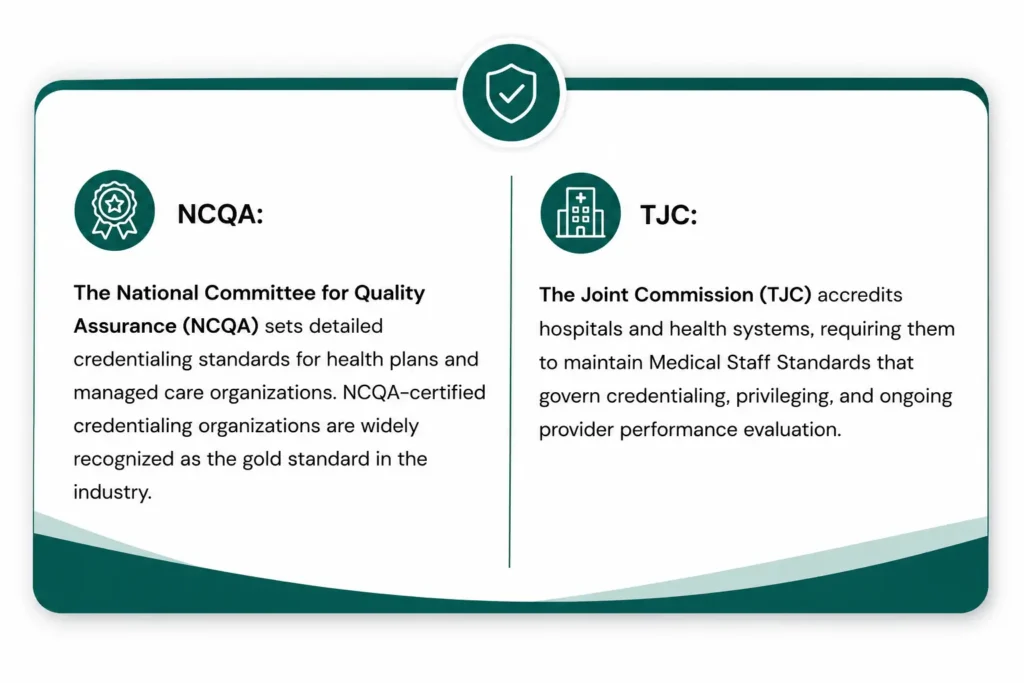
Alignment with these standards is not just about compliance — it is a signal to the market that your organization takes provider quality seriously.
Technology and the Future of Medical Credentialing
The credentialing landscape is evolving rapidly. Several technological trends are reshaping how organizations approach provider verification:
- Blockchain-based credentialing: creating immutable, instantly verifiable provider credential records
- AI-powered document processing: automating the extraction and verification of credential documents
- Centralized credentialing databases: reducing the duplication of effort across multiple organizations, credentialing the same provider
- Real-time license monitoring tools: alerting organizations immediately when a provider’s license or certification status changes
These innovations are making credentialing faster, more accurate, and less dependent on manual administrative work.
Key Takeaways: Why Medical Credentialing Cannot Be Ignored
To summarize what every healthcare leader should know:
- Medical credentialing is a mandatory process that verifies provider qualifications before they are authorized to deliver patient care.
- It is required for regulatory compliance, accreditation, and insurance reimbursement.
- Failure to credential properly exposes organizations to significant legal, financial, and reputational risk.
- The process involves multiple steps — from primary source verification to governing board approval — and repeats every two to three years.
- Professional medical credentialing services offer healthcare organizations a reliable, efficient path to compliance without overburdening internal teams.
- Technology is transforming credentialing — organizations that adopt modern credentialing solutions gain a measurable competitive and operational advantage.
Conclusion
Medical credentialing is far more than an administrative formality. It is a fundamental pillar of healthcare quality, patient safety, and organizational integrity. In an industry where the margin for error is measured in human lives and institutional trust, no healthcare organization can afford to treat credentialing as an afterthought.
Whether you manage credentialing in-house or leverage the expertise of dedicated medical credentialing services, the commitment to rigorous, timely, and accurate provider verification is what separates high-performing healthcare organizations from those that face avoidable risk.
Investing in credentialing is, ultimately, an investment in the safety of every patient who walks through your doors.