

Every patient’s journey begins long before they see a doctor. It begins the moment they call to book an appointment, walk through the front door, or receive their first billing statement. That first touchpoint is the front desk, and how well it is managed can make or break the entire patient experience.
Front desk management in healthcare refers to the coordinated handling of all administrative and operational functions at the point of patient entry. This includes scheduling, patient check-in, insurance verification, co-pay collection, and the critical handoff between the front office and clinical teams. When done right, it creates a seamless experience. When done poorly, it creates delays, errors, and financial losses that ripple through the entire practice.
Understanding Front Office Management in a Medical Setting
Front office management goes far beyond answering phones and greeting patients. It is the administrative backbone of any healthcare facility, whether a private clinic, specialty practice, or large hospital network.
A well-run front office is responsible for:
- Appointment scheduling and calendar management
- Patient registration and demographic data collection
- Insurance eligibility verification and pre-authorization
- Collecting co-pays, deductibles, and outstanding balances
- Coordinating referrals and follow-up visits
- Maintaining HIPAA-compliant patient records
- Supporting accurate medical billing workflows
The front desk team sits at the intersection of patient care and financial operations. Their accuracy directly impacts claim submission, reimbursement timelines, and patient satisfaction scores.
Why Front Desk Management Directly Impacts Medical Billing
One of the most underappreciated truths in healthcare administration is this: most medical billing errors begin at the front desk, not in the billing department.
When a front desk staff member collects inaccurate insurance information, misspells a patient name, or fails to obtain the correct referral authorization, that error travels downstream into the billing cycle. The result is denied claims, delayed payments, and costly rework.
Common Front Desk Errors That Affect Medical Billing
| Front Desk Error | Billing Impact |
|---|---|
| Incorrect insurance ID collected | Claim denial, resubmission delay |
| Eligibility was not verified before the visit | Patient liability surprise, unpaid claim |
| Missing referral or prior auth | Payer rejects claim entirely |
| Wrong date of birth or patient name | Claim mismatch, returned as unprocessable |
| Co-pay not collected at time of service | Revenue leakage, costly follow-up billing |
According to the American Medical Association, claim denial rates in the U.S. average between 5% and 10%, with a significant portion attributable to front-end administrative errors. Practices that invest in strong front office management protocols consistently see lower denial rates and faster reimbursement cycles.
The Role of a Medical Billing Service in Supporting Front Desk Operations
Many practices today partner with a professional medical billing service to bridge the gap between front desk administration and revenue cycle management. This partnership works best when there is a clear, structured communication flow between the front office team and the billing team.
A reputable medical billing service will typically:
- Conduct real-time eligibility checks tied to the scheduling workflow
- Flag missing authorizations before the patient arrives
- Provide denial trend reports so front desk managers can identify recurring data errors
- Train front office staff on payer-specific requirements
- Offer clean claim rates of 95% or higher through front-end quality controls
The relationship between front desk operations and a medical billing service is not transactional. It is collaborative. When both sides share data and accountability, practices see measurable improvements in revenue, compliance, and patient trust.
Key Responsibilities of an Effective Front Desk Manager
The front desk manager is not just an office coordinator. In a healthcare setting, this person carries both operational and compliance responsibilities that require a nuanced skill set.
Patient Experience and Communication
The first impression a patient forms of your practice happens at the front desk. A skilled manager ensures that every patient interaction, whether in person or over the phone, reflects the values of the organization. This includes clear communication about financial responsibilities, wait times, and care coordination.
Scheduling and Capacity Management
Effective scheduling is both a science and an art. Front desk management involves balancing provider availability, patient demand, appointment type lengths, and no-show patterns. Advanced practices use predictive scheduling software to minimize idle time and reduce patient wait times.
Insurance Verification and Pre-Authorization
One of the highest-impact tasks at the front office level is verifying insurance coverage before each appointment. This step alone can reduce claim denials by 30% to 40% when done consistently and accurately. Pre-authorization for procedures, imaging, or specialist visits must be documented and attached to the patient file before the visit occurs.
Financial Counseling and Point-of-Service Collections
Collecting balances at the time of service is significantly more cost-effective than billing patients after the fact. Studies show that the likelihood of collecting a patient balance drops from 90% at time of service to less than 50% once the patient leaves the office. Front desk staff need to be comfortable having financial conversations in a compassionate, professional manner.
HIPAA Compliance and Patient Privacy at the Front Desk
Healthcare front desks handle some of the most sensitive personal information in existence. From Social Security numbers to diagnosis codes, the data flowing through a medical front office must be protected under the Health Insurance Portability and Accountability Act (HIPAA).
Effective front office management includes:
- Training all staff on HIPAA Privacy and Security Rules annually
- Using secure, encrypted systems for patient data entry
- Limiting physical access to patient records and screens
- Ensuring conversations about patient information occur in private settings
- Implementing role-based access controls in practice management software
A single HIPAA violation can result in fines ranging from $100 to $50,000 per violation. More importantly, breaches erode patient trust in ways that are difficult to recover from. Privacy is not just a legal requirement. It is a cornerstone of quality care.
Technology in Modern Front Desk Management
The modern healthcare front office looks nothing like it did a decade ago. Technology has transformed nearly every aspect of front desk operations, from how patients schedule appointments to how staff verify insurance in real time.
Key Technologies Transforming Front Office Operations
Electronic Health Records (EHR) Integration The front desk and the clinical team must work from the same system. When EHR platforms are properly integrated with scheduling, billing, and communication tools, data flows seamlessly and human error is minimized.
Online Patient Portals Allowing patients to self-schedule, complete intake forms, and view statements online reduces front desk call volume and improves data accuracy. Patients who complete their own forms are less likely to have typos or errors than information collected verbally over the phone.
Automated Eligibility Verification Real-time insurance eligibility verification tools connect directly to payer databases. When integrated into the scheduling workflow, these tools can flag coverage issues days before the appointment, giving the front office time to resolve them proactively.
AI-Powered Scheduling Tools Some practices now use artificial intelligence to optimize appointment slots, predict no-shows, and send automated reminders via text or email. These tools reduce gaps in the schedule and improve patient follow-through.
Building a High-Performance Front Desk Team
Technology alone does not create an excellent front office. People do. The best systems in the world are ineffective without well-trained, motivated staff who understand their role in the larger revenue and care cycle.
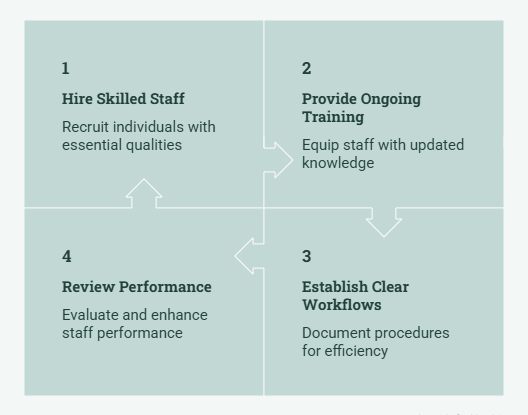
Hiring for the Right Skills
Front desk staff in healthcare need a unique combination of qualities. They must be organized, detail-oriented, empathetic, and comfortable navigating complex insurance conversations. When hiring, look for candidates with experience in customer service, healthcare administration, or medical coding.
Ongoing Training and Development
The healthcare landscape changes constantly. Insurance requirements shift, billing codes are updated, and patient expectations evolve. High-performing practices invest in ongoing training for their front office teams through workshops, webinars, and regular performance reviews.
Clear Workflows and Standard Operating Procedures
Every function at the front desk should have a documented standard operating procedure. From how to handle a new patient registration to how to respond to an irate caller, clear protocols reduce variability and protect the practice from compliance risk.
The Financial Case for Investing in Front Office Management
For practice administrators and healthcare executives evaluating where to invest operational resources, the return on investment for front desk infrastructure is compelling.
Consider this: a mid-sized primary care practice seeing 150 patients per day with an average billing value of $150 per encounter generates approximately $22,500 in daily revenue. If poor front-end processes result in a 7% denial rate, that practice loses over $1,500 per day in initially uncollected revenue, much of which is never fully recovered even after appeals.
By contrast, practices that partner with a qualified medical billing service and implement robust front office management protocols for effective medical billing and front office management in healthcare typically achieve:
- Denial rates below 3%
- First-pass claim acceptance rates above 95%
- Faster average days in accounts receivable (A/R)
- Higher patient satisfaction scores
- Reduced staff burnout through clear, efficient workflows
The math makes a strong argument. Strong front office management is not an administrative expense. It is a revenue strategy.
Front Desk Management Best Practices: A Quick Reference
| Best Practice | Why It Matters |
|---|---|
| Verify insurance at least 48 hours before the appointment | Allows time to resolve issues before the visit |
| Collect co-pays and balances at check-in | Maximizes point-of-service collection rates |
| Confirm referrals and authorizations in advance | Prevents claim denials at the payer level |
| Train staff on HIPAA quarterly | Reduces compliance risk and patient data breaches |
| Audit front desk data accuracy monthly | Identifies patterns that impact medical billing |
| Use EHR-integrated scheduling tools | Reduces double entry and human error |
| Offer online patient intake forms | Improves data accuracy and reduces phone volume |
Conclusion: Front Desk Management Is the Foundation of a Healthy Practice
In healthcare, the clinical side of patient care naturally receives the most attention. But behind every successful physician practice is a well-oiled administrative engine, and the front desk is at its heart.
Effective front desk management directly supports accurate medical billing, reduces claim denials, protects patient privacy, and shapes the experience patients have at every visit. When front office management operates at a high level, the entire organization benefits — providers can focus on care, billing teams receive clean data, and patients feel confident in the practice they have chosen.
Whether your organization manages billing internally or partners with a professional medical billing service, the quality of your front office operations will determine how efficiently revenue flows and how well patients are served. Investment in your front desk is, quite simply, investment in the health of your practice.