

Introduction: The Backbone of a High-Performing Medical Practice
In today’s complex healthcare landscape, the financial health of a medical practice depends on far more than clinical excellence. Behind every successful physician’s office, hospital outpatient department, or specialty clinic is a well-organized system of front office management — the first point of contact for patients and the critical gateway to accurate, timely medical billing.
Front office management in medical billing refers to the administrative and operational processes handled at the front desk that directly influence revenue cycle performance. From patient registration and insurance verification to appointment scheduling and co-pay collection, every front-desk interaction sets the stage for downstream billing accuracy and cash flow.
When front desk management operates efficiently, claim denials decrease, reimbursements accelerate, and patient satisfaction improves. When it breaks down, even the best clinical documentation cannot prevent financial loss.
This comprehensive guide explores what front office management truly means in the context of medical billing, why it matters, and how healthcare organizations can build a front desk operation that drives sustainable revenue cycle success.
What Is Front Office Management in Medical Billing?
Front office management in a healthcare setting encompasses all patient-facing and administrative functions performed before and during a clinical encounter. In the context of medical billing, it specifically refers to the processes that collect, verify, and organize the data required to submit accurate insurance claims and collect patient payments.
The front office acts as a bridge between the patient, the clinical team, and the billing department. Poor data collected at the front desk — a misspelled name, a wrong insurance ID, a missing referral authorization — can trigger a cascade of downstream billing errors that cost practices thousands of dollars in denied claims and administrative rework.
Core Functions of Front Office Management
Effective front desk management in medical billing includes:
- Patient Registration & Demographics Collection: Accurately capturing patient name, date of birth, address, contact information, and Social Security Number (where applicable).
- Insurance Eligibility Verification: Confirming active coverage, co-pay amounts, deductibles, and out-of-pocket maximums before the visit.
- Pre-Authorization & Referral Management: Obtaining required prior authorizations from payers for procedures, diagnostics, or specialist referrals.
- Appointment Scheduling: Aligning scheduling with provider templates and payer requirements to reduce no-shows and optimize revenue per hour.
- Co-pay and Patient Balance Collection: Collecting patient financial responsibility at the point of service to reduce post-visit accounts receivable.
- Medical Records & Documentation Intake: Ensuring all necessary records, consent forms, and HIPAA disclosures are completed before the encounter.
- Charge Capture Initiation: Flagging encounter types and service codes at the point of scheduling to support accurate coding downstream.
Why Front Office Management Is Critical to Medical Billing Success
According to industry research, approximately 50–65% of claim denials are caused by front-end errors — data problems originating at the point of patient access, long before a claim ever reaches a payer. These include:
- Incorrect patient demographics
- Invalid or inactive insurance information
- Missing prior authorizations
- Duplicate patient records
- Eligibility not verified
This means that investing in strong front office management is one of the highest-return activities a healthcare organization can pursue. A well-trained front desk team, supported by the right technology and workflows, can significantly reduce denial rates and accelerate collections.
The Financial Impact of Front Desk Errors
Consider a mid-sized primary care practice processing 400 claims per month:
| Issue | Claims Affected | Average Denial Cost | Monthly Loss |
|---|---|---|---|
| Wrong insurance information | 8% (32 claims) | $120 each | $3,840 |
| Missing prior authorization | 5% (20 claims) | $200 each | $4,000 |
| Incorrect patient demographics | 4% (16 claims) | $95 each | $1,520 |
| Total Avoidable Monthly Loss | $9,360 |
Over a year, that’s nearly $112,000 in preventable revenue leakage — all traceable back to front desk management gaps.
Key Components of an Effective Front Office Management System
1. Patient Registration: The Foundation of Clean Claims
Accurate patient registration is the single most important function in front office management. Every subsequent step in the medical billing process depends on the quality of data captured at registration.
Best practices include:
- Scanning government-issued ID and insurance cards at every visit
- Using real-time eligibility verification tools integrated with your practice management system
- Updating demographic information at every encounter, not just at initial registration
- Standardizing data entry protocols to reduce human error
Pro Tip: Practices that implement a “registration audit” process — reviewing a random sample of registrations weekly — typically see a 20–30% reduction in demographic-related denials within 90 days.
2. Insurance Eligibility and Benefits Verification
One of the most impactful responsibilities of front desk management is verifying patient insurance eligibility before every appointment. Eligibility verification answers critical questions:
- Is the patient’s policy currently active?
- What is the patient’s deductible, and how much has been met?
- What is the co-pay for this type of visit?
- Does the service require a referral or pre-authorization?
- Is the rendering provider in-network with this plan?
Many medical billing service providers emphasize that eligibility verification should ideally be completed 48–72 hours before the scheduled appointment, giving sufficient time to resolve issues before the patient arrives.
3. Prior Authorization Management
Prior authorization — also called pre-authorization or pre-cert — is the process of obtaining payer approval before delivering certain healthcare services. It is one of the most time-consuming aspects of front office management and one of the most consequential for medical billing outcomes.
Services commonly requiring prior authorization include:
- Specialist referrals (especially with HMO plans)
- Advanced imaging (MRI, CT scans, PET scans)
- Elective surgical procedures
- Certain high-cost medications
- Durable medical equipment (DME)
- Mental health and substance abuse services
Failure to obtain prior authorization is one of the top reasons for claim denials. Effective front desk teams maintain an authorization tracking log, document approval numbers, and flag upcoming expirations to prevent lapses.
4. Appointment Scheduling Optimization
Appointment scheduling may seem like a simple administrative task, but in the context of medical billing, it directly affects revenue. Inefficient scheduling leads to:
- Unfilled appointment slots and lost revenue
- Double-bookings that compromise care quality and documentation
- Mismatched appointment types that require manual billing corrections
Smart scheduling practices include aligning appointment types with CPT code families, building in buffer time for complex patients, and using recall systems to reduce no-shows — all of which support cleaner billing downstream.
5. Point-of-Service Collections
Collecting patient financial responsibility at the time of service is a cornerstone of effective front office management. Industry data consistently shows that the probability of collecting a patient balance drops dramatically after the patient leaves the office:
- At time of service: ~95% collection rate
- Post-visit statement (30 days): ~70% collection rate
- Second statement (60 days): ~50% collection rate
- Collections agency: ~20% collection rate
Front desk staff should be trained to comfortably discuss financial responsibility with patients, present payment plans when appropriate, and use digital payment tools that make it easy for patients to pay before they leave.
6. HIPAA Compliance and Patient Privacy at the Front Desk
Front desk management carries significant HIPAA compliance responsibilities. Patient information is exchanged verbally, digitally, and in print at the front office — making privacy and security non-negotiable.
Key compliance responsibilities at the front desk:
- Obtaining signed HIPAA Privacy Notice acknowledgments at registration
- Using privacy screens and secure check-in kiosks
- Verifying patient identity before discussing account or clinical information
- Ensuring fax machines and printers with patient data are in restricted areas
- Training staff on minimum-necessary information standards
Healthcare organizations that partner with a professional medical billing service should ensure their vendor also maintains rigorous HIPAA compliance practices, as breaches occurring through third-party billing partners can carry significant liability.
Front Office Management and the Revenue Cycle: A Seamless Connection
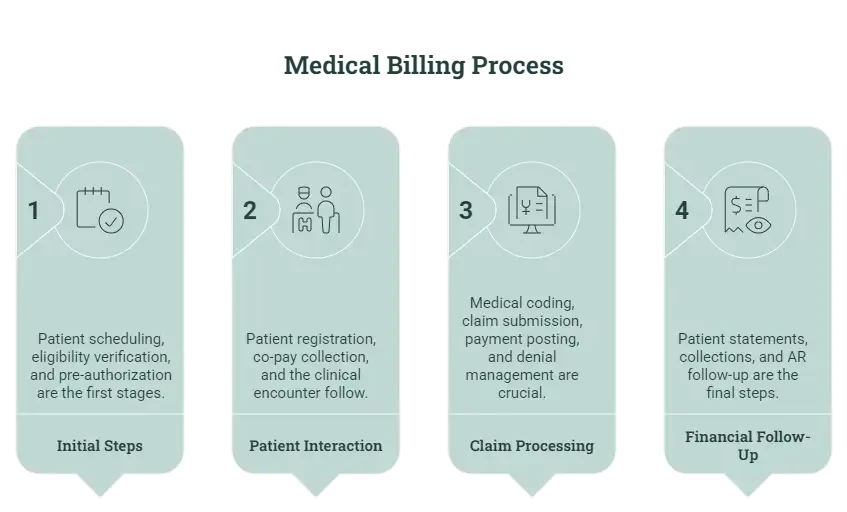
Medical billing doesn’t begin when a claim is submitted — it begins the moment a patient calls to schedule an appointment. The revenue cycle is a continuous loop, and front office management represents the upstream portion that sets the quality of everything downstream.
How a Professional Medical Billing Service Strengthens Front Office Operations
Many healthcare practices, particularly small and mid-sized groups, find it challenging to maintain the technology, training, and staffing levels required for high-performing front office management. This is where partnering with a dedicated medical billing service delivers measurable value.
A full-service medical billing service typically provides:
- Real-time eligibility verification tools integrated with your EHR/practice management system
- Authorization management workflows with tracking and escalation protocols
- Front desk training programs covering billing compliance, patient communication, and data entry accuracy
- Denial prevention dashboards that identify front-end error patterns before they become systemic problems
- HIPAA-compliant document management for patient records and authorizations
- Key performance indicator (KPI) reporting on registration accuracy, co-pay collection rates, and authorization turnaround
When evaluating a medical billing service partner, look for demonstrated expertise in front-end revenue cycle operations, not just claim submission and coding.
Key Performance Indicators for Front Office Management
High-performing healthcare organizations monitor specific KPIs to measure the effectiveness of front desk management. These metrics provide actionable insight into where process improvements are needed.
Essential Front Office KPIs
| KPI | Industry Benchmark | Description |
|---|---|---|
| Insurance Verification Rate | > 95% of scheduled visits | Percentage of appointments with eligibility verified in advance |
| Point-of-Service Collection Rate | > 90% | Co-pays collected at time of service |
| Prior Authorization Denial Rate | < 5% | Claims denied for missing or invalid auth |
| Registration Error Rate | < 2% | Demographic or insurance data errors per claim |
| No-Show Rate | < 8% | Appointments missed without cancellation |
| Front-End Denial Rate | < 5% | Total denials attributable to front-desk errors |
Tracking these metrics monthly allows practice managers to identify trends, benchmark against industry standards, and target specific training interventions.
Common Challenges in Front Office Management — and How to Overcome Them
Challenge 1: High Staff Turnover
The front desk is often one of the highest-turnover positions in a medical practice. Constant retraining leads to inconsistent data quality and billing errors.
Solution: Invest in standardized onboarding protocols, checklists, and electronic workflows that make it easy for new staff to perform correctly from day one.
Challenge 2: Outdated Technology
Manual eligibility checks, paper-based registration forms, and disconnected systems slow down front desk workflows and increase error rates.
Solution: Implement a modern practice management system with real-time eligibility verification, electronic intake forms, and automated appointment reminders.
Challenge 3: Patient Reluctance to Discuss Finances
Many patients are uncomfortable discussing co-pays, deductibles, or outstanding balances — and many front desk staff are equally uncomfortable raising the subject.
Solution: Train staff in empathetic financial conversations, provide clear signage about payment policies, and use digital tools that allow patients to review balances privately before their appointment.
Challenge 4: Complex Payer Requirements
Each insurance payer has different authorization requirements, referral rules, and eligibility nuances — and these change frequently.
Solution: Maintain an up-to-date payer-specific reference guide and consider a medical billing service partner who stays current on payer policy changes across all major commercial and government plans.
Best Practices for Optimizing Front Office Management in Medical Billing
To summarize the key strategies for building a best-in-class front office management operation:
- Verify eligibility for 100% of scheduled appointments — no exceptions.
- Collect co-pays and known patient balances at every visit using a scripted, empathetic approach.
- Implement a prior authorization tracker with owner accountability and escalation protocols.
- Audit registration data quality monthly and provide targeted feedback to staff.
- Use technology to automate repetitive tasks — eligibility checks, appointment reminders, digital intake forms.
- Train staff regularly on payer changes, HIPAA updates, and patient communication skills.
- Partner with a reputable medical billing service that offers integrated front-end revenue cycle support.
- Track and report on front office KPIs in monthly practice management meetings.
Conclusion: Front Office Management Is Where Medical Billing Excellence Begins
The connection between front office management and medical billing outcomes is undeniable. Practices that invest in rigorous front desk management — accurate registration, proactive eligibility verification, disciplined authorization tracking, and confident point-of-service collections — consistently outperform their peers in clean claim rates, denial rates, and days in accounts receivable.
Whether you manage an independent physician practice, a multi-specialty group, or a hospital outpatient department, the principles are the same: clean data in, clean claims out. The front desk is not just a greeting station — it is the revenue engine of your practice.
For organizations seeking to elevate their front desk management practices without stretching internal resources, partnering with an experienced medical billing service can provide the technology, expertise, and processes needed to transform front office performance and drive sustainable financial results.
Frequently Asked Questions (FAQs)
What is the difference between front office management and medical billing?
Front office management refers to patient-facing administrative functions (registration, scheduling, eligibility verification) that occur before and during the clinical encounter. Medical billing encompasses the broader process of submitting claims, following up on payments, and managing the revenue cycle — but it depends heavily on the quality of data produced by front office operations.
How does front desk management affect claim denial rates?
Industry data shows that 50–65% of claim denials originate from front-end errors — incorrect demographics, invalid insurance, or missing authorizations. Strong front desk management directly reduces these denial rates.
What should I look for in a medical billing service for front office support?
Look for a medical billing service that offers real-time eligibility verification, authorization management tools, front desk training programs, and front-end denial analytics — not just coding and claim submission services.
How often should insurance eligibility be verified?
Best practice is to verify insurance eligibility 48–72 hours before every scheduled appointment, as well as on the day of service for walk-ins or same-day appointments.