

The rapid growth of virtual healthcare has fundamentally changed the way medical practices operate — and at the center of this transformation is telemedicine billing. As more patients receive care through video calls, phone consultations, and digital platforms, healthcare providers must understand how to accurately document, code, and submit claims for these services. Without a reliable telemedicine billing service in place, even the most efficiently run virtual practice can face delayed reimbursements, denied claims, and compliance risks.
This guide breaks down everything you need to know about telemedicine billing, how it works, and why partnering with an experienced medical billing service can make all the difference.
What Is Telemedicine Billing?
Telemedicine billing refers to the process of coding and submitting insurance claims for healthcare services delivered remotely through digital communication technologies. Just like in-person visits, virtual appointments must be documented, assigned the correct procedure codes, and submitted to payers — whether private insurers or government programs like Medicare and Medicaid.
What makes telemedicine billing unique is that it requires a thorough understanding of telehealth-specific regulations, place-of-service (POS) codes, and modifier requirements that do not apply to traditional face-to-face visits. Errors in any of these areas can result in denied claims or significant revenue loss for your practice.
How Does Telemedicine Billing Work?
At its core, telemedicine billing follows the same general workflow as standard medical billing — but with additional layers of compliance and code specificity. Here is a step-by-step breakdown of how the process works:
Step 1: Patient Registration and Eligibility Verification
Before any virtual visit occurs, the billing team verifies the patient’s insurance coverage and confirms that the payer covers telehealth services. Not all insurance plans reimburse telemedicine at the same rate, and some may require prior authorization.
Step 2: Documentation of the Telehealth Visit
The provider documents the encounter in the patient’s medical record, noting the mode of delivery (video, audio-only, or asynchronous messaging), the duration of the visit, and the clinical details that justify the services rendered.
Step 3: Assigning the Correct CPT Codes
Proper coding is the cornerstone of accurate telemedicine billing. Providers must select the appropriate Current Procedural Terminology (CPT) codes that reflect both the type of service and the telehealth delivery method. Commonly used codes include:
| CPT Code | Description |
|---|---|
| 99202–99215 | Office or outpatient evaluation and management (E/M) visits |
| 99421–99423 | Online digital E/M services (patient-initiated) |
| G0071 | Communication technology-based services for Medicare patients |
| 98970–98972 | Qualified non-physician health care professional online assessments |
Step 4: Applying the Correct Place of Service and Modifiers
One of the most common billing errors in telehealth involves incorrect Place of Service (POS) codes and modifiers. The most widely used include:
- POS 02 — Telehealth services provided from a distant site
- POS 10 — Telehealth services provided in a patient’s home (introduced post-COVID)
- Modifier 95 — Synchronous telemedicine service rendered via real-time interactive audio and video
- Modifier GT — Via interactive audio and video telecommunication systems (primarily for Medicare)
Getting these details right is essential. A single incorrect modifier can cause a claim to be rejected or flagged for audit.
Step 5: Claims Submission and Follow-Up
Once the claim is coded correctly, it is submitted electronically to the payer. The medical billing service then monitors the claim status, follows up on any rejections or requests for additional information, and ensures timely payment posting to the provider’s account.
Why Telemedicine Billing Is More Complex Than Traditional Medical Billing
Many healthcare providers underestimate the complexity of telehealth reimbursement. Unlike standard in-person visits, telemedicine billing is governed by a constantly evolving patchwork of federal, state, and payer-specific rules. Here is what makes it particularly challenging:
Payer Variability: Medicare, Medicaid, and commercial insurers each have their own policies on what telehealth services are covered, at what rates, and with what documentation requirements.
Temporary vs. Permanent Policies: Many telehealth flexibilities introduced during the COVID-19 public health emergency have been extended, but not all of them have been made permanent. Staying current with these changes requires continuous education and policy monitoring.
State Licensure Requirements: Providers must be licensed in the state where the patient is located at the time of the visit — not where the provider’s office is based.
Audio-Only Restrictions: Certain payers reimburse for audio-only visits under specific conditions. Others do not cover them at all. Billing incorrectly for audio-only services is a frequent source of denials.
Given these complexities, many practices are turning to specialized telemedicine billing services to handle this critical function professionally.
The Role of a Professional Telemedicine Billing Service
A dedicated telemedicine billing service brings specialized expertise that general administrative staff simply cannot replicate. Here is what a high-quality medical billing partner will do for your practice:
- Stay current with payer policies and telehealth regulation updates at both federal and state levels
- Audit documentation to ensure it supports the codes billed and meets payer requirements
- Reduce claim denials through accurate coding and modifier application on the first submission
- Handle appeals for denied or underpaid claims, recovering revenue that would otherwise be lost
- Generate detailed reporting on key performance indicators like denial rates, collections, and days in accounts receivable
- Ensure HIPAA compliance throughout the billing process, protecting both the practice and the patient
For practices offering a broad range of telehealth services — from behavioral health to chronic disease management — partnering with an experienced medical billing service is not just convenient. It is a strategic business decision.
Common Telemedicine Billing Mistakes to Avoid
Even experienced providers make billing errors when navigating the nuances of telehealth reimbursement. The most frequent mistakes include:
- Using the wrong POS code — billing POS 11 (office) instead of POS 02 or POS 10 for telehealth visits
- Missing required modifiers — omitting Modifier 95 or GT on claims that require them
- Insufficient documentation — failing to record the technology used, patient consent, or medical necessity
- Billing for non-covered services — submitting claims for telehealth services that the payer does not reimburse
- Ignoring patient location — not accounting for whether the patient was at home or another originating site at the time of the visit
These errors can lead to delayed payments, audits, and in some cases, recoupment of previously paid claims. A professional medical billing team proactively identifies and prevents these issues before claims are submitted.
Telemedicine Billing for Different Specialties
Telehealth is not one-size-fits-all. Different medical specialties have unique billing considerations:
| Specialty | Key Telehealth Billing Consideration |
|---|---|
| Primary Care | High volume E/M visits; chronic care management codes |
| Behavioral Health | Audio-only coverage; consent documentation requirements |
| Dermatology | Store-and-forward (asynchronous) coding under specific payers |
| Cardiology | Remote patient monitoring (RPM) codes (99453, 99454, 99457) |
| Pediatrics | Parental consent requirements; different originating site rules |
Each of these specialties benefits from a telemedicine billing service that understands the intricacies of specialty-specific coding and payer contracts.
Remote Patient Monitoring: An Expanding Area of Telehealth Billing
Remote Patient Monitoring (RPM) is an increasingly important component of virtual care that comes with its own set of billing codes and requirements. RPM involves collecting patient health data — such as blood pressure, glucose levels, or oxygen saturation — through connected devices and transmitting it to the provider for review.
Key RPM billing codes include:
- 99453 — Initial setup and patient education on RPM device use
- 99454 — Supply of the device and daily recording or transmission for 30-day periods
- 99457 — Remote physiologic monitoring treatment management (first 20 minutes)
- 99458 — Additional 20 minutes of RPM treatment management
Accurate RPM billing requires meticulous time tracking and documentation. Many practices use specialized medical billing services to manage RPM claims separately from standard E/M telehealth visits.
How to Choose the Right Medical Billing Service for Telemedicine
Not every billing company is equipped to handle the demands of telehealth reimbursement. When evaluating a medical billing service for your virtual care practice, look for the following:
Telehealth-Specific Expertise: Ask prospective billing partners about their experience with telehealth coding, including their familiarity with CMS telehealth updates and commercial payer policies.
Technology Integration: The right billing service will integrate seamlessly with your electronic health record (EHR) and telehealth platform, minimizing manual data entry and reducing errors.
Transparent Reporting: You should have real-time visibility into your claims pipeline, denial rates, and revenue cycle performance through a secure, intuitive dashboard.
HIPAA-Compliant Processes: Confirm that the billing service uses encrypted data transmission, role-based access controls, and documented compliance protocols.
Proven Track Record: Look for case studies, client testimonials, or measurable outcomes that demonstrate the service’s ability to improve collections and reduce administrative burden for telehealth practices.
The Future of Telemedicine Billing
The telehealth landscape — and its billing requirements — will continue to evolve. Several trends are shaping the future of telemedicine billing:
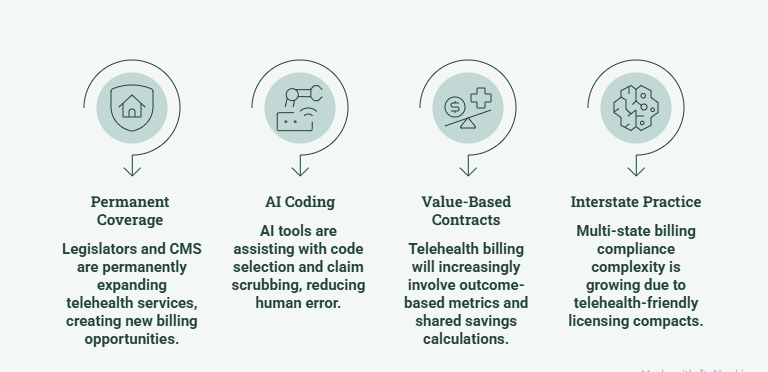
Permanent Telehealth Coverage Expansions: Legislators and CMS continue to expand the list of covered telehealth services permanently, creating new billing opportunities for providers.
AI-Powered Medical Coding: Artificial intelligence tools are beginning to assist with code selection and claim scrubbing, reducing human error in the billing process.
Value-Based Telehealth Contracts: As reimbursement models shift toward value-based care, telehealth billing will increasingly involve outcome-based metrics and shared savings calculations.
Interstate Practice Growth: As more states adopt telehealth-friendly licensing compacts, the complexity of multi-state billing compliance will continue to grow — making professional billing support even more essential.
Conclusion
Telemedicine billing is far more than a back-office function. It is a specialized discipline that directly determines how much revenue your practice collects for the virtual care you provide. From accurate CPT coding and modifier application to payer-specific compliance and denial management, every step of the billing process requires precision, expertise, and up-to-date regulatory knowledge.
For healthcare organizations serious about protecting and growing their telehealth revenue, investing in a professional telemedicine billing service is one of the smartest operational decisions you can make. The right medical billing partner will not only reduce claim denials and accelerate collections — they will give your clinical team the freedom to focus on what matters most: delivering high-quality care to patients wherever they are.
Whether you are launching a new telehealth program or looking to optimize an existing one, the foundation of financial sustainability lies in getting your medical billing service right from day one.