

Introduction: Why Telemedicine Billing Demands Specialized Expertise
The rapid expansion of virtual care has transformed how healthcare providers deliver services, but it has also introduced a new layer of administrative complexity. Telemedicine billing is not simply a digital version of traditional medical billing. It operates under a distinct set of rules, payer-specific policies, and evolving regulatory frameworks that can trip up even experienced practice managers.
According to the American Medical Association (AMA), telehealth utilization remains significantly higher than pre-pandemic levels, with millions of virtual visits processed annually across the U.S. healthcare system. For practices navigating this landscape, partnering with a qualified telemedicine billing service — or building internal expertise — is no longer optional. It is a strategic necessity.
This guide covers everything your practice needs to know about medical billing for telehealth: from CPT codes and reimbursement policies to compliance requirements and best practices that protect your revenue cycle.
What Is Telemedicine Billing?
Telemedicine billing refers to the specialized process of coding, submitting, and managing insurance claims for healthcare services delivered via remote communication technology — including video calls, telephone consultations, remote patient monitoring (RPM), and asynchronous patient messaging (store-and-forward).
Unlike in-person visits, virtual care encounters require:
- Specific CPT or HCPCS codes that accurately reflect the service modality
- Place of Service (POS) codes that distinguish telehealth from in-office visits
- Modifier codes (such as Modifier 95 or Modifier GT) to indicate a service was rendered via interactive audio-visual telecommunications
- Compliance with payer-specific telehealth policies, which vary significantly between Medicare, Medicaid, and commercial insurers
Getting these elements right is the foundation of effective medical billing for telehealth services.
Key CPT Codes Used in Telemedicine Billing
Understanding the correct codes is critical to accurate claim submission and maximum reimbursement. Below are the most commonly used CPT codes in a telemedicine billing workflow:
Evaluation & Management (E/M) Codes
| CPT Code | Description |
|---|---|
| 99202–99215 | Office or outpatient E/M visits (now used for telehealth) |
| 99421–99423 | Online digital E/M services (patient-initiated) |
| 99441–99443 | Telephone E/M services (audio-only) |
Remote Patient Monitoring (RPM) Codes
| CPT Code | Description |
|---|---|
| 99453 | Remote monitoring setup and patient education |
| 99454 | Device supply with daily recording/programmed alerts |
| 99457 | Remote physiologic monitoring treatment; first 20 minutes |
| 99458 | Each additional 20 minutes |
Behavioral Health & Chronic Care
| CPT Code | Description |
|---|---|
| 90832–90838 | Psychotherapy via telehealth |
| 99490 | Chronic care management (CCM), first 20 minutes |
| 99484 | General behavioral health integration care management |
Pro Tip: Always confirm that the CPT code is covered under the patient’s specific payer plan for telehealth. Coverage decisions differ widely by insurer and state.
Place of Service (POS) Codes for Telehealth
Selecting the correct Place of Service code is one of the most commonly misunderstood aspects of telemedicine billing. Using the wrong POS code can result in claim denials or underpayments.
- POS 02: Telehealth (patient is not in their home)
- POS 10: Telehealth (patient is in their home)
- POS 11: Office (used in specific Medicare scenarios where facility fee applies)
The distinction between POS 02 and POS 10 became especially important after CMS clarified billing requirements for home-based telehealth services. For Medicare patients receiving care at home, POS 10 is now the standard code.
Modifier Codes: What They Mean and When to Use Them
Modifier codes communicate additional information about how or where a service was delivered. In telehealth medical billing, the most frequently applied modifiers include:
- Modifier 95: Synchronous telemedicine service rendered via real-time interactive audio and video
- Modifier GT: Via interactive audio and video telecommunication systems (used for certain Medicare and Medicaid claims)
- Modifier GQ: Via asynchronous telecommunications system (store-and-forward)
- Modifier 93: Synchronous audio-only telephone or other real-time interactive audio telecommunications
Using an incorrect modifier — or omitting one entirely — is among the top causes of telemedicine claim denials. A dedicated telemedicine billing service ensures modifier accuracy at every claim touchpoint.
Medicare & Medicaid Telehealth Billing Policies
Medicare
The Centers for Medicare & Medicaid Services (CMS) have significantly expanded telehealth coverage in recent years, particularly following flexibilities introduced during the COVID-19 Public Health Emergency (PHE). Key Medicare telehealth billing rules include:
- Eligible practitioners include physicians, nurse practitioners, physician assistants, clinical psychologists, and licensed clinical social workers, among others.
- The patient’s geographic location has historically been restricted, though many waivers extended access to urban and suburban beneficiaries.
- Audio-only telehealth services are reimbursable for specific codes when a patient cannot access video technology.
- Federally Qualified Health Centers (FQHCs) and Rural Health Clinics (RHCs) may bill telehealth as a distant site.
Important: Congress periodically extends or modifies telehealth flexibilities. Practices should monitor CMS updates and work with a knowledgeable medical billing service provider to stay compliant.
Medicaid
Medicaid telehealth billing policies are state-specific, making compliance especially complex for multi-state practices. While all states cover some form of telehealth, coverage rules for live video, RPM, and store-and-forward services differ by state. Key considerations include:
- Informed consent requirements (written or verbal, depending on state)
- Originating site requirements (some states still restrict where the patient can be)
- Reimbursement parity laws (some states mandate that telehealth is paid at the same rate as in-person care)
Common Telemedicine Billing Errors (And How to Avoid Them)
Even experienced billing teams encounter telemedicine-specific pitfalls. The following are the most frequent errors and best practices to prevent them:
1. Incorrect or Missing Modifier Codes
Problem: Submitting claims without the appropriate modifier (e.g., 95 or GT) leads to automatic denials from most payers. Solution: Implement a claim scrubbing workflow that automatically flags telehealth claims missing required modifiers before submission.
2. Wrong Place of Service Code
Problem: Billing POS 11 (office) for a service delivered to the patient at home results in reimbursement discrepancies and potential fraud risk. Solution: Standardize intake workflows to document the patient’s physical location at the time of service and map it to the correct POS code.
3. Insufficient Documentation
Problem: Payers require documentation that demonstrates medical necessity, time spent, and confirmation that the service was delivered via qualifying technology. Solution: Use telehealth-specific documentation templates in your EHR that capture all required elements — including the technology platform used, patient location, and informed consent.
4. Billing Audio-Only Visits Under Wrong Codes
Problem: Audio-only telephone visits have their own CPT code set (99441–99443) and specific payer coverage rules. Billing them under standard E/M codes triggers denials. Solution: Train your clinical and billing staff on audio-only coding, and verify payer acceptance before billing.
5. Ignoring State-Level Parity Laws
Problem: In states with telehealth reimbursement parity, some providers unknowingly bill below the in-person rate. Solution: Conduct regular fee schedule audits, particularly when parity laws go into effect in new states.
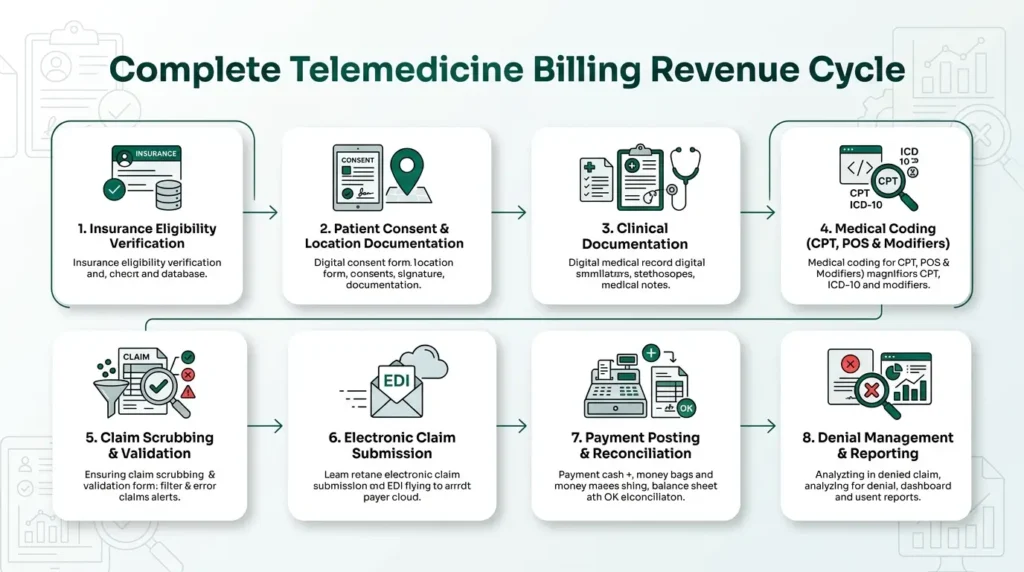
The Revenue Cycle for Telemedicine: A Step-by-Step Overview
Effective telemedicine billing is part of a broader revenue cycle management (RCM) process. Here is how a compliant, optimized telehealth billing workflow looks in practice:
In-House vs. Outsourced Telemedicine Billing Service: Which Is Right for Your Practice?
Many practices face the decision of whether to manage telehealth billing internally or partner with an external medical billing service provider. Both options have distinct advantages:
In-House Billing
- Pros: Direct control over processes, immediate access to billing staff, easier communication with clinical teams
Cons: Requires continuous training on evolving telehealth regulations, higher staffing costs, risk of errors due to limited specialization
Outsourced Telemedicine Billing Service
- Pros: Access to specialized telehealth coding expertise, dedicated denial management teams, scalability, reduced overhead costs
Cons: Requires careful vendor vetting, data security due diligence, and clear SLA agreements
For high-volume telehealth practices or those scaling virtual care programs, outsourcing to a specialized telemedicine billing service typically offers the best return on investment. These providers bring dedicated coding teams, compliance frameworks, and technology integrations that would be cost-prohibitive to replicate in-house.
HIPAA Compliance in Telemedicine Billing
Patient data security is non-negotiable in any medical billing environment — and telehealth introduces additional exposure points. Practices must ensure:
- Business Associate Agreements (BAAs) are in place with all billing vendors and telehealth platforms
- Billing systems and EHRs are integrated securely with end-to-end encryption
- Staff are trained in HIPAA-compliant communication protocols for telehealth
- Patient financial data is stored and transmitted in compliance with applicable state and federal privacy laws
Reputable telemedicine billing service providers operate under strict HIPAA compliance frameworks and conduct regular security audits to protect patient and practice data.
Case Study: How a Multi-Specialty Group Reduced Telehealth Denials by 38%
A mid-sized multi-specialty group practice in the Southeast transitioned a significant portion of its outpatient volume to telehealth in 2021. Within six months, their telehealth claim denial rate climbed to 21% — well above their in-person denial rate of 6%.
Root causes identified:
- Inconsistent use of Modifier 95 vs. Modifier GT
- POS code errors for patients calling from home
- Lack of real-time payer policy updates for 14 different insurance plans
Actions taken:
- Engaged a specialized telemedicine billing service for their telehealth claims
- Implemented claim scrubbing rules specific to telehealth modifiers and POS codes
- Established a monthly payer policy review process
Results after 90 days:
- Telehealth denial rate dropped from 21% to 13%
- Clean claim rate improved to 94%
- Average reimbursement per telehealth visit increased by 11%
This example illustrates the direct financial impact of billing accuracy in virtual care settings.
Future Trends in Telemedicine Billing
The landscape of telemedicine and its associated medical billing requirements will continue to evolve. Key trends shaping the future include:
- Permanent telehealth legislation at the federal level, which would eliminate the need for temporary waivers
- AI-driven coding assistance that supports coders in selecting the right telehealth-specific codes with greater accuracy
- Expanded RPM reimbursement as chronic disease management via remote monitoring gains broader payer acceptance
- Behavioral health telehealth expansion, with more insurers achieving parity for mental health virtual visits
- Cross-state licensure compacts, simplifying telehealth delivery across state lines and reducing billing complexity for multi-state practices
Practices that invest now in telehealth billing infrastructure and compliance will be best positioned to capitalize on these trends.
Conclusion: Precision in Telemedicine Billing Protects Your Practice
Telemedicine billing is one of the most specialized and rapidly changing areas of healthcare revenue cycle management. From choosing the right CPT codes and POS designations to applying modifiers correctly and navigating payer-specific telehealth policies, the margin for error is narrow — and the financial consequences of getting it wrong are significant.
Whether you manage medical billing in-house or work with a trusted telemedicine billing service, the key is to treat telehealth billing as the distinct discipline it is. Invest in certified coding expertise, stay current with CMS and payer policy changes, and build compliance into every step of your revenue cycle.
Practices that do this consistently will see fewer denials, faster reimbursements, and a stronger foundation for growing their virtual care programs with confidence.