
In today’s complex healthcare landscape, the financial health of any medical practice depends on one critical process: accurate, timely, and compliant revenue cycle management. At the core of this process sits the relationship between medical coding service and medical billing service — two functions that are deeply interconnected and equally vital.
Many healthcare providers assume that billing and coding are interchangeable terms. They are not. Understanding how each function works, and why one cannot succeed without the other, is essential for any clinic, hospital, or specialty practice aiming to maximize revenue, minimize claim denials, and maintain compliance with ever-changing healthcare regulations.
The Foundation: What Is Medical Coding?
Medical coding is the process of translating a patient’s clinical visit, diagnosis, procedure, and treatment into standardized alphanumeric codes. These codes are drawn from three primary classification systems:
- ICD-10-CM (International Classification of Diseases, 10th Revision) for diagnoses
- CPT (Current Procedural Terminology) for medical procedures and services
- HCPCS Level II codes for equipment, supplies, and non-physician services
A professional medical coding service takes the physician’s notes, operative reports, and clinical documentation and converts them into a precise set of codes that accurately represent the services rendered. Every diagnosis must be coded to the highest level of specificity. Every procedure must reflect the complexity and resources involved.
When done correctly, medical coding creates a universally understood clinical language that insurers, government payers, and healthcare systems all recognize.
What Is Medical Billing — and Why Does It Depend on Coding?
Medical billing is the process of submitting claims to insurance payers, following up on outstanding payments, posting payments, and managing patient accounts. A dedicated medical billing service handles the entire revenue cycle from claim submission to final payment collection.
The critical connection between the two functions becomes clear when you understand this: a billing team can only submit what the coding team provides. If the codes are wrong, vague, or unsupported by documentation, the claim will either be denied, underpaid, or flagged for audit.
Think of it this way:
Medical coding is the engine. Medical billing is the vehicle. Without a properly built engine, even the best vehicle will not move.
How Coding Errors Affect Billing Outcomes
| Coding Issue | Billing Consequence |
|---|---|
| Upcoding (inflated codes) | Claim denial, fraud investigation, financial penalties |
| Downcoding (under-reported services) | Revenue loss, underpayment |
| Incorrect diagnosis linkage | Claim rejection, delayed reimbursement |
| Missing modifiers | Reduced payment or full denial |
| Unbundling errors | Audit risk, compliance violations |
The EEAT Principle in Healthcare Revenue Cycle Management
High-performing healthcare organizations do not treat medical coding and billing as administrative afterthoughts. They treat them as strategic, expertise-driven functions that require specialized knowledge, continuous training, and strict compliance oversight.
Expertise
Certified coders hold credentials such as CPC (Certified Professional Coder), CCS (Certified Coding Specialist), or COC (Certified Outpatient Coder) from recognized bodies like AAPC and AHIMA. These professionals understand anatomy, medical terminology, pharmacology, and payer-specific guidelines at a level that directly impacts claim accuracy.
A premium medical coding service employs coders who specialize by specialty — cardiology, orthopedics, oncology, mental health, and more — because coding rules vary significantly across disciplines.
Authoritativeness
Authoritative medical billing services operate under strict adherence to:
- HIPAA (Health Insurance Portability and Accountability Act)
- CMS (Centers for Medicare and Medicaid Services) guidelines
- OIG (Office of Inspector General) compliance programs
- Payer-specific LCD (Local Coverage Determinations)
Working with a certified, compliant partner signals to payers and regulators that your practice operates with integrity.
Trustworthiness
For high-profile healthcare organizations, trust is non-negotiable. Patients, partners, and insurers expect complete data privacy, zero tolerance for fraudulent billing, and transparent reporting. A reputable medical billing service provides detailed analytics, regular audit trails, and real-time dashboards so providers always know where their revenue stands.
Key Benefits of Integrating Medical Coding and Billing Services
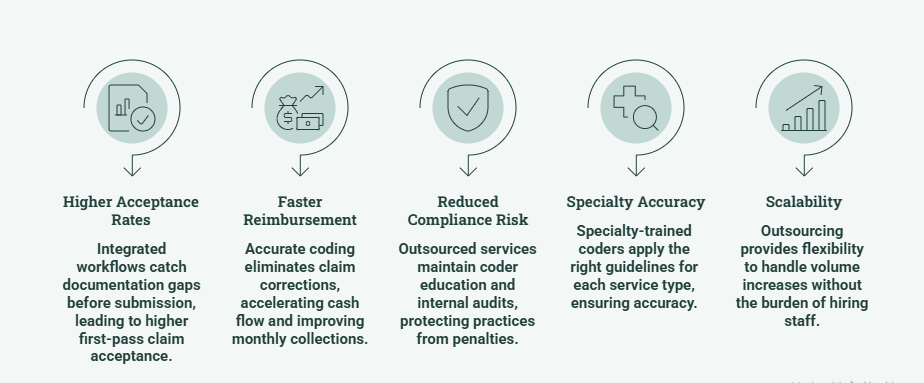
When your practice brings together a specialized medical coding service with a comprehensive medical billing service under one coordinated workflow, the advantages compound significantly, as medical coding services enhance accuracy in medical billing services by ensuring precise documentation, reducing claim denials, and improving reimbursement efficiency.
1. Higher First-Pass Claim Acceptance Rates
Industry data consistently shows that practices with integrated coding and billing workflows achieve first-pass claim acceptance rates of 95% or higher. When coders and billers operate in sync, documentation gaps are caught before submission rather than after denial.
2. Faster Reimbursement Cycles
Accurate coding eliminates the back-and-forth of claim corrections and resubmissions. Clean claims move through payer systems faster, which directly accelerates your cash flow. For large medical groups and hospital systems, this can translate to millions of dollars in improved monthly collections.
3. Reduced Compliance Risk
Healthcare fraud and abuse enforcement has intensified in recent years. The OIG’s Work Plan and CMS audits target improper payments aggressively. An outsourced medical coding service that maintains ongoing coder education and internal audits protects your practice from costly penalties and reputational damage.
4. Specialty-Specific Accuracy
Different specialties carry different coding challenges. A general surgeon’s coding requirements differ vastly from those of a psychiatric practice or a radiation oncologist. Specialty-trained coders apply the right guidelines, modifiers, and documentation standards for each service type — which generalist billers simply cannot replicate.
5. Scalability Without Overhead
As your practice grows, in-house billing and coding staff become expensive and difficult to scale. Outsourcing to a professional medical billing service gives you the flexibility to handle volume increases, new service lines, or geographic expansion without the burden of hiring, training, and retaining full-time staff.
Real-World Impact: A Case Illustration
Consider a mid-sized orthopedic practice with 12 physicians. Prior to outsourcing, the practice was experiencing:
- A 28% claim denial rate due to coding inaccuracies
- The average days in accounts receivable is 62 days
- Annual write-offs of approximately $480,000
After implementing a coordinated medical coding and billing solution with certified specialty coders:
- The claim denial rate dropped to 7% within six months
- Days in AR reduced to 34 days
- Annual write-offs fell below $90,000
The practice recovered more than $390,000 in previously lost revenue — simply by ensuring that the coding behind their billing was accurate, complete, and compliant.
How to Choose the Right Medical Coding and Billing Partner
Selecting a vendor for your revenue cycle is one of the most consequential decisions a healthcare organization makes. Here are the standards to apply:
Credentialing and Certification: Ensure the service employs AAPC or AHIMA-credentialed coders with specialty-specific experience relevant to your practice.
Technology Infrastructure: Your partner should support major EHR and practice management platforms. Seamless integration eliminates manual data entry and reduces the risk of transcription errors.
Transparency and Reporting Demand real-time access to performance dashboards, denial management reports, and coding audit results. A trustworthy partner has nothing to hide.
HIPAA Compliance and Data Security. Patient data protection is a legal and ethical obligation. Your billing and coding vendor must maintain rigorous data security protocols, including encryption, access controls, and breach response procedures.
Denial Management Expertise: Denials are inevitable in any billing environment. What separates excellent services from average ones is how efficiently and successfully they manage the appeals process.
| Evaluation Criteria | What to Look For |
|---|---|
| Coder Credentials | CPC, CCS, COC — specialty certified |
| Denial Rate | Below 10% first-pass denials |
| Days in AR | Under 40 days for most specialties |
| EHR Compatibility | Integration with your current system |
| Compliance Program | Active OIG and HIPAA compliance protocols |
| Reporting | Real-time dashboards and monthly audits |
The Role of Technology in Modern Medical Coding Services
Artificial intelligence and natural language processing are reshaping how medical coding services operate. Computer-Assisted Coding (CAC) tools can analyze clinical notes and suggest appropriate codes — but they require human oversight from credentialed coders who understand clinical context, payer nuances, and compliance requirements.
The best medical coding services today use technology to augment coder productivity, not replace coder expertise. Automation handles volume. Expertise handles accuracy. The combination delivers both speed and compliance, which is precisely what modern medical billing service operations demand.
Conclusion: Precision Coding Drives Billing Excellence
The relationship between medical coding service and medical billing service is not simply procedural — it is foundational. Every dollar your practice collects begins with a code. Every claim your billing team submits relies on the accuracy and completeness of that code.
Healthcare organizations that invest in professional, certified, specialty-specific medical coding see measurable improvements across their entire revenue cycle: fewer denials, faster collections, stronger compliance posture, and greater financial predictability.
For practices committed to long-term growth, protecting patient data, and operating with the highest standards of integrity, the message is clear: effective medical billing starts with exceptional medical coding. Treat them as one cohesive system, and your revenue cycle will reflect that precision.