
Introduction: The Critical Link Between Medical Coding and Revenue Integrity
In today’s complex healthcare landscape, the financial health of a medical practice hinges on one often-overlooked pillar: accurate medical coding. Whether you run a single-physician clinic or a multi-specialty hospital network, your medical billing service is only as strong as the coding that feeds it.
A single miscoded procedure can trigger claim denials, delay reimbursements, or even invite compliance audits. That’s why high-performing healthcare organizations are turning to professional medical coding services to streamline their medical billing workflows, reduce revenue leakage, and ensure full regulatory compliance.
This article explores how a specialized medical coding service can transform your billing operations, improve cash flow, and give your clinical team more time to focus on what matters most: patient care.
What Is Medical Coding and Why Does It Matter?
Medical coding is the process of translating clinical documentation (diagnoses, treatments, procedures, and medications) into standardized alphanumeric codes. These codes are drawn from systems like ICD-10-CM, CPT, and HCPCS Level II, and they serve as the universal language between healthcare providers and payers such as insurance companies, Medicare, and Medicaid.
Without precise coding:
- Insurance claims get rejected or underpaid
- Providers face compliance and legal exposure
- Practice revenue suffers significant shortfalls
- Administrative staff get bogged down in rework
The Three Core Code Sets in Medical Coding
| Code Set | Purpose | Example |
|---|---|---|
| ICD-10-CM | Diagnosis codes | Z00.00: Routine general medical exam |
| CPT (Current Procedural Terminology) | Procedures and services | 99213: Office visit, established patient |
| HCPCS Level II | Supplies, equipment, non-physician services | A6216: Gauze, non-impregnated |
Each of these systems requires specialized expertise, continuous education, and real-time awareness of coding guideline updates. That is precisely why outsourcing to a dedicated medical coding service is increasingly the standard of care for efficient and compliant practices.
How Medical Coding Directly Impacts Your Medical Billing Service
Medical billing and medical coding are two sides of the same coin. Billing handles the submission and follow-up of claims with insurance payers, while coding provides the foundational data that makes billing possible.
Here is how the two processes interact:
- Clinical documentation is created by the provider after a patient encounter
- Medical coders review documentation and assign appropriate diagnosis and procedure codes
- Medical billers use those codes to generate and submit claims to payers
- Payers adjudicate claims based on the coded data
- Payment is issued or a denial is triggered, requiring a formal appeal
When coding is inaccurate or incomplete, the entire billing cycle breaks down. Research from the American Academy of Professional Coders (AAPC) indicates that claim denial rates can reach 5 to 10% in organizations with poor coding practices, costing practices thousands of dollars monthly in rework, delayed payments, and lost revenue.
Key Insight: Improving coding accuracy by just 2 to 3% can result in a measurable increase in net collections for most mid-sized practices.
Top Benefits of Outsourcing Your Medical Coding Service
Partnering with a professional medical coding service provider delivers advantages that go well beyond error reduction. Here is what leading healthcare organizations consistently report:
1. Dramatically Reduced Claim Denials
Certified coders with specialty-specific expertise apply the correct codes the first time, minimizing payer rejections. First-pass claim acceptance rates improve from industry averages of 85 to 90% up to 95 to 98% with professional coding support.
2. Accelerated Reimbursement Cycles
Faster, cleaner claims mean faster payment. When your medical billing service is powered by accurate coding, you eliminate the delays caused by coding errors, missing modifiers, and unbundling issues.
3. Regulatory Compliance and Risk Mitigation
Medical coding is governed by HIPAA, CMS guidelines, and payer-specific policies. Professional coding services maintain certified coders with CPC, CCS, and RHIA credentials who stay current with annual code updates and Office of Inspector General (OIG) compliance requirements, protecting your organization from costly audits.
4. Specialty-Specific Expertise
Coding complexity varies dramatically by specialty, whether in cardiology and orthopedics or behavioral health and oncology. A dedicated medical coding service matches certified coders to your specific specialty, ensuring nuanced clinical documentation is captured accurately and completely.
5. Scalability Without Overhead Costs
Hiring, training, and retaining in-house coders is expensive. Outsourced coding services scale with your practice volume, removing the HR burden, benefits costs, and productivity gaps that come with staff turnover.
6. Real-Time Data and Reporting
Top-tier coding service providers offer dashboards and analytics that give practice managers real-time visibility into coding accuracy rates, denial trends, coder productivity, and revenue cycle performance metrics.
Common Medical Coding Errors That Hurt Your Revenue Cycle
Understanding where coding mistakes happen is the first step toward preventing them. The most frequently cited coding errors include:
- Upcoding or downcoding: Assigning a higher or lower level of service than what is documented
- Unbundling: Billing separately for procedures that should be combined under one code
- Missing or incorrect modifiers: Failure to append modifiers such as modifier 25 or modifier 59 that explain circumstances to payers
- Diagnosis code specificity: Using unspecified codes when more specific codes are available and supported by documentation
- Outdated codes: Using discontinued codes that were removed in the latest code set update
- Lack of medical necessity documentation: Codes not supported by clinical documentation in the patient chart
A professional medical coding service employs systematic quality audits and regular coder education to eliminate these costly mistakes before claims are ever submitted.
What to Look for in a Medical Coding Service Provider
Not all coding vendors are created equal. When evaluating a medical coding service for your organization, assess these critical criteria:
Certified Coding Professionals
Ensure coders hold recognized credentials from established bodies:
- CPC (Certified Professional Coder) from AAPC
- CCS (Certified Coding Specialist) from AHIMA
- RHIA or RHIT (Registered Health Information credentials)
HIPAA-Compliant Infrastructure
Patient data security is non-negotiable. Verify the vendor operates under HIPAA-compliant data handling protocols, uses secure encrypted transmission channels, and provides a signed Business Associate Agreement (BAA).
Specialty Coverage
Confirm the provider has demonstrated expertise in your specific specialty. Coding for neurology looks very different from coding for family medicine, and that distinction matters enormously for reimbursement accuracy.
Transparent Turnaround Time
The industry standard turnaround for professional fee coding is 24 to 48 hours. For high-volume inpatient facilities, 72 hours is acceptable. Anything beyond that may suggest capacity or workflow issues.
Audit and Quality Assurance Process
Ask for documented accuracy metrics. Top-tier providers maintain coding accuracy rates of 95% or higher, validated through both internal and external audits conducted on a regular basis.
Technology Integration
The best providers integrate seamlessly with your EHR and practice management system such as Epic, Athenahealth, eClinicalWorks, or Kareo, minimizing manual handoffs and reducing the risk of transcription errors between platforms.
Medical Coding Service in Action: A Real-World Scenario
Scenario: A 12-physician orthopedic group practice was experiencing a denial rate of 11%, nearly double the industry benchmark, due to issues with their internal coding team. The primary problems identified were:
- Inconsistent use of modifiers for bilateral procedures
- Frequent use of unspecified fracture diagnosis codes
- Failure to link diagnosis codes to the correct procedures
After transitioning to a certified medical coding service with orthopedic specialization, the results were significant:
- First-pass claim acceptance rate improved from 89% to 97% within 90 days
- Denial-related write-offs dropped by 62%
- Average days in Accounts Receivable (AR) decreased from 38 days to 24 days
- The practice redirected two billing staff members from denial management to patient collections
This example illustrates how optimized medical coding creates a cascading positive effect throughout the entire medical billing revenue cycle.
Integrating Medical Coding With Your Medical Billing Service
The highest-performing healthcare revenue cycles treat medical coding and medical billing as a unified, integrated workflow rather than siloed departments. Here is what a fully integrated model looks like:
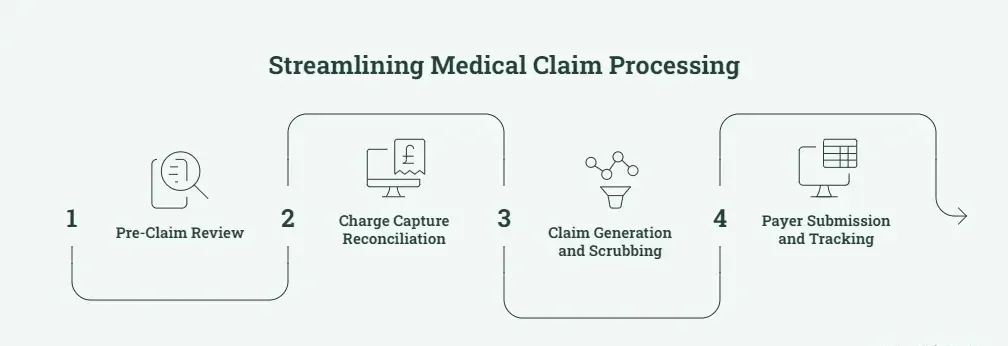
Step 1: Pre-Claim Coding Review
Coders review clinical notes, operative reports, and encounter documentation before any claim is generated, catching issues before they become denials.
Step 2: Charge Capture Reconciliation
Coded services are matched against charges captured by the clinical team to identify any missed billable services that would otherwise result in lost revenue.
Step 3: Claim Generation and Scrubbing
The medical billing team uses the finalized codes to generate a clean claim, which passes through a claim scrubber for rule-based error detection before submission.
Step 4: Payer Submission and Tracking
Claims are submitted electronically with automated tracking of acknowledgment, adjudication status, and payment posting.
Step 5: Denial Management Loop
Denied claims route back to coding for root cause analysis, creating a continuous improvement cycle that steadily drives down denial rates over time.
The Future of Medical Coding: AI, Automation, and Human Expertise
The medical coding profession is evolving rapidly. Computer-Assisted Coding (CAC) tools and AI-powered Natural Language Processing (NLP) systems are now capable of reading clinical notes and suggesting codes in real time. However, these technologies work best as augmentation tools for certified human coders, not as outright replacements.
The most effective medical coding services today combine:
- AI-assisted code suggestions for speed and consistency
- Certified coder review for accuracy and compliance
- Ongoing coder education to stay current with annual ICD-10 and CPT updates
- Data analytics to identify patterns in denials and optimize clinical documentation practices
Organizations that embrace this hybrid approach are positioning themselves for sustained revenue cycle excellence in an increasingly value-based care environment.
Conclusion: Invest in Your Medical Coding Service, Transform Your Medical Billing
Your medical billing service can only perform at its peak when it is built on a foundation of accurate, compliant, and complete medical coding. Whether you are struggling with high denial rates, slow reimbursements, or compliance concerns, a professional medical coding service is the strategic investment that pays measurable dividends.
Specialized medical coding expertise reduces claim rejections, accelerates cash flow, and protects your organization from audit risk. The most successful healthcare practices treat coding not as a back-office function, but as a core revenue strategy that directly drives financial performance.