

Medical credentialing is one of the most critical yet often overlooked pillars of the modern healthcare system. Whether you are a healthcare organization onboarding new physicians, a solo practitioner joining an insurance network, or a healthcare administrator managing compliance, understanding the full scope of medical credentialing services is essential. This article breaks down everything you need to know, from its core benefits and step-by-step process to the most common challenges that slow it down.
What Is Medical Credentialing?
At its core, medical credentialing is the formal process of verifying a healthcare provider’s qualifications, education, training, licensure, and professional history. It ensures that every clinician delivering patient care meets the established standards set by regulatory bodies, accreditation organizations, and payers.
Think of it as a thorough background and qualification check, but one with profound consequences. A lapse in credentialing can expose a healthcare facility to legal liability, insurance claim denials, and most importantly, patient safety risks.
Credentialing applies to a wide range of professionals, including:
- Physicians and surgeons
- Nurse practitioners and physician assistants
- Dentists and oral surgeons
- Mental health professionals
- Allied health professionals such as physical therapists and radiologists
Why Medical Credentialing Matters: The Core Benefits
1. Ensuring Patient Safety
The primary purpose of credentialing is straightforward: protecting patients. By rigorously verifying that every provider has the appropriate training, valid licensure, and a clean disciplinary record, healthcare organizations can dramatically reduce the risk of medical errors and malpractice.
Studies from the Joint Commission consistently highlight that credentialing gaps are linked to adverse patient outcomes. When a hospital or clinic uses robust medical credentialing services, it builds a verified, trustworthy care team that patients can rely on.
2. Regulatory and Accreditation Compliance
Healthcare organizations must comply with standards set by bodies such as The Joint Commission (TJC), the National Committee for Quality Assurance (NCQA), and the Centers for Medicare and Medicaid Services (CMS). These organizations require that all clinical staff undergo proper credentialing and privileging before treating patients.
Failure to comply can result in:
- Loss of accreditation
- Exclusion from Medicare and Medicaid programs
- Significant financial penalties
- Potential closure of a facility
Maintaining compliant credentialing records is not just best practice; it is a legal necessity.
3. Revenue Protection and Billing Accuracy
One of the most direct financial impacts of medical credentialing involves insurance reimbursements. Before a provider can bill payers, they must first be enrolled and credentialed with each individual insurance network. Providers who are not credentialed or whose credentials have lapsed simply cannot receive payment for services rendered.
Consider this scenario: A newly hired cardiologist begins seeing patients on their first day. However, the credentialing paperwork was not submitted on time. Every claim that cardiologist generates may be denied, creating a cash flow gap that can cost a practice tens of thousands of dollars per month.
This is precisely why many organizations rely on specialized medical credentialing services to streamline the process and eliminate costly gaps.
4. Building Institutional Trust and Reputation
Patients today are more informed than ever. They research their providers before scheduling appointments. Healthcare organizations that can demonstrate rigorous credentialing standards build stronger trust with both patients and referring physicians. It signals a commitment to quality, safety, and professional accountability.
For high-profile healthcare facilities and specialty practices, this reputation is an invaluable competitive advantage.
5. Reducing Liability Exposure
From a legal perspective, credentialing serves as a protective shield for healthcare institutions. If a patient suffers harm caused by an unqualified or improperly credentialed provider, the organization may face “negligent credentialing” lawsuits. Proper documentation of the credentialing process demonstrates due diligence and can significantly reduce legal exposure.
The Medical Credentialing Process: Step by Step
The credentialing process varies slightly depending on the organization and specialty, but it generally follows a consistent structure. Here is a clear breakdown of how it works:
| Stage | Activity | Responsible Party |
|---|---|---|
| 1. Application | Provider submits credentials and supporting documents | Provider / Credentialing Team |
| 2. Primary Source Verification | Verification of education, training, licensure | Credentialing Specialist |
| 3. Background Check | Criminal history, malpractice history review | Third-party Verification Body |
| 4. Committee Review | Medical staff committee evaluates the application | Credentialing Committee |
| 5. Privileging | Granting specific clinical privileges | Medical Executive Committee |
| 6. Payer Enrollment | Enrolling provider with insurance networks | Credentialing / Billing Team |
| 7. Ongoing Monitoring | License renewals, re-credentialing every 2–3 years | Credentialing Department |
Stage 1: Application and Document Collection
The process begins when a provider submits their application along with a comprehensive documentation package. This typically includes:
- Medical school diplomas and transcripts
- Residency and fellowship completion certificates
- State medical licenses
- DEA registration (if applicable)
- Board certifications
- Malpractice insurance certificates
- Professional references
- Work history and any gap explanations
Incomplete applications are one of the leading causes of delays, which is why organized document collection is so critical.
Stage 2: Primary Source Verification (PSV)
This is the heart of the credentialing process. Primary source verification means confirming credentials directly with the issuing institution, not relying on copies provided by the provider. For example, a medical school diploma is verified directly with the university’s registrar.
The Council for Affordable Quality Healthcare (CAQH) has developed a standardized database that many hospitals and payers use to streamline PSV, saving significant time and reducing duplicate work.
Stage 3: Background and Sanctions Checks
Credentialing professionals check federal and state exclusion databases, the National Practitioner Data Bank (NPDB), state licensure boards, and the Office of Inspector General (OIG) exclusion list. Any red flags, such as disciplinary actions, malpractice settlements, or criminal history, are flagged for review.
Stage 4: Committee Review and Privileging
Once verification is complete, a medical staff credentials committee reviews the application and makes a recommendation. This is followed by privileging, which determines the specific clinical procedures and services a provider is authorized to perform at a given facility. For example, a general surgeon may be privileged for laparoscopic procedures but not for cardiac surgery.
Stage 5: Payer Enrollment
Credentialing with a hospital and credentialing with insurance payers are two separate but related processes. Payer enrollment involves submitting applications to individual insurance networks such as Blue Cross Blue Shield, Aetna, UnitedHealthcare, and Medicare. Each payer has its own timeline, documentation requirements, and processing procedures.
This stage often takes the longest, anywhere from 90 to 180 days per payer, which is why early initiation is critical.
Stage 6: Ongoing Monitoring and Re-credentialing
Credentialing is not a one-time event. Most organizations require re-credentialing every two to three years. Ongoing monitoring should also include:
- Tracking license expiration dates
- Monitoring malpractice claims
- Reviewing continued education requirements
- Checking OIG and NPDB for new sanctions
Automated credentialing management systems and professional medical credentialing services play a key role in keeping these records current.
Common Challenges in Medical Credentialing
Despite its importance, the credentialing process is often riddled with obstacles. Understanding these challenges is the first step toward overcoming them.
Challenge 1: Lengthy Timelines
The average credentialing process takes anywhere from 60 to 180 days, depending on the complexity of the application and the responsiveness of verification sources. For healthcare organizations onboarding multiple providers at once, this can create serious operational bottlenecks.
Challenge 2: Incomplete or Inaccurate Applications
Providers frequently submit applications with missing documents, incorrect dates, or unexplained employment gaps. Each error requires follow-up communication, adding days or even weeks to the process.
Challenge 3: Managing Multiple Payer Enrollments
When a provider participates with ten or more insurance networks, managing simultaneous enrollment applications becomes logistically demanding. Each payer operates on its own schedule and may require different forms, documentation, and follow-up.
Challenge 4: Keeping Up with Renewals
Licenses, certifications, and malpractice insurance all have expiration dates. Letting any of these lapse can trigger an immediate suspension of billing privileges. Without a robust tracking system, organizations are constantly at risk of missing critical renewal windows.
Challenge 5: Staff Turnover in Credentialing Departments
Credentialing requires specialized knowledge, attention to detail, and familiarity with regulatory requirements. High staff turnover can disrupt ongoing processes, cause delays, and increase the risk of errors.
Challenge 6: Technology Gaps
Many smaller practices still rely on paper-based or spreadsheet-driven credentialing systems. These manual processes are inherently prone to error and make it nearly impossible to track the status of multiple applications at once.
How Professional Medical Credentialing Services Solve These Problems
Outsourcing to dedicated medical credentialing services has become an increasingly popular solution for healthcare organizations of all sizes. Here is why:
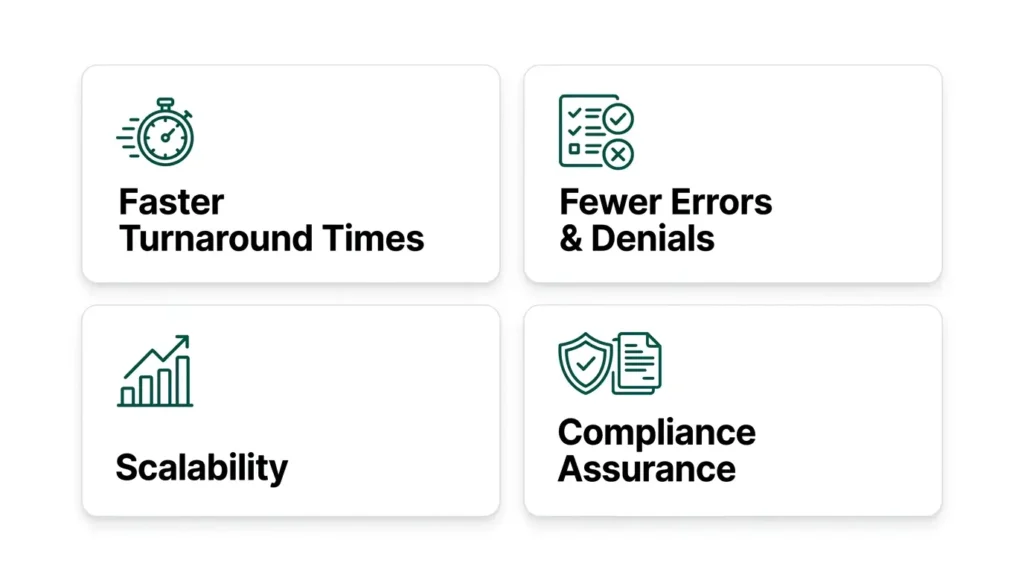
Faster turnaround times. Experienced credentialing firms have established relationships with verification sources and payers, enabling them to process applications more efficiently than in-house teams starting from scratch.
Reduced administrative burden. Outsourcing frees up internal staff to focus on patient care and core operations rather than navigating paperwork.
Fewer errors and denials. Credentialing specialists are trained to catch application issues before submission, significantly reducing denial rates.
Scalability. Whether a hospital is onboarding two providers or two hundred, credentialing services can scale to meet demand without adding internal headcount.
Compliance assurance. Professional services stay current with changing regulatory requirements, ensuring organizations remain compliant with accreditation standards and payer policies.
For multi-specialty practices, hospital systems, and telehealth companies experiencing rapid growth, professional medical credentialing services deliver measurable ROI in the form of faster revenue realization and reduced compliance risk.
Medical Credentialing vs. Medical Privileging: Understanding the Difference
These two terms are often used interchangeably, but they represent distinct processes:
| Aspect | Medical Credentialing | Medical Privileging |
|---|---|---|
| Definition | Verification of qualifications and background | Granting permission to perform specific procedures |
| Scope | Organization-wide | Facility or department-specific |
| Who is Involved | All clinical staff | Licensed providers performing procedures |
| Outcome | Verified provider file | Approved clinical privileges list |
Both processes must be completed before a provider can begin seeing patients at a given facility.
Best Practices for Streamlining Medical Credentialing
Healthcare organizations looking to optimize their credentialing programs should consider the following best practices:
- Start early. Begin the credentialing process as soon as a provider accepts an offer, not after they have already started.
- Use a centralized credentialing platform. Technology solutions like Symplr, Modio Health, or Verisys can automate tracking and reminders.
- Leverage CAQH ProView. Encourage all providers to maintain complete, current CAQH profiles to speed up payer enrollment.
- Assign a dedicated credentialing coordinator. Having a single point of accountability reduces miscommunication and delays.
- Conduct regular internal audits. Review credentialing files quarterly to catch expiring documents before they become a problem.
- Partner with professional credentialing services for complex or high-volume needs.
The Future of Medical Credentialing
The credentialing landscape is evolving rapidly. Key trends shaping the future include:
Digital credentialing and blockchain. Emerging technologies are enabling secure, portable digital credentials that providers can carry across organizations, reducing redundant verification.
Interstate medical licensure. The Interstate Medical Licensure Compact (IMLC) is helping physicians obtain licensure in multiple states more efficiently, which is particularly relevant for the growing telehealth market.
AI-powered automation. Artificial intelligence is being applied to credential verification, anomaly detection, and document management, dramatically reducing processing times.
Continuous monitoring vs. periodic re-credentialing. Rather than waiting two to three years for re-credentialing cycles, organizations are increasingly adopting real-time monitoring of licensure status, sanctions, and malpractice filings.
Conclusion
Medical credentialing is far more than a regulatory checkbox. It is a foundational system that protects patients, shields organizations from liability, ensures accurate reimbursement, and upholds the integrity of the healthcare profession. From the initial application through ongoing re-credentialing, every stage of the process demands precision, consistency, and expertise.
For organizations navigating this complexity, professional medical credentialing services offer a proven path to faster onboarding, stronger compliance, and fewer revenue disruptions. In an industry where trust, safety, and accuracy are non-negotiable, investing in a rigorous credentialing program is not just smart; it is essential.
Whether you are building a credentialing program from the ground up or looking to optimize an existing one, understanding the benefits, process, and challenges outlined in this guide is your most important first step.