
In today’s fast-paced healthcare environment, accuracy and efficiency are not just desirable traits — they are non-negotiable. Every misdiagnosis, billing error, or documentation gap can have serious consequences for patients and healthcare organizations alike. This is where medical transcription services play a transformative role.
From converting physician voice recordings into precise clinical documentation to supporting a seamless medical billing service, professional transcription solutions sit at the intersection of patient safety and operational excellence. In this article, we explore how these services elevate healthcare delivery, minimize errors, and streamline administrative workflows.
What Are Medical Transcription Services?
Medical transcription services involve converting audio recordings of healthcare providers — such as doctors, nurses, and specialists — into accurate, formatted written documents. These documents include:
- Patient history and physical examination reports
- Operative and procedure notes
- Discharge summaries
- Consultation records
- Radiology and pathology reports
- Progress notes and SOAP notes
Modern transcription solutions combine the expertise of trained medical transcriptionists with advanced speech recognition technology, delivering documents that are both clinically precise and compliant with healthcare regulations such as HIPAA.
Why Accuracy in Clinical Documentation Matters
Poor documentation in healthcare does not simply create administrative headaches. It directly impacts patient outcomes, legal compliance, and financial performance.
The Real Cost of Documentation Errors
According to research from the American Health Information Management Association (AHIMA), clinical documentation errors contribute to thousands of preventable adverse events annually. These errors can lead to:
- Incorrect medication dosages or treatment plans
- Delays in patient care due to missing or ambiguous records
- Claim denials and revenue loss through a compromised medical billing service
- Legal liability for providers and institutions
- Loss of patient trust and organizational reputation
Professional medical transcription services address each of these risks by ensuring that every clinical encounter is documented with speed, clarity, and precision.
How Medical Transcription Services Improve Healthcare Accuracy
1. Eliminating Human Error in Documentation
Physicians are trained to heal, not to type. When doctors are burdened with real-time data entry through Electronic Health Records (EHR) systems, cognitive load increases and errors multiply.
By allowing providers to dictate notes naturally and trusting a professional transcription team to convert those notes into structured clinical records, healthcare organizations can significantly reduce transcription inaccuracies.
Trained medical language specialists understand complex medical terminology, drug names, anatomical references, and procedure codes. This domain expertise results in documents that are far more accurate than what physicians can produce themselves during or after a patient visit.
2. Faster Turnaround for Critical Records
Time is a critical factor in healthcare. Emergency departments, surgical teams, and ICU staff need access to patient records almost immediately. Medical transcription services offer rapid turnaround times — many providers guarantee 24-hour or even 4-hour delivery windows for urgent cases.
Faster documentation translates directly into:
- Quicker clinical decision-making
- Reduced patient wait times
- Smoother handoffs between care teams
- Earlier billing submissions through the medical billing service workflow
3. Consistent Medical Record Quality
Inconsistent documentation quality is a persistent problem in healthcare facilities that rely solely on manual or internal staff for transcription. When records are dictated and processed by specialized professionals, quality remains high and standardized across all departments and practitioners.
This consistency is especially valuable in large hospital systems, multi-specialty clinics, and telehealth platforms where dozens of providers contribute to a patient’s care journey.
4. Compliance with Regulatory Standards
Healthcare organizations must comply with a complex web of regulations: HIPAA, CMS guidelines, ICD-10 coding requirements, and state-specific licensing mandates. Reputable medical transcription services are built with compliance at their core.
Key compliance features include:
- End-to-end encryption for all transmitted patient data
- Secure, HIPAA-compliant cloud storage and access controls
- Audit trails for document creation, editing, and delivery
- Non-disclosure agreements with all transcriptionists
- Regular staff training on privacy and security best practices
For high-profile healthcare clients managing sensitive patient populations, this level of security is not optional. It is foundational.
The Connection Between Medical Transcription and Medical Billing
One of the most underappreciated benefits of high-quality transcription is its direct impact on the medical billing service cycle.
How Poor Transcription Derails Billing
Medical billing depends on precise documentation. Insurance companies and government payers evaluate clinical records to determine whether a claim is valid, what codes apply, and how much reimbursement is warranted. When documentation is vague, incomplete, or inconsistent, claims are denied or underpaid.
Consider this scenario: A specialist dictates a complex procedure note that includes multiple billable components. If the transcription misses key details or uses imprecise language, the billing team may code the claim incorrectly. This results in:
- Claim denials that require costly resubmissions
- Revenue cycle delays that impact cash flow
- Audit flags that invite regulatory scrutiny
- Potential compliance violations under Medicare and Medicaid rules
How Accurate Transcription Strengthens the Revenue Cycle
When medical transcription services produce complete and precisely worded clinical records, the downstream effect on billing is substantial.
Coding specialists and billing teams can:
- Identify all billable services from each patient encounter
- Apply the correct ICD-10 and CPT codes with confidence
- Reduce first-pass claim denial rates
- Accelerate reimbursement timelines
- Build stronger documentation for prior authorizations and appeals
Many healthcare organizations integrate transcription and billing workflows so that completed transcription records flow directly into the billing queue. This integration minimizes lag time, reduces manual data handling, and ensures that every documented service is captured and billed appropriately.
Technology-Driven Transcription: The Modern Approach
The landscape of medical transcription has evolved significantly. Today’s leading service providers combine human expertise with advanced technology to deliver results that neither can achieve alone.
AI-Assisted Speech Recognition
Sophisticated natural language processing (NLP) tools can process physician dictations in real time, producing draft transcriptions that human editors then review and refine. This hybrid approach dramatically speeds up turnaround times without sacrificing accuracy.
For specialties with highly structured report formats — such as radiology, pathology, and cardiology — AI-powered templates ensure that every required data point is captured and placed correctly within the document.
Integration with EHR Systems
Modern medical transcription services integrate directly with major EHR platforms including Epic, Cerner, Meditech, and Allscripts. This means transcribed documents are automatically placed into the correct patient record without manual upload steps or the risk of filing errors.
Seamless EHR integration also supports real-time access for care teams, enabling better coordination and reducing the administrative burden on clinical staff.
Continuous Quality Assurance
Reputable providers implement multi-layered quality assurance protocols. Each transcription typically passes through at minimum two review stages before delivery: an initial transcriptionist pass and a quality editor review. This ensures that the final document meets both clinical and linguistic standards.
Case Study: Streamlining Documentation at a Multi-Specialty Clinic
A mid-sized multi-specialty clinic in the southeastern United States was struggling with mounting documentation backlogs, frequent billing errors, and physician dissatisfaction due to heavy EHR data entry demands.
After partnering with a professional medical transcription service, the clinic experienced measurable improvements within the first quarter:
- Average transcription turnaround reduced from 48 hours to under 12 hours
- First-pass claim approval rates improved by 22% through better documentation supporting the medical billing service team
- Physician satisfaction scores increased significantly, as providers regained time previously spent on administrative documentation
- HIPAA audit performance improved, with zero compliance violations recorded over the subsequent 12 months
This real-world example demonstrates that the return on investment for professional transcription services extends well beyond documentation alone — it touches every dimension of clinical and financial performance.
Choosing the Right Medical Transcription Service Provider
Not all transcription solutions are created equal. When evaluating providers, healthcare organizations should prioritize the following:
Security and Privacy Standards
The provider must demonstrate full HIPAA compliance, including Business Associate Agreement (BAA) execution, encrypted data transmission, secure server infrastructure, and a documented breach response protocol. Patient data privacy is non-negotiable, and any provider who cannot clearly articulate their security posture should be disqualified immediately.
Domain Expertise
Look for providers with specialists in your area of medicine. A general transcription firm that dabbles in healthcare cannot match the accuracy of a company whose entire team is trained in medical terminology, clinical workflows, and specialty-specific documentation requirements.
Turnaround Time Guarantees
Understand the provider’s service level agreements (SLAs) for both standard and urgent transcriptions. Reliable turnaround commitments with penalty clauses demonstrate that the provider stands behind their performance.
Integration Capabilities
Confirm that the transcription platform integrates with your existing EHR system and, where applicable, your medical billing service software. Fragmented workflows defeat the purpose of outsourcing documentation.
Scalability
As your practice grows, your transcription volume will grow with it. Choose a provider that can scale seamlessly to accommodate increased demand without compromising quality or turnaround times.
The Future of Medical Transcription in Healthcare
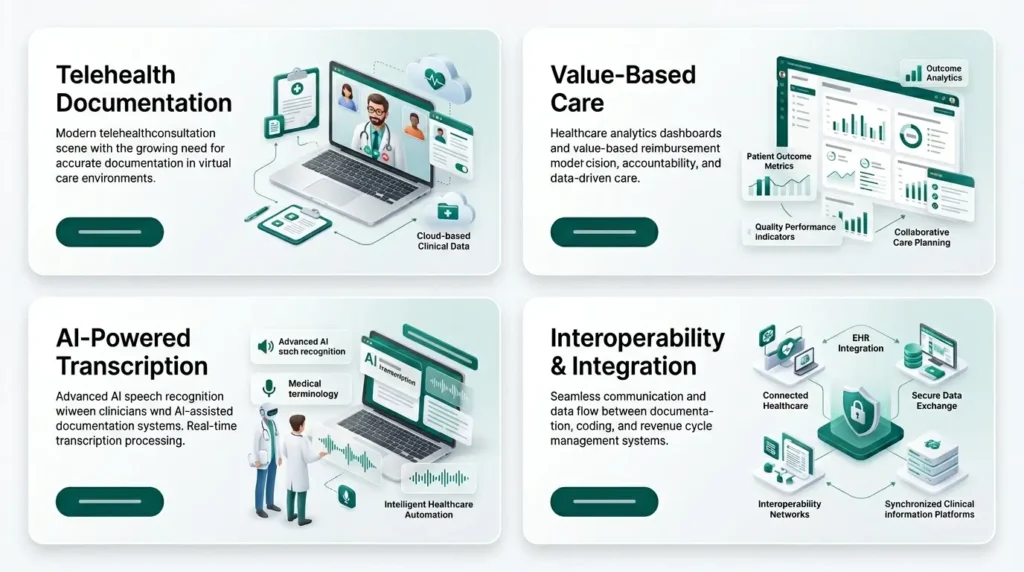
The demand for professional medical transcription services is growing alongside the healthcare industry itself. Several trends are shaping the future of this field:
Conclusion
Medical transcription services are far more than a convenience for busy physicians. They represent a strategic investment in clinical accuracy, regulatory compliance, revenue cycle integrity, and patient safety.
By ensuring that every patient encounter is documented with precision, these services directly support a high-performing medical billing service operation, reduce administrative burden on clinical staff, and create the documentation infrastructure that modern healthcare demands.
For healthcare organizations that prioritize quality, privacy, and operational excellence, partnering with a trusted medical transcription provider is one of the most impactful decisions they can make. In a field where every word carries clinical and financial weight, professional transcription is not a luxury, it is a necessity.