

Medical credentialing is one of the most critical yet often misunderstood processes in the healthcare industry. Whether you are a solo physician launching a new practice, a hospital administrator managing a large clinical team, or a healthcare organization seeking to streamline operations, understanding medical credentialing is essential for delivering safe, compliant, and high-quality patient care.
This complete guide breaks down everything healthcare providers need to know about medical credentialing, from its definition and importance to the step-by-step process, common challenges, and how professional medical credentialing services can transform your practice.
What Is Medical Credentialing?
Medical credentialing is the formal process of verifying and assessing the qualifications, training, licensure, and professional background of healthcare providers. It is a structured evaluation system used by hospitals, health systems, insurance payers, and healthcare organizations to confirm that a provider meets established standards of competence and ethics before they are permitted to treat patients or receive insurance reimbursements.
In simple terms, credentialing answers one fundamental question: Is this healthcare provider qualified and safe to deliver patient care?
The process applies to a wide range of healthcare professionals, including:
- Physicians (MDs and DOs)
- Nurse practitioners and physician assistants
- Dentists and oral surgeons
- Mental health professionals
- Allied health professionals such as physical therapists and radiologists
- Chiropractors and naturopathic doctors
Why Is Medical Credentialing Important?
Medical credentialing is not just a bureaucratic formality. It is a cornerstone of patient safety and institutional accountability. Here is why it matters:
1. Patient Safety and Quality of Care
Credentialing ensures that every provider treating patients has the proper education, training, and licensure to do so safely. By verifying credentials, healthcare organizations protect patients from unqualified or fraudulent practitioners.
2. Insurance Reimbursement and Revenue Cycle
Before a provider can bill insurance companies, including Medicare and Medicaid, they must be credentialed and enrolled with each payer. Without completed credentialing, providers cannot receive reimbursements, leading to significant revenue loss for healthcare practices.
Real-World Impact: A new physician joining a practice cannot begin billing insurance payers until credentialing is complete. Delays of even 60 to 90 days can result in tens of thousands of dollars in lost revenue.
3. Legal and Regulatory Compliance
Hospitals and healthcare organizations are legally required to credential their providers under standards set by the Joint Commission (TJC), the National Committee for Quality Assurance (NCQA), and the Centers for Medicare & Medicaid Services (CMS). Non-compliance can result in loss of accreditation, fines, and legal liability.
4. Risk Management and Liability Protection
Credentialing reduces an organization’s exposure to malpractice claims. If a provider with falsified credentials causes patient harm, the institution may bear legal and financial consequences for failing to perform due diligence.
5. Professional Reputation and Trust
Credentialed providers signal trustworthiness to patients, peers, and payers. It is an objective, verifiable demonstration of professional standing.
The Medical Credentialing Process: Step by Step
Understanding the credentialing process helps providers and administrators set realistic timelines and avoid costly mistakes.
Step 1: Application Submission
The provider completes a detailed credentialing application, typically through the Council for Affordable Quality Healthcare (CAQH) ProView portal, which is a standardized platform used by most insurance payers. Information submitted includes:
- Medical education and training history
- Board certifications
- State medical licenses
- DEA registration
- Malpractice insurance history
- Work history covering typically 10 years
- Peer references
- Hospital privileges
Step 2: Primary Source Verification (PSV)
This is the most critical phase of credentialing. Primary Source Verification involves directly confirming each submitted credential with the original issuing authority. This includes:
- Medical schools and residency programs
- Licensing boards and state medical boards
- Specialty certification boards such as the American Board of Internal Medicine
- The National Practitioner Data Bank (NPDB)
- Malpractice carriers
- Previous employers
The purpose is to eliminate fraud and ensure the accuracy of all submitted information.
Step 3: Credentialing Committee Review
Once verification is complete, the provider’s file is reviewed by a credentialing committee typically composed of senior physicians and administrative leaders within the healthcare organization. They assess whether the provider meets the organization’s standards for clinical competency and professional conduct.
Step 4: Approval and Privileging
Following committee approval, the provider is granted clinical privileges, which are specific procedures or services they are authorized to perform within a given facility. Privileging is distinct from credentialing but closely tied to it.
Step 5: Ongoing Monitoring and Re-Credentialing
Medical credentialing is not a one-time event. Providers must undergo re-credentialing every two to three years. Ongoing monitoring includes tracking license renewals, malpractice claims, sanctions, and disciplinary actions between credentialing cycles.
Credentialing vs. Enrollment: Understanding the Difference
A common point of confusion is the distinction between credentialing and payer enrollment.
| Medical Credentialing | Payer Enrollment | |
|---|---|---|
| Purpose | Verify qualifications and competency | Enroll provider with insurance payers for billing |
| Conducted by | Hospitals, health systems, credentialing bodies | Insurance companies including Medicare, Medicaid, and commercial payers |
| Timeline | 60 to 120 days typically | 90 to 180 days for some payers |
| Outcome | Clinical privileges granted | Ability to bill and receive reimbursement |
Both processes are often managed together and are essential for a fully operational healthcare practice.
Common Challenges in Medical Credentialing
Despite its importance, the credentialing process is notoriously complex and time-consuming. Healthcare organizations frequently encounter the following challenges:
1. Lengthy Turnaround Times
The average credentialing process takes 90 to 120 days, and delays are common due to incomplete applications, slow primary source responses, or payer backlogs. This directly impacts a provider’s ability to begin practicing and billing.
2. Administrative Burden
Managing credentialing in-house requires dedicated staff, sophisticated tracking systems, and deep knowledge of payer-specific requirements. For small and mid-sized practices, this burden can overwhelm existing administrative resources.
3. Data Accuracy and Completeness
A single missing document or inaccurate entry can halt the entire process. Common errors include outdated malpractice certificates, expired licenses, or gaps in employment history that are not properly explained.
4. Multiple Payer Requirements
Each insurance payer has its own credentialing and enrollment requirements. Managing separate applications, timelines, and follow-ups for dozens of payers is a significant operational challenge.
5. Keeping Up With Re-Credentialing Deadlines
With providers credentialed across multiple facilities and payers, tracking re-credentialing deadlines is a critical and often overlooked administrative function.
The Role of Professional Medical Credentialing Services
Given the complexity and high stakes of the credentialing process, many healthcare organizations turn to professional medical credentialing services to manage the process efficiently and accurately.
What Do Medical Credentialing Services Offer?
A reputable credentialing service provider offers end-to-end management of the credentialing lifecycle, including:
- Application preparation and submission across facilities and payers
- Primary Source Verification coordination and follow-up
- CAQH profile management and updates
- Payer enrollment with Medicare, Medicaid, and commercial insurers
- Deadline tracking and re-credentialing management
- Compliance monitoring for licensing, sanctions, and exclusions
- Customized reporting and audit trails
Key Benefits of Outsourcing Credentialing
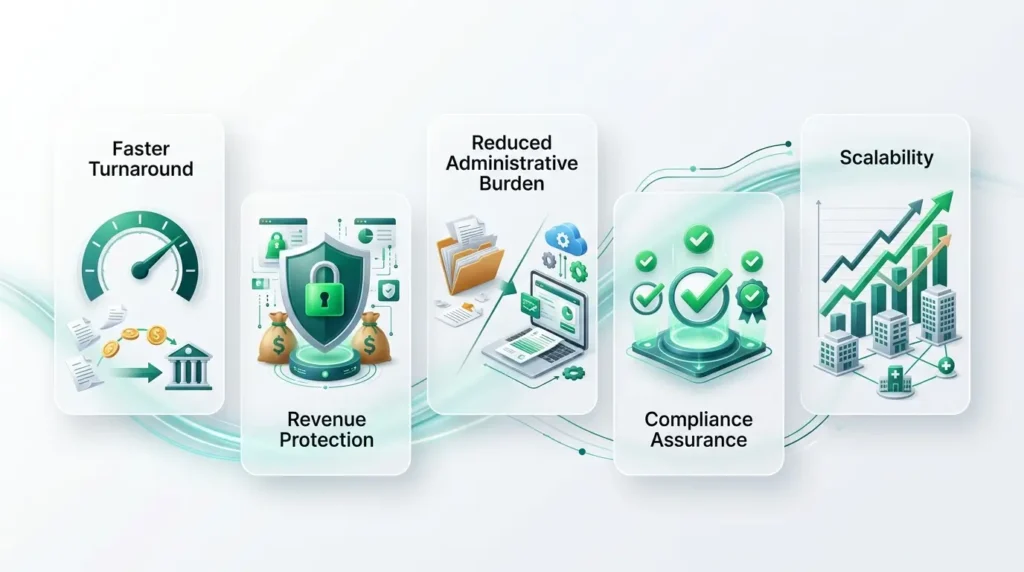
Faster turnaround: Experienced credentialing specialists know exactly what payers and facilities require, reducing application errors and follow-up delays.
Revenue protection: By accelerating payer enrollment, credentialing services help practices begin billing sooner, which directly protects revenue.
Reduced administrative burden: Outsourcing frees your in-house staff to focus on patient care and core operational functions.
Compliance assurance: Professional services stay current with changing regulatory requirements and payer policies, reducing your risk of non-compliance.
Scalability: Whether onboarding one provider or one hundred, credentialing services scale with your organization’s needs.
Case Study Snapshot: A multi-specialty group practice in a major metropolitan area reduced its average credentialing turnaround time from 110 days to 62 days after partnering with a dedicated medical credentialing service. This change enabled new providers to begin billing within two months of hire, recovering an estimated $180,000 in previously delayed revenue per provider annually.
Who Needs Medical Credentialing?
Medical credentialing requirements apply across a broad spectrum of healthcare settings:
- Hospitals and Health Systems are required to credential all clinical staff granted privileges
- Private Practices and Group Practices require credentialing for payer enrollment and billing
- Telehealth Providers increasingly require multi-state licensure and payer enrollment verification
- Urgent Care Centers and Ambulatory Surgery Centers require credentialing for accreditation and insurance contracting
- Behavioral Health Organizations require it for mental health payer networks
- Community Health Centers and FQHCs require it for federal funding compliance
How Long Does Medical Credentialing Take?
The timeline for credentialing varies depending on the type of credentialing, the completeness of the application, and the responsiveness of primary sources. General timelines are as follows:
- Hospital credentialing: 60 to 120 days
- Medicare enrollment: 60 to 90 days
- Commercial payer enrollment: 90 to 180 days, with some payers taking longer
- Re-credentialing: 30 to 60 days with accurate and up-to-date files
Starting the credentialing process as early as possible, ideally 3 to 6 months before a provider’s intended start date, is strongly recommended.
Tips for a Smooth Credentialing Process
Whether managing credentialing in-house or with a partner, these best practices can help streamline the process:
- Maintain a complete and current CAQH profile. Update it at least every 120 days to prevent attestation expiration.
- Gather documents proactively. Collect licenses, board certifications, DEA registrations, and malpractice certificates before beginning applications.
- Track expiration dates. Use a centralized calendar or credentialing software to monitor license and certification renewal dates.
- Follow up consistently. Primary sources and payers often require multiple follow-ups, and consistent outreach is key to preventing delays.
- Maintain organized provider files. A complete, well-documented provider file accelerates every future credentialing and re-credentialing cycle.
- Engage experienced credentialing professionals. For organizations managing multiple providers, professional medical credentialing services offer the expertise and infrastructure needed to manage the process efficiently and accurately.
The Future of Medical Credentialing
The credentialing landscape is evolving rapidly. Key trends shaping the future include:
- Centralized Credentialing Platforms: Initiatives like the Credentialing Verification Organization (CVO) model and interstate medical licensure compacts aim to streamline multi-state credentialing.
- Digital Credentialing and Blockchain: Emerging technologies are enabling secure, tamper-proof digital storage and sharing of credential data.
- Artificial Intelligence and Automation: AI-powered credentialing platforms are reducing manual data entry, improving accuracy, and accelerating primary source verification.
- Telehealth Expansion: The growth of telemedicine is driving demand for streamlined interstate credentialing solutions that enable providers to practice across state lines efficiently.
Conclusion
Medical credentialing is far more than a compliance checkbox. It is a foundational process that protects patients, ensures regulatory compliance, and enables healthcare organizations to operate and grow with confidence. From primary source verification and payer enrollment to ongoing re-credentialing monitoring, the process demands precision, expertise, and consistent follow-through.
For healthcare providers and organizations seeking to reduce delays, protect revenue, and maintain compliance, investing in professional medical credentialing services is not just a convenience. It is a strategic imperative.