

Intro:
Medical billing is the financial backbone of every healthcare practice — yet it remains one of the most complex, error-prone, and time-consuming processes in the industry. Whether you are a solo physician, a specialty clinic, or a multi-location hospital network, partnering with a medical billing service can mean the difference between a thriving practice and a cash-flow crisis.
In this comprehensive guide, we break down exactly how a medical billing service works — step by step — so you can make an informed decision about your revenue cycle management.
What Is a Medical Billing Service?
A medical billing service is a specialized company or department that manages the end-to-end process of submitting and following up on insurance claims, patient invoices, and payment collections on behalf of healthcare providers. Rather than hiring and training an in-house billing team, thousands of practices across the country outsource this critical function to the best medical billing service partners they can find — companies with deep expertise in payer policies, coding regulations, HIPAA compliance, and denial management.
A reliable medical billing service provider in USA handles everything from verifying a patient’s insurance eligibility on day one to posting the final payment and reconciling accounts — ensuring providers get paid accurately and on time. For high-volume practices and specialty groups, this level of comprehensive oversight is not a luxury; it is an operational necessity.
Why Medical Billing Is So Complex
Before diving into the step-by-step process, it is important to understand why medical billing demands specialized expertise. Healthcare billing operates at the intersection of clinical documentation, regulatory compliance, and insurance contract management — and each of these domains is constantly changing.
The American Medical Association reports that up to 20% of claims are initially denied, and the reasons are rarely straightforward. Payers operate under their own unique rules, fee schedules, and submission formats. Coding standards — including ICD-10-CM, CPT, and HCPCS codes — are updated every year. Compliance requirements under HIPAA, CMS guidelines, and state-specific regulations add another layer of complexity that most practices are not equipped to manage alone.
On top of all this, patient responsibility calculations involving deductibles, co-pays, co-insurance, and out-of-pocket maximums have grown increasingly complicated as high-deductible health plans have become the norm. Even a minor error in a single claim can delay payment by weeks or result in permanent revenue loss — which is precisely why the best medical billing service providers exist.
The Medical Billing Process: Step by Step
Here is how a professional medical billing service manages the full revenue cycle from patient registration to final payment posting.
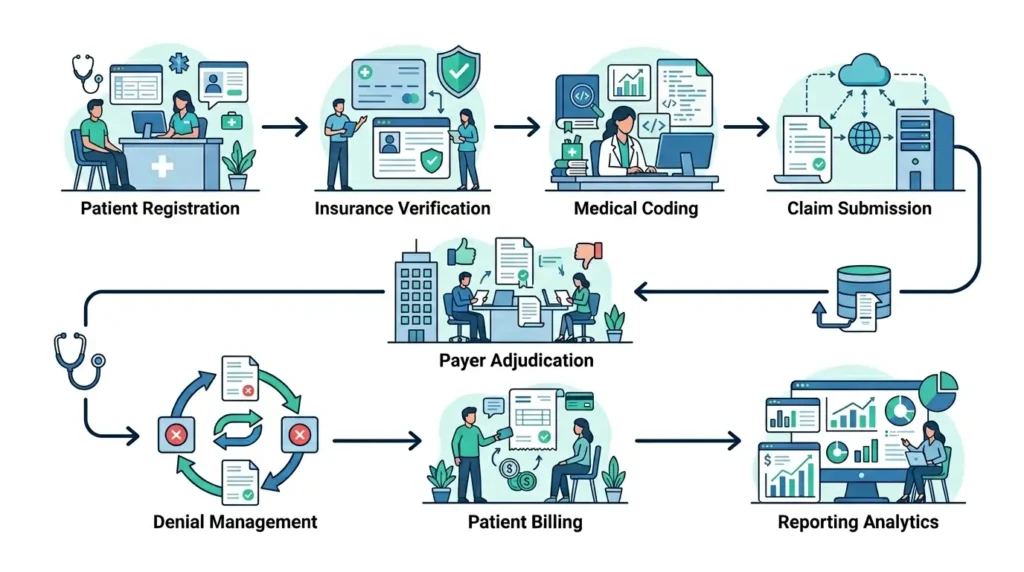
Step 1: Patient Registration and Eligibility Verification
The medical billing process begins before the patient ever walks through the door. At the point of scheduling, the billing team collects essential demographic information — name, date of birth, address, and insurance ID — and verifies insurance eligibility in real time through payer portals or clearinghouse connections.
Coverage details are confirmed thoroughly: active plan status, deductible amounts, copay requirements, and whether the provider is in-network. Any services requiring pre-authorization are identified and initiated well ahead of the appointment. Eligibility errors are among the top reasons claims are denied, and a rigorous medical billing service eliminates these issues at the source — not after services have already been rendered.
Step 2: Charge Capture
Once the patient receives care, the provider documents every service, procedure, and diagnosis performed during the encounter. Physicians complete their clinical notes in the Electronic Health Record (EHR), and all billable services — evaluation and management visits, procedures, lab orders, and administered medications — are identified and captured.
A professional medical billing service integrates directly with your EHR system to enable seamless, real-time charge capture. This integration ensures that no billable service is overlooked and that documentation is reviewed for completeness before it advances to the coding stage — protecting your revenue at every point of handoff.
Step 3: Medical Coding
Medical coding is one of the most technically demanding steps in the entire medical billing workflow. Certified coders translate the physician’s clinical notes into standardized code sets:
- ICD-10-CM codes — for diagnoses and clinical conditions
- CPT codes — for procedures and professional services
- HCPCS Level II codes — for equipment, supplies, and administered drugs
Beyond simply assigning codes, coders must ensure that every code is supported by the underlying clinical documentation, that code combinations comply with medical necessity requirements, and that bundling rules and modifier guidelines are correctly applied. The best medical billing service providers in the USA employ AAPC-certified or AHIMA-credentialed coders with speciality-specific training — from cardiology and orthopaedics to behavioural health and primary care. This depth of expertise directly reduces denial rates and audit exposure.
Step 4: Claims Scrubbing and Submission
Before a claim ever reaches an insurance payer, it passes through a rigorous internal review known as claims scrubbing. Automated scrubbing software checks every claim for errors, missing fields, invalid code combinations, and formatting issues. Claims flagged by the software are manually reviewed by the billing team before submission.
Clean claims are then submitted electronically to the appropriate payer — either directly or through a clearinghouse — and submission confirmation numbers are recorded for tracking. A professional medical billing service typically achieves a first-pass acceptance rate of 95% or higher, meaning the vast majority of claims are processed without rejection on the very first submission. This metric alone has a significant impact on how quickly a practice gets paid.
Step 5: Payer Adjudication and Remittance Processing
After a claim is submitted, the insurance payer reviews it against the patient’s plan terms, the provider’s contract, and the services billed — a process called adjudication. The payer then issues an Explanation of Benefits (EOB) or Electronic Remittance Advice (ERA) detailing the amount billed, the allowed amount, contractual adjustments, patient responsibility, and the net payment to the provider.
The billing team posts these payments accurately to the practice management system and applies appropriate contractual write-offs. Accurate payment posting is critical — not only for clean financial reporting, but for identifying underpayments. Many practices unknowingly accept less than they are contractually owed, and a vigilant medical billing service catches and appeals these discrepancies systematically.
Step 6: Denial Management and Appeals
No matter how clean the initial submission, claim denials are an inevitable part of medical billing. What separates an average billing operation from the best medical billing service is how effectively and quickly those denials are resolved.
Every denied or rejected claim is categorized by denial reason code, and the billing team investigates root causes — whether that is an eligibility issue, a coding error, missing documentation, a failed authorization, or a timely filing violation. Corrected claims are resubmitted promptly, and formal appeals are filed with supporting clinical documentation when warranted. Denial trend data is reported back to the practice with actionable recommendations for preventing the same issues upstream.
A real-world example illustrates the stakes: a mid-sized orthopedic practice partnering with a specialized medical billing service in USA provider reduced its denial rate from 14% to under 4% within just six months — recovering over $280,000 in previously lost revenue through disciplined denial analysis and appeals management.
Step 7: Patient Billing and Collections
Once insurance payments are posted, any remaining patient responsibility is billed directly to the patient. The medical billing service generates clear, itemized statements sent via mail or the patient portal, offers payment plan options where appropriate, and provides online payment capabilities for convenience.
Follow-up communications are sent on outstanding balances, and accounts that remain unpaid beyond a defined threshold are escalated to early-out collections — always in full compliance with HIPAA and FDCPA regulations. The best medical billing service providers recognize that patient billing is also a patient experience touchpoint. Every communication is handled with professionalism, transparency, and empathy, protecting the practice’s reputation as much as its revenue.
Step 8: Reporting and Analytics
The final, and often underestimated, step in the medical billing process is performance reporting. A data-driven billing partner delivers monthly financial reports covering the metrics that matter most:
- Days in Accounts Receivable (AR) — how quickly money is being collected
- Net Collection Rate — the percentage of collectible revenue actually captured
- Denial Rate by Payer and Code — identifying systemic problem areas
- Clean Claim Rate — measuring submission quality over time
Practice administrators and physicians use these insights to make informed operational and strategic decisions. A high-performing medical billing service doesn’t just process claims — it provides the business intelligence your practice needs to grow profitably, plan for expansion, and negotiate stronger payer contracts.
Key Benefits of Outsourcing to a Medical Billing Service
| Benefit | Impact |
|---|---|
| Reduced administrative burden | Physicians focus on patient care, not paperwork |
| Higher clean claim rates | Faster reimbursement with fewer denials |
| Specialty coding expertise | Maximum compliant revenue capture |
| HIPAA-compliant data security | Patient data protected at every step |
| Scalable capacity | Grows with your practice without hiring overhead |
| Transparent reporting | Full visibility into your financial performance |
How to Choose the Best Medical Billing Service in the USA
Choosing the right medical billing service partner requires more than comparing pricing. Start by evaluating specialty experience — a billing company that works extensively in your field understands payer-specific nuances that a generalist firm simply cannot match. Technology integration matters equally; your billing partner should work seamlessly with your existing EHR and practice management system without requiring costly workarounds.
Look for genuine transparency in reporting, including real-time dashboards and detailed monthly breakdowns. Verify that all coders hold recognized certifications (AAPC or AHIMA) and that the company maintains signed HIPAA Business Associate Agreements. Ask specifically about their first-pass acceptance rate, their average denial resolution timeline, and their pricing structure — whether percentage-based (typically 4–9% of collections) or flat-rate — and confirm there are no hidden fees.
Pro Tip: The best medical billing service partners function as true revenue cycle extensions of your practice — proactively surfacing issues, offering strategic guidance, and delivering consistent, measurable results month after month.
Privacy, Security, and HIPAA Compliance
Any reputable medical billing service must maintain the highest standards of data security and regulatory compliance. This is not a checkbox exercise — it is a legal and ethical obligation that directly affects your patients’ trust and your practice’s liability.
HIPAA-compliant infrastructure requires encrypted data storage and transmission at all times. Signed Business Associate Agreements are a legal requirement for every vendor that handles protected health information. Role-based access controls must limit data visibility to authorized personnel only, and regular security audits combined with ongoing staff training are essential for preventing breaches. Disaster recovery protocols ensure that financial and clinical data remain protected even in the event of a system failure or cyberattack.
For high-profile practices, specialty groups, and health systems managing sensitive patient populations, these protections are non-negotiable — and should be among the first questions asked when evaluating any medical billing service provider.
Conclusion
Understanding how a medical billing service works — from eligibility verification to payment posting, denial management, and reporting — reveals just how much expertise, technology, and precision are required to manage healthcare revenue effectively.
For practices looking to maximize collections, reduce administrative overhead, and maintain full regulatory compliance, partnering with the best medical billing service is not simply a convenience — it is a strategic imperative. A professional medical billing service provider brings certified expertise, advanced technology, and proven processes that transform your revenue cycle from a persistent source of frustration into a genuine competitive advantage. The right partner does not just process your claims — they protect your revenue, safeguard your patients’ data, and strengthen your practice’s long-term financial health.