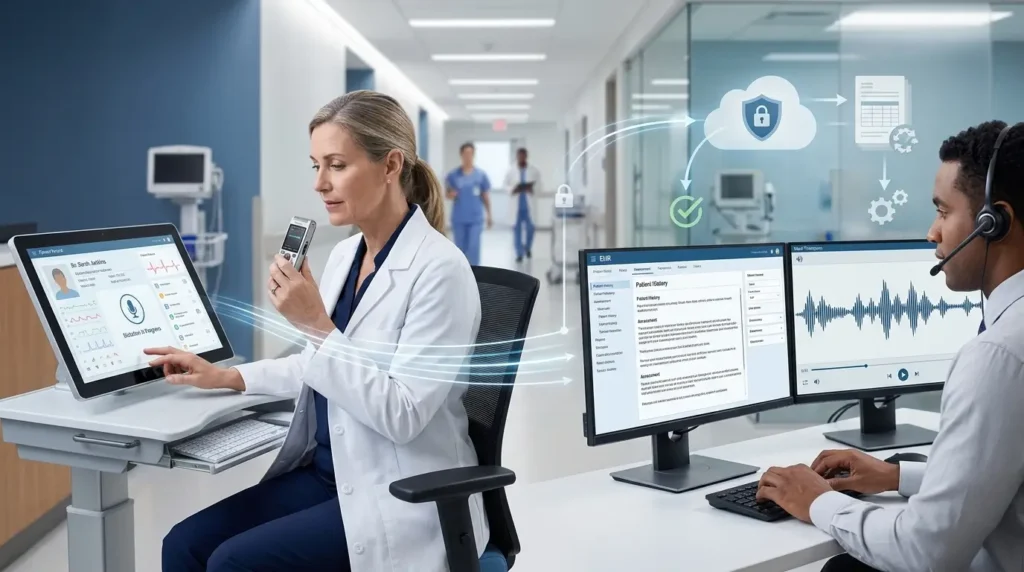
In today’s fast-paced healthcare landscape, accuracy, efficiency, and compliance are non-negotiable. Whether you run a busy multi-specialty clinic, a hospital system, or a private practice, the volume of clinical documentation generated every single day is staggering. That’s exactly where professional medical transcription services step in, transforming raw voice recordings, dictations, and clinical notes into precise, structured, and HIPAA-compliant medical records.
Beyond documentation alone, a well-integrated transcription solution works hand-in-glove with your medical billing service, ensuring that every procedure, diagnosis, and treatment note is accurately captured before it ever reaches the billing desk. The result? Fewer claim denials, faster reimbursements, and a healthier revenue cycle overall.
What Are Medical Transcription Services?
Medical transcription services involve converting physician dictations, voice recordings, and verbal clinical notes into formatted, written medical documents. These documents include:
- SOAP notes (Subjective, Objective, Assessment, Plan)
- Discharge summaries
- Operative reports
- Radiology and pathology reports
- Consultation letters
- History and physical (H&P) examinations
Professional transcription providers, whether human-based, AI-assisted, or a hybrid model, ensure that documentation is accurate, timely, and compliant with medical coding and regulatory standards. These services integrate seamlessly into Electronic Health Record (EHR) systems, dramatically reducing the administrative burden on clinicians.
Why Medical Documentation Quality Matters More Than Ever
Before diving into the benefits, it’s important to understand the stakes.
According to the American Medical Association (AMA), physicians spend nearly 2 hours on administrative and documentation tasks for every 1 hour of direct patient care. Poor documentation doesn’t just slow down clinicians. It creates cascading problems:
- Delayed or denied insurance claims
- Increased medical liability exposure
- Compliance violations under HIPAA and HITECH
- Poor patient outcomes due to miscommunication
- Revenue leakage in your medical billing workflow
Partnering with a trusted medical transcription service directly addresses each of these pressure points.
Benefit #1: Dramatically Improved Clinical Documentation Accuracy
The most immediate and measurable benefit of professional medical transcription is documentation accuracy.
The Human Cost of Transcription Errors
A transcription error is never just an administrative inconvenience. In healthcare, an incorrectly transcribed diagnosis code, medication dosage, or surgical note can have serious consequences for patient safety and legal liability.
Professional medical transcription services deploy a combination of the following:
- Trained medical transcriptionists with specialty-specific knowledge in areas like cardiology, oncology, and orthopedics
- AI-powered speech recognition platforms that learn clinician-specific speech patterns over time
- Multi-tier quality assurance (QA) review processes that typically involve at least two human reviewers before document finalization
Key Accuracy Advantages
- Reduced error rates compared to self-service or non-medical outsourced typists
- Specialty vocabulary recognition so terms like “laparoscopic cholecystectomy” or “ejection fraction” are transcribed correctly every time
- Context-aware corrections where professional transcriptionists catch when a physician misspoke or used shorthand
- Consistent formatting aligned with facility-specific or specialty-specific templates
Real-World Example: A large regional hospital network in the U.S. Midwest reduced documentation error rates by 34% within six months of transitioning to a professional medical transcription partner. This directly improved their compliance audit scores and reduced physician rework time.
2: Accelerated Revenue Cycle Through Better Medical Billing Integration
Here’s where the ROI becomes crystal clear. Accurate transcription directly fuels an efficient medical billing service.
The Transcription and Billing Connection
Your billing team, whether in-house or outsourced, can only code what’s documented. When transcription is incomplete, vague, or inaccurate, coders are left guessing. That leads to:
- Upcoding or downcoding, both of which create compliance risk
- Claim denials from payers due to insufficient documentation
- Delayed reimbursements that strain cash flow
- Time-consuming appeals and resubmissions
Professional medical transcription services solve this at the source. When every clinical encounter is thoroughly and accurately documented, your medical billing service has exactly what it needs to submit clean, complete claims on the first attempt.
Measurable Billing Improvements
| Metric | Without Professional Transcription | With Professional Transcription |
|---|---|---|
| First-pass claim acceptance rate | 70–80% | 93–97% |
| Average days in AR (Accounts Receivable) | 45–60 days | 25–35 days |
| Denial rate | 10–15% | 3–5% |
| Documentation turnaround time | 24–72 hours | 4–12 hours |
Source: Industry benchmarks from AHIMA and MGMA
3: Significant Reduction in Physician Burnout and Administrative Burden
Physician burnout is one of the most pressing crises in modern healthcare. Documentation overload is consistently ranked as the #1 driver of clinician dissatisfaction.
How Transcription Services Give Time Back to Clinicians
When physicians and advanced practice providers (APPs) dictate notes verbally rather than typing them into an EHR during or after each encounter, the cognitive and time burden shifts dramatically.
Key time-saving benefits include:
- Voice-first workflows allow clinicians to complete documentation in real time, often during the encounter itself
- Post-encounter dictation typically takes 2 to 4 minutes versus 10 to 15 minutes of manual EHR data entry
- Same-day or next-day turnaround from transcription services means notes are finalized before the next patient day begins
- Reduced clerical multitasking so physicians can be fully present with patients, not distracted by screen time
Case Study: A primary care group practice with 12 physicians implemented a professional transcription service and reduced after-hours documentation time by an average of 1.8 hours per physician per day. Over a year, this equated to recovering more than 5,000 physician-hours, the equivalent of rehiring a full-time clinician.
Why This Matters for High-Volume Practices
For surgical centers, large multispecialty groups, and hospital-employed physicians managing 25 to 40 daily patient encounters, the compounding time savings from professional medical transcription services are transformational. The benefits extend beyond efficiency into physician retention and long-term satisfaction.
4: Airtight HIPAA Compliance and Data Security
When it comes to protected health information (PHI), there is zero margin for error.
The Compliance Imperative
Professional medical transcription services operate under stringent HIPAA and HITECH compliance frameworks. This is especially critical because raw audio dictations and draft transcripts are themselves PHI, meaning every touchpoint in the transcription workflow must be secured.
What Compliant Transcription Services Provide
- Business Associate Agreements (BAAs) required under HIPAA for any vendor handling PHI
- End-to-end encryption of audio files and transcribed documents both in transit and at rest
- Role-based access controls (RBAC) limiting document access to authorized personnel only
- Audit trails and activity logs for every document, edit, and access event
- Secure staffing protocols including background checks, NDA agreements, and locked-down workstations for remote transcriptionists
- Redundant data backup with geographic failover to prevent data loss
Avoiding the True Cost of Non-Compliance
HIPAA violation penalties range from $100 to $50,000 per violation, with annual maximums reaching $1.9 million per violation category. A single data breach stemming from an unsecured transcription workflow can trigger OCR investigations, class-action lawsuits, and irreparable reputational damage.
Partnering with a certified, HIPAA-compliant medical transcription service is not just good practice. It is a critical risk management strategy every healthcare organization must prioritize.
5: Seamless EHR Integration and Scalable Workflow Flexibility
The modern healthcare IT environment is complex. Practices use dozens of different EHR platforms including Epic, Cerner, Athenahealth, eClinicalWorks, and many others. A professional medical transcription service is built to integrate directly into these environments.
EHR-Native Documentation Workflows
Today’s leading transcription providers offer:
- Direct EHR integration via HL7 and FHIR-compliant APIs so transcribed documents populate directly into the correct chart fields
- Custom document templates tailored to your specialty, facility, or payer requirements
- Auto-population of structured data fields including CPT codes, ICD-10 codes, and demographic information pre-filled from transcription
- Mobile dictation apps that sync with desktop EHR systems in real time
Scalability for Growing Practices
One of the most underappreciated advantages of professional transcription services is elastic scalability. Whether your organization is onboarding new providers, opening additional locations, managing seasonal patient volume surges, or expanding into telehealth services, a professional transcription partner scales with you without the overhead of hiring, training, and managing in-house staff.
Flexible Delivery Models Include
- Fully outsourced transcription — the most cost-effective option for smaller practices
- Hybrid AI with human review — the best accuracy-to-cost ratio for high-volume practices
- Real-time ambient AI transcription — a cutting-edge solution for tech-forward organizations
- Blended onshore and offshore teams — enabling 24/7 coverage across time zones
How to Choose the Right Medical Transcription Service
Not all transcription providers are created equal. When evaluating vendors, healthcare leaders should assess the following criteria:
- HIPAA certification and BAA availability — a non-negotiable baseline requirement
- Accuracy guarantees — look for providers offering 98 to 99% or higher accuracy SLAs
- Turnaround time commitments — standard TAT of 4 to 12 hours for routine reports
- Specialty expertise — confirm the provider has transcriptionists trained in your clinical area
- EHR compatibility — verify integration with your existing platform before signing
- Medical billing service alignment — ensure transcription output feeds cleanly into your billing workflow
- Pricing transparency — per-line, per-minute, or per-report pricing models with no hidden fees
- References and case studies — request documented outcomes from similar-sized practices
The Strategic Link: Medical Transcription Services and Medical Billing Service
Throughout this article, one theme has emerged repeatedly. Professional transcription and professional billing are inseparable disciplines.
When your medical transcription service delivers complete, accurate, and timely clinical documentation, your medical billing service operates at peak performance. The documentation chain flows like this:
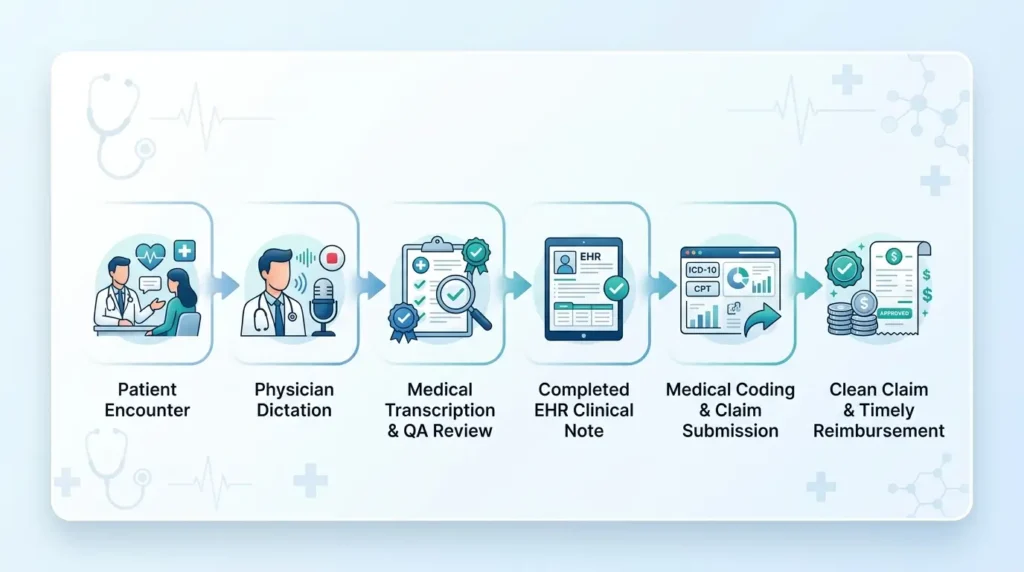
Disruption at any point in this chain, particularly at the transcription stage, creates compounding downstream problems for revenue cycle management. Investing in professional transcription is therefore a revenue cycle investment, not merely an administrative one.
Conclusion: The Business Case for Professional Medical Transcription Services
The evidence is clear. Professional medical transcription services deliver measurable, compounding value across every dimension of healthcare operations:
- Accuracy that protects patients and reduces liability
- Revenue cycle acceleration through seamless medical billing service integration
- Physician time savings that combat burnout and improve care quality
- HIPAA compliance and data security that safeguard your organization
- EHR integration and scalability that future-proof your documentation infrastructure
For healthcare organizations serious about operational excellence, clinical quality, and sustainable growth, the question is not whether to invest in professional transcription. It’s how quickly you can make the transition.
Whether you’re a solo practitioner, a growing group practice, or a health system managing thousands of daily encounters, the right medical transcription service, tightly aligned with your medical billing service, is one of the highest-ROI investments available in healthcare administration today.