

Medical credentialing is one of the most critical and often underestimated steps in launching or expanding a healthcare practice. Whether you’re a solo practitioner, a multi-specialty group, or a healthcare organization onboarding new providers, understanding the credentialing timeline can help you avoid costly delays, revenue gaps, and compliance risks.
In this guide, we break down exactly how long the medical credentialing process takes, what factors affect the timeline, and how partnering with professional medical credentialing services can dramatically speed things up.
What Is Medical Credentialing, and Why Does It Matter?
Medical credentialing is the formal process by which healthcare organizations, insurance payers, and hospitals verify a provider’s qualifications, training, licensure, and professional history. It ensures that every physician, nurse practitioner, or specialist treating patients meets the required standards for clinical competency and ethical conduct.
Without completed credentialing, providers cannot bill insurance companies, meaning every day of delay is a day of lost revenue. That’s why many practices turn to a professional medical billing service to manage both credentialing and billing workflows simultaneously, ensuring revenue cycle continuity from day one.
Key Reasons Credentialing Is Non-Negotiable:
- Insurance reimbursement eligibility: Providers must be credentialed with each payer to submit claims.
- Legal and regulatory compliance: Hospitals and health systems are mandated to credential clinical staff.
- Patient safety and trust: Credentialing verifies that providers are qualified to deliver care.
- Risk management: It protects organizations from liability associated with unqualified practitioners.
How Long Does Medical Credentialing Typically Take?
The honest answer: it varies, but plan for 90 to 180 days.
Here’s a breakdown of typical timelines by category:
| Credentialing Type | Estimated Timeline |
|---|---|
| Hospital Credentialing | 60 to 120 days |
| Insurance Panel Enrollment (single payer) | 60 to 150 days |
| Multi-payer Enrollment | 90 to 180 days |
| Medicare/Medicaid Enrollment | 60 to 90 days |
| CAQH Profile Setup & Attestation | 2 to 4 weeks |
| Re-credentialing (existing provider) | 30 to 60 days |
Important: These timelines begin after a complete and accurate application is submitted. Incomplete or error-filled applications can add weeks, or even months, to the process.
The 5 Stages of the Medical Credentialing Process
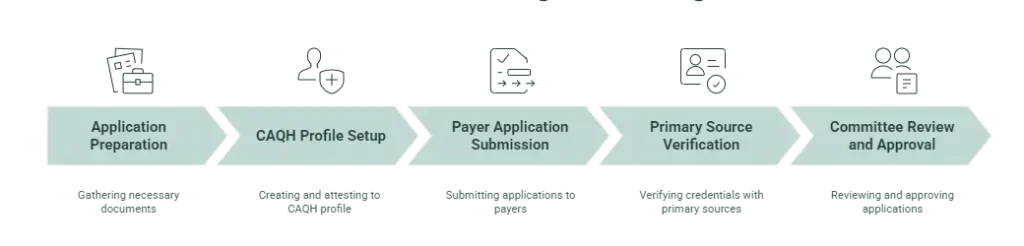
Understanding each phase helps providers and practice managers set realistic expectations and proactively manage bottlenecks.
Stage 1: Application Preparation (1 to 3 Weeks)
The first step involves gathering all required documentation. This is where most delays originate, as providers often underestimate how much documentation is needed.
Required documents typically include:
- Current medical license(s) in all relevant states
- DEA certificate and state-controlled substance registration
- Board certification certificates
- Medical school diploma and residency/fellowship completion letters
- Malpractice insurance coverage history (last 5 to 10 years)
- Curriculum vitae (CV) covering the last 10 years with no gaps
- Hospital affiliations and privileges history
- CAQH (Council for Affordable Quality Healthcare) profile login and attestation
A professional medical credentialing service will audit your documentation upfront, catching missing items before they cause downstream delays.
Stage 2: CAQH Profile Setup and Attestation (2 to 4 Weeks)
Most major commercial insurers, including Aetna, UnitedHealthcare, Cigna, and Blue Cross Blue Shield, use the CAQH ProView database as the foundation of their credentialing process. Providers must create a CAQH profile, upload all supporting documents, and attest to the accuracy of their data every 120 days.
Common issues at this stage:
- Outdated or expired malpractice certificates uploaded
- Missing work history entries (gaps trigger automatic review flags)
- Failure to complete attestation on time, causing expiration
Experienced medical credentialing services manage CAQH attestation proactively, ensuring your profile is always current and accurate.
Stage 3: Payer Application Submission (1 to 2 Weeks)
Once the CAQH profile is complete, credentialing specialists submit applications to each payer panel the provider wishes to join. Each payer has its own application portal, forms, and supplemental requirements.
Key considerations:
- Some payers have closed panels and are not accepting new providers in certain specialties or regions.
- Medicare and Medicaid enrollments are submitted via PECOS (Provider Enrollment, Chain, and Ownership System) for Medicare.
- Some payers require a Group NPI in addition to the individual provider NPI.
Working with a medical billing service that includes credentialing support ensures these nuances are handled correctly the first time.
Stage 4: Primary Source Verification (4 to 12 Weeks)
This is the most time-consuming phase. The payer (or a credentialing verification organization, CVO) contacts each primary source directly to confirm the provider’s credentials, including medical schools, residency programs, state licensing boards, malpractice carriers, and references.
Factors that extend this phase:
- Licensing boards in some states have processing backlogs of 6 to 12 weeks
- International medical schools may take longer to respond
- Malpractice carriers sometimes delay confirmation of claims history
- References who are slow to respond or unavailable
Providers who trained internationally should build additional buffer time, often an extra 4 to 8 weeks, into their credentialing timeline.
Stage 5: Committee Review and Approval (2 to 8 Weeks)
After verification is complete, credentialing committees at hospitals or payer organizations convene to review each application. Committees at large health systems may meet only monthly, which can push timelines out significantly if a provider misses a review cycle.
For insurance panel enrollment, payer credentialing departments issue approval letters and set the provider’s effective date, which is the date from which claims can be submitted and reimbursed.
Pro Tip: Always request a retroactive billing date tied to the provider’s start date where possible. Many payers allow this, and a skilled medical credentialing and billing team knows exactly when and how to request it.
Factors That Can Delay the Credentialing Process

Even with perfect preparation, external delays happen. Here are the most common culprits:
1. Incomplete or Inaccurate Applications:
A single missing document or a discrepancy in dates can halt the entire process while the payer requests corrections.
2. Licensing Board Backlogs:
State medical boards vary widely in processing speed. Some states verify licenses within days; others may take 8 to 12 weeks or longer.
3. Malpractice History:
Any past claims, even resolved ones, require additional review and documentation, extending the timeline.
4. Closed Payer Panels:
If a payer’s panel is closed to new providers in your specialty or ZIP code, credentialing simply cannot proceed until the panel reopens.
5. Provider Inattention to Follow-Ups:
Credentialing requires active follow-through. Unanswered payer requests for additional information can cause applications to lapse entirely.
How Professional Medical Credentialing Services Accelerate the Process
Partnering with a dedicated medical credentialing service is one of the most impactful decisions a growing practice can make. Here’s why:
Expertise in Payer Requirements
Each commercial payer, Medicare, Medicaid, and managed care organization has unique requirements. Credentialing specialists know exactly what each payer needs, reducing back-and-forth and rejection rates.
Proactive Application Tracking
Rather than waiting on payers passively, experienced credentialing professionals follow up weekly, escalating when necessary and documenting every touchpoint.
Integrated Revenue Cycle Management
When medical credentialing services are integrated with your medical billing workflow, your billing team knows the moment a provider is credentialed and can begin submitting claims immediately, eliminating revenue gaps.
CAQH and Re-credentialing Maintenance
Credentialing isn’t a one-time event. Most payers require re-credentialing every 2 to 3 years, and CAQH profiles must be attested every 120 days. A professional service manages these cycles on your behalf, so nothing lapses.
Medical Billing and Credentialing: Two Sides of the Same Coin
Many healthcare practices treat credentialing and medical billing as separate administrative functions, a mistake that creates unnecessary gaps. In reality, they are tightly interconnected.
- No credentialing = No billing. Providers cannot submit insurance claims until credentialing is finalized with each payer.
- Billing errors reveal credentialing gaps. Claim denials often expose credentialing issues, such as an expired license, lapsed panel enrollment, or mismatched NPI data.
- Effective date management matters. A knowledgeable medical billing service coordinates the provider’s credentialing effective date with the billing system to ensure accurate claim submission from day one.
Organizations that consolidate medical credentialing and medical billing under one expert team consistently experience faster time-to-revenue, fewer claim denials, and stronger compliance posture.
Real-World Example: New Practice Launch Timeline
Here’s a realistic scenario for a newly licensed specialist opening an independent practice:
| Week | Activity |
|---|---|
| Week 1 to 2 | Document gathering; CV preparation; license verification |
| Week 3 to 4 | CAQH profile creation and attestation |
| Week 5 to 6 | Payer applications submitted (Medicare, Medicaid, top 3 commercial payers) |
| Week 7 to 18 | Primary source verification in progress; active follow-up with payers |
| Week 14 to 24 | Committee reviews; approvals begin rolling in |
| Week 20 to 26 | All panels active; medical billing begins for all payers |
Bottom line: A new provider should expect 5 to 6 months before being fully operational across all payers. Planning ahead and engaging professional medical credentialing services from the very beginning is essential to minimizing this gap.
Tips to Speed Up Your Medical Credentialing Process
- Start early: Begin the credentialing process 6 months before your anticipated start date.
- Keep your CAQH profile current: Attest on time, every time, and update documents as they renew.
- Eliminate gaps in your work history: Explain any gaps in your CV proactively to avoid delays.
- Organize your malpractice history upfront: Request loss runs from all prior carriers before applying.
- Partner with a credentialing expert: A qualified medical credentialing service handles follow-up, payer communication, and documentation, which can reduce your timeline by weeks.
- Check payer panel status before applying: Avoid wasted time on closed panels by confirming availability with a credentialing specialist first.
- Integrate credentialing with billing: Ensure your medical billing service is looped in from the start, ready to activate billing the moment credentialing is approved.
Conclusion: Don’t Let Credentialing Delays Cost You Revenue
The medical credentialing process is complex, document-intensive, and often frustratingly slow, but it doesn’t have to derail your practice’s financial performance. With the right preparation and the right partner, you can navigate the process efficiently and get providers’ billing as quickly as possible.
Professional medical credentialing services bring specialized knowledge, established payer relationships, and systematic follow-up processes that independent practices simply cannot replicate on their own. When paired with expert medical billing support, they form the foundation of a resilient, high-performing revenue cycle.
Ready to streamline your credentialing and billing operations? Partnering with an experienced medical billing service that offers end-to-end credentialing support is the single most effective step you can take to protect your revenue and accelerate your practice’s growth.
FAQs
FAQ 1: How long does the medical credentialing process usually take?
The medical credentialing process typically takes 90 to 180 days, depending on the payer, provider history, and the completeness of submitted documents.
FAQ 2: What can delay medical credentialing?
Common delays include incomplete applications, missing documentation, licensing board backlogs, malpractice history reviews, and slow responses from verification sources.
FAQ 3: Can a provider bill insurance before credentialing is complete?
No. Providers generally cannot submit claims to insurance companies until credentialing and payer enrollment have been approved.
FAQ 4: How can medical credentialing services speed up the process?
Professional credentialing services help by preparing accurate applications, managing CAQH profiles, tracking submissions, and following up with payers to reduce delays.
FAQ 5: How often do healthcare providers need re-credentialing?
Most insurance payers and healthcare organizations require providers to complete re-credentialing every 2 to 3 years to maintain active participation status.