

Introduction: The Hidden Engine Behind High-Performing Medical Practices
In today’s competitive healthcare landscape, clinical excellence alone is no longer enough to sustain a thriving practice. The administrative backbone — specifically medical billing and front desk management — determines whether a practice runs efficiently, retains patients, and remains financially healthy.
According to the American Medical Association, administrative burdens consume nearly 34.2% of total healthcare costs in the United States. Inefficiencies in billing cycles and front office workflows translate directly into revenue loss, patient dissatisfaction, and physician burnout.
This article explores how a professional medical billing service and structured front office management system work in tandem to transform practice operations — reducing overhead, accelerating cash flow, and elevating the patient experience.
What Is Medical Billing and Why Does It Matter?
Medical billing is the process of translating healthcare services into standardized codes (CPT, ICD-10, HCPCS) and submitting claims to insurance payers for reimbursement. It is the financial lifeline of any medical practice.
The Medical Billing Cycle: A Step-by-Step Overview
A clean, efficient billing cycle involves multiple stages:
- Patient Registration: Accurate demographic and insurance data collection
- Insurance Eligibility Verification: Confirming active coverage before the appointment
- Medical Coding: Assigning correct procedure and diagnosis codes
- Charge Capture — Ensuring all rendered services are documented and billable
- Claims Submission — Electronic or paper submission to primary and secondary payers
- Payment Posting — Recording insurance and patient payments accurately
- Denial Management — Reviewing, appealing, and resubmitting rejected claims
- Patient Statements & Collections — Managing outstanding balances professionally
Every step carries risk. A single coding error or a missed eligibility check can result in a denied claim — costing the practice time, money, and administrative strain.
The Case for a Professional Medical Billing Service
Outsourcing to a dedicated medical billing service has become a strategic imperative for practices of all sizes. Here’s why.
1. Reduced Claim Denials and Faster Reimbursements
In-house billing teams often struggle to keep up with ever-changing payer rules and coding updates. A specialized medical billing service employs certified coders (CPC, CCS) who are trained to stay current with:
- ICD-10 and CPT code updates
- Payer-specific billing guidelines
- Medicare and Medicaid compliance requirements
Case Example: A mid-sized internal medicine practice in Texas reduced its denial rate from 18% to under 4% within six months of partnering with a dedicated medical billing service — increasing monthly collections by over $42,000.
2. Increased Revenue Integrity
Revenue leakage is a silent killer in medical practices. Common causes include:
- Unbundling or upcoding errors
- Missing charges due to incomplete documentation
- Failure to bill for ancillary services
A professional billing partner performs regular revenue cycle audits to identify gaps and recover missed income — ensuring every service rendered is accurately compensated.
3. HIPAA Compliance and Data Security
Patient billing data is highly sensitive. Reputable medical billing services invest heavily in:
- HIPAA-compliant billing platforms
- End-to-end data encryption
- Regular security audits and staff training
- Business Associate Agreements (BAAs)
Practices that manage billing in-house often underestimate compliance risk. A single data breach can result in fines ranging from $100 to $50,000 per violation under HIPAA regulations.
4. Scalability Without Added Overhead
As practices grow — adding providers, locations, or specialties — billing complexity scales accordingly. An external medical billing service scales seamlessly without the need to hire, train, and manage additional billing staff.
Front Desk Management: The First Impression That Shapes Everything
While billing handles the financial backend, front desk management controls the patient-facing front end. The front office is where patient relationships begin — and where operational efficiency is either built or broken.
What Does Front Office Management Include?
Effective front office management encompasses:
- Patient scheduling and appointment optimization
- Insurance verification and pre-authorization
- Copay and balance collection at the point of service
- Patient communication (reminders, follow-ups, portal support)
- Referral coordination and prior authorization tracking
- Intake documentation and medical history collection
Each of these functions, when managed poorly, creates friction for both staff and patients.
How Front Desk Management Directly Impacts Revenue
Many practice owners focus on clinical productivity without recognizing how deeply front desk management affects the bottom line.
Scheduling Efficiency and No-Show Reduction
Poor scheduling leads to empty slots, over-booking, and provider frustration. A well-managed front office uses:
- Automated appointment reminders (SMS, email, voice)
- Waitlist management to fill cancellations
- Strategic scheduling templates aligned with provider capacity
Studies show that automated reminder systems can reduce no-show rates by up to 38%, recovering thousands in weekly revenue.
Point-of-Service Collections
One of the highest-leverage functions of the front desk is collecting copays, deductibles, and outstanding balances at the time of service. Once a patient leaves without paying, collection rates drop significantly — often below 50% for balances over $200.
Best practices include:
- Verifying patient balances before each visit
- Displaying clear payment expectations in the waiting room
- Offering flexible payment options (credit card, payment plans)
- Training front desk staff in compassionate but confident financial conversations
Insurance Verification and Prior Authorization
Errors in insurance verification are one of the top three causes of claim denials. A proactive front office verifies insurance eligibility for every patient — ideally 48–72 hours in advance — checking:
- Active coverage and plan type
- Deductible and out-of-pocket status
- Prior authorization requirements for procedures or referrals
- Coordination of benefits for dual-coverage patients
This single process, when done consistently, prevents the majority of downstream billing complications.
The Synergy Between Medical Billing and Front Desk Management
The most successful practices treat medical billing and front office management not as separate silos but as integrated components of a unified revenue cycle management (RCM) strategy.
Where the Two Systems Intersect
| Front Desk Function | Billing Impact |
|---|---|
| Insurance eligibility verification | Prevents claim denials at submission |
| Accurate patient demographics | Reduces returned/rejected claims |
| Point-of-service collections | Lowers patient A/R days |
| Prior authorization tracking | Avoids post-service payment disputes |
| Referral coordination | Ensures correct billing pathways |
| Intake documentation quality | Improves coding accuracy |
When front office staff and billing teams communicate effectively — sharing data, flagging discrepancies, and aligning workflows — the entire revenue cycle accelerates.
A Unified Technology Platform
Leading practices invest in integrated practice management software that connects scheduling, front desk operations, EHR documentation, and billing in a single platform. This eliminates duplicate data entry, reduces human error, and enables real-time visibility into financial performance.
Popular platforms include Kareo, AdvancedMD, athenahealth, and eClinicalWorks — each offering varying degrees of front office and billing integration.
Key Performance Indicators: Measuring Efficiency
To know if your medical billing service and front desk management systems are working, track these critical KPIs:
Billing KPIs
- Clean claim rate (target: >95%)
- Denial rate (target: <5%)
- Days in Accounts Receivable (A/R) (target: <30 days)
- Net collection rate (target: >95%)
- First-pass resolution rate (target: >90%)
Front Office KPIs
- No-show rate (target: <8%)
- Appointment fill rate (target: >85%)
- Insurance verification rate (target: 100% of scheduled patients)
- Point-of-service collection rate (target: >90%)
- Patient wait time (target: <15 minutes)
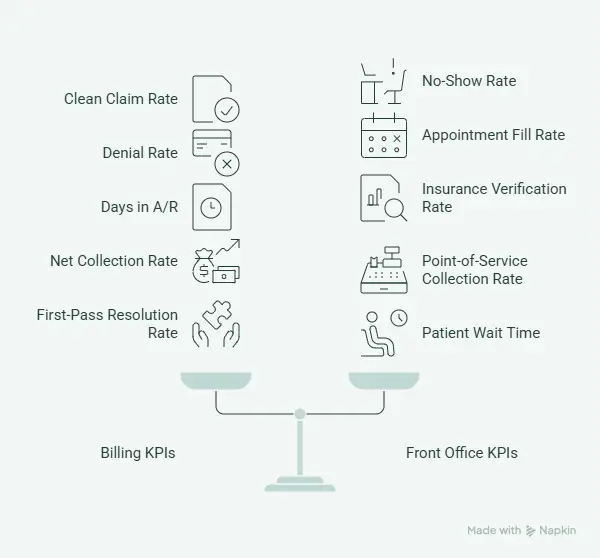
Reviewing these metrics monthly allows practice administrators to identify trends, address inefficiencies, and demonstrate ROI from their billing and front office investments.
Choosing the Right Medical Billing Service: What to Look For
Not all billing partners are created equal. When evaluating a medical billing service, high-performing practices prioritize:
Specialty-Specific Experience
Billing for cardiology differs vastly from billing for behavioral health or orthopedics. Choose a service with demonstrated expertise in your specialty.
Transparent Reporting and Real-Time Dashboards
Your billing partner should provide monthly performance reports, denial trend analysis, and payer-by-payer collection breakdowns — with no black boxes.
Certified Billing and Coding Staff
Look for credentials including:
- Certified Professional Coder (CPC) — AAPC
- Certified Coding Specialist (CCS) — AHIMA
- Certified Revenue Cycle Professional (CRCP)
Denial Management Protocols
Ask specifically: What is your appeals process? What percentage of denied claims do you successfully recover? The best services maintain denial recovery rates above 85%.
HIPAA Compliance Infrastructure
Verify that the vendor maintains a signed BAA, uses encrypted data transmission, and undergoes annual HIPAA security risk assessments.
Scalable Pricing Models
Evaluate whether pricing is percentage-based (typically 3–8% of collections) or per-claim — and ensure it aligns with your practice volume and growth trajectory.
Building a High-Performance Front Office Team
Investing in your front desk management capabilities starts with your people.
Training and Ongoing Education
Front office staff should receive training in:
- Insurance verification processes and payer portals
- Medical terminology and basic coding awareness
- HIPAA privacy standards and patient confidentiality
- Conflict resolution and patient communication
- EHR and practice management system proficiency
Standardized Workflows and SOPs
High-functioning front offices operate from documented standard operating procedures (SOPs) for every common scenario: new patient intake, referral processing, prior authorization requests, and end-of-day reconciliation.
Consistency eliminates the variability that leads to missed steps and costly errors.
Staff Retention and Morale
High front desk turnover is one of the most expensive and underrecognized problems in healthcare administration. Replacing a single front office employee costs an estimated $3,000–$5,000 when accounting for recruitment, onboarding, and productivity loss.
Practices that invest in competitive compensation, career development pathways, and a positive team culture consistently report higher staff retention and better patient satisfaction scores.
Real-World Impact: What Optimized Systems Deliver
Here is what practices typically experience within 6–12 months of implementing robust medical billing and front office management systems:
- 15–25% increase in net collections
- 30–40% reduction in denial rates
- 20–35% decrease in days in A/R
- Significant improvement in patient satisfaction scores (Press Ganey, CAHPS)
- Reduced physician administrative burden — allowing more time for patient care
- Better regulatory compliance — reducing audit and penalty risk
These are not theoretical outcomes. They are consistent results achieved by practices that treat administrative operations with the same seriousness as clinical quality.
Conclusion: Efficiency Is a Competitive Advantage
In an era of rising overhead, value-based contracts, and heightened patient expectations, operational efficiency is no longer optional — it is a strategic differentiator.
A high-performing medical billing service ensures that every dollar earned in the clinical setting is successfully collected. Optimized front desk management ensures that every patient interaction — from first phone call to final payment — reflects the professionalism and care that defines your practice.
Together, these systems protect your revenue, safeguard patient data, reduce administrative burden on clinical staff, and position your practice for sustainable growth.
Whether you are a solo practitioner, a multi-specialty group, or a large health system, the investment in professional medical billing and disciplined front office management is one of the highest-return decisions available to healthcare leaders today.
Frequently Asked Questions (FAQ)
Q: What is the difference between medical billing and medical coding?
Medical coding is the process of assigning standardized alphanumeric codes to diagnoses and procedures. Medical billing uses those codes to submit reimbursement claims to insurance payers. Both functions are interdependent.
Q: How much does a medical billing service cost?
Most services charge between 3% and 8% of monthly collections, depending on specialty, volume, and service scope. Some charge per-claim fees. Practices typically see a net positive ROI within the first 60–90 days.
Q: Can small practices benefit from outsourced billing?
Absolutely. Small practices often benefit most from outsourcing, as they lack the volume to justify a full in-house billing team but still need expert revenue cycle management.
Q: What makes front desk management “effective”?
Effective front desk management means consistent execution of eligibility verification, efficient scheduling, proactive patient communication, point-of-service collections, and seamless handoff to clinical and billing teams.