

Managing healthcare finances is one of the most complex challenges facing medical practices today. From coding errors and claim denials to compliance requirements and delayed reimbursements, the billing side of healthcare can quickly overwhelm even the most well-staffed office. That’s why thousands of providers across the country are turning to a professional medical billing service to streamline operations, protect revenue, and reduce administrative burden.
This comprehensive guide explains everything you need to know about medical billing — what it is, how it works, the benefits of outsourcing, and how to choose the best medical billing service for your practice.

What Is a Medical Billing Service?
A medical billing service is a specialized third-party company or platform that manages the end-to-end process of submitting and following up on claims with health insurance payers. These services act as the financial backbone of healthcare practices, ensuring that providers receive accurate and timely reimbursements for the care they deliver.
Unlike in-house billing teams, a dedicated medical billing partner brings industry expertise, cutting-edge software, and compliance knowledge that most individual practices simply cannot afford to maintain on their own.
What Does Medical Billing Actually Cover?
Medical billing is far more than just sending invoices. It encompasses a full revenue cycle, including:
- Patient registration and eligibility verification — Confirming insurance coverage before appointments
- Medical coding — Translating diagnoses and procedures into standardized CPT and ICD-10 codes
- Charge capture — Ensuring all billable services are documented and submitted
- Claim submission — Sending claims electronically to insurance payers
- Payment posting — Recording incoming payments from insurers and patients
- Denial management — Identifying, appealing, and resolving rejected claims
- Patient billing and collections — Managing patient statements and outstanding balances
- Reporting and analytics — Tracking key performance indicators (KPIs) for financial health
Why Medical Billing Is Critical for Healthcare Practices
Revenue cycle management is the lifeblood of any healthcare organization. According to industry data, nearly 80% of medical bills contain errors, and claim denial rates can reach 5–10% across specialties. Even a single percentage point improvement in clean claim rates can translate to tens of thousands of dollars in recovered revenue annually.
Without a reliable billing system, practices face:
- Delayed or lost reimbursements due to claim errors or late submissions
- Compliance risks from improper coding under HIPAA and CMS guidelines
- Administrative overload that pulls clinical staff away from patient care
- Reduced cash flow that limits investment in staff, equipment, and growth
A professional medical billing service addresses all of these pain points head-on.
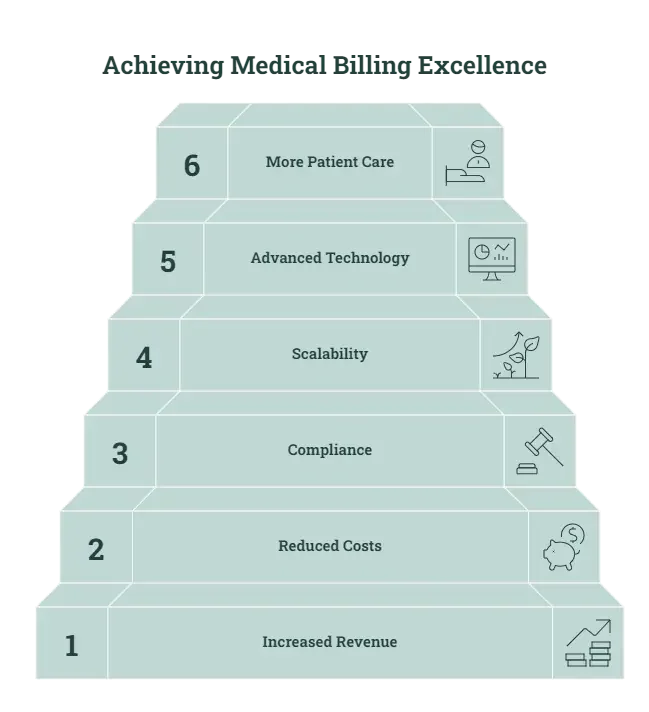
Key Benefits of Outsourcing to a Medical Billing Service
1. Increased Revenue and Faster Reimbursements
Outsourcing to a skilled medical billing company means your claims are submitted correctly the first time. Fewer errors equal fewer denials, which directly boosts collections. Most reputable billing partners maintain first-pass claim acceptance rates above 95%, far exceeding what many in-house teams achieve.
2. Reduced Operational Costs
Hiring, training, and retaining in-house billing staff is expensive. Factor in software subscriptions, compliance training, and employee benefits, and the costs add up quickly. Outsourcing to a medical billing service typically costs 4–9% of collections, which is often significantly less than managing billing internally — especially for small and mid-size practices.
3. Compliance and Risk Management
Healthcare billing is governed by strict regulations — HIPAA, ICD-10, CPT coding standards, and payer-specific policies. A top-tier medical billing service stays current with all regulatory changes, protecting your practice from costly audits and penalties.
4. Scalability and Flexibility
Whether you’re a solo practitioner or a multi-specialty group, a good medical billing partner scales with your needs. As your patient volume grows or you add new service lines, your billing operations adapt seamlessly — without the lag of recruiting and training new staff.
5. Access to Advanced Technology
Leading medical billing services in the USA invest in enterprise-grade software platforms that offer real-time claim tracking, automated eligibility checks, predictive denial analytics, and detailed financial reporting. Independent practices gain access to these tools without the capital investment.
6. More Time for Patient Care
When billing is handled externally, your clinical and administrative staff can refocus on what matters most — delivering excellent patient experiences. Reducing billing-related stress contributes to lower staff burnout and better workplace culture.
How the Medical Billing Process Works: Step by Step
Understanding the medical billing workflow helps practices appreciate where value is created and where revenue can be lost. Here’s a breakdown of the complete process:
Step 1: Patient Registration and Insurance Verification
Before the patient even arrives, the billing process begins. Demographic information is collected and insurance eligibility is confirmed in real time to identify coverage, co-pays, and deductibles. This step prevents claim rejections that stem from outdated insurance information.
Step 2: Medical Coding
Following each patient encounter, the provider’s clinical notes are converted into standardized codes:
- ICD-10 codes — Diagnoses and conditions
- CPT codes — Procedures and services rendered
- HCPCS codes — Supplies, equipment, and some services
Accurate coding is essential. Under-coding results in lost revenue; over-coding triggers compliance audits. A certified medical coder ensures the right code is applied every time.
Step 3: Charge Entry and Claim Creation
All coded services are entered into the billing system and a clean claim is created. This claim includes patient demographics, provider NPI numbers, procedure codes, diagnosis codes, and payer information.
Step 4: Claim Submission
Claims are submitted electronically to primary and secondary payers via clearinghouses. Electronic claims are processed faster than paper, typically within 14–30 days for commercial insurance and 30 days for Medicare.
Step 5: Adjudication and Payment Posting
The insurance payer reviews the claim and issues a payment decision — approved, partially paid, or denied. Payments and Explanation of Benefits (EOBs) are posted to the patient’s account. Any underpayments or discrepancies are flagged for follow-up.
Step 6: Denial Management and Appeals
Denied or underpaid claims are reviewed immediately. Common denial reasons include:
- Incorrect or missing patient information
- Non-covered services
- Coordination of benefits issues
- Coding errors or mismatched diagnosis-procedure combinations
A proactive billing team appeals these claims with supporting documentation to recover maximum reimbursement.
Step 7: Patient Billing and Collections
After insurance has paid its portion, any remaining patient balance is billed directly. Modern billing services offer patient-friendly statements, online payment portals, and flexible payment plans to improve collection rates while maintaining positive patient relationships.
Step 8: Reporting and Analytics
Comprehensive reporting provides practices with visibility into their financial health. Key metrics include:
- Days in Accounts Receivable (AR)
- Clean claim rate
- Denial rate by payer
- Net collection rate
- Adjusted collection rate
What to Look for in the Best Medical Billing Service
Choosing the right billing partner is a strategic decision. The best medical billing service for your practice should offer:
- Specialty-Specific Expertise
Different specialties have different coding requirements, payer mixes, and reimbursement challenges. Look for a service with documented experience in your specialty — whether that’s primary care, cardiology, behavioral health, physical therapy, or surgical subspecialties.
- Transparent Pricing
Avoid billing companies that charge hidden fees or lock you into long-term contracts with no flexibility. Reputable providers are upfront about their fee structures, which typically range from 4% to 9% of monthly collections.
- HIPAA-Compliant Technology
Your billing partner handles sensitive Protected Health Information (PHI) daily. Verify that they use HIPAA-compliant software, secure data transmission, and have robust breach prevention protocols in place.
- Certified Coders and Billing Staff
The quality of your billing service depends on the people behind it. Look for staff credentials such as:
- CPC (Certified Professional Coder) — AAPC
- CCS (Certified Coding Specialist) — AHIMA
- CMRS (Certified Medical Reimbursement Specialist)
- Real-Time Reporting and Transparency
You should have on-demand access to financial dashboards and reports. Avoid services that gatekeep your own data. The best partners offer 24/7 portal access so you always know where your revenue stands.
- Strong Denial Management Track Record
Ask prospective partners for their average first-pass acceptance rate and denial resolution rate. These metrics directly reflect the quality of their work and the revenue impact on your practice.
Medical Billing Service USA: The Evolving Landscape
The medical billing service USA market has expanded significantly over the last decade, driven by rising administrative costs, workforce shortages, and the complexity of value-based care models. Today’s top billing companies offer:
- Cloud-based platforms with AI-assisted coding and denial prediction
- Offshore and hybrid billing teams for cost efficiency
- Revenue Cycle Management (RCM) as a complete solution, not just claim submission
- Integration with major EHR/EMR systems like Epic, Athenahealth, Kareo, eClinicalWorks, and DrChrono
The shift toward integrated RCM partnerships — where billing, coding, credentialing, and practice management are bundled — is becoming the gold standard for high-performing medical practices across the United States.
Common Medical Billing Mistakes That Cost Practices Revenue
Even experienced in-house teams fall into patterns that erode revenue. Awareness is the first step toward correction:
- Upcoding or undercoding: Both carry significant risk; one triggers audits, the other leaves money on the table
- Failing to verify insurance eligibility: One of the top reasons for preventable claim denials
- Missing timely filing deadlines: Each payer has its own submission window; missing it means forfeiting the claim
- Ignoring aging AR: Accounts receivable older than 90 days become increasingly difficult to collect
- Poor documentation by providers: Billing is only as good as the clinical notes it’s based on
A professional medical billing service installs checks and processes that prevent these issues before they escalate.
Real-World Impact: How Medical Billing Services Transform Practices
Consider a mid-size internal medicine practice in Texas struggling with a 12% denial rate and 55 days in AR. After partnering with a specialized medical billing service, the practice achieved:
- Denial rate reduced to 4.2% within six months
- Days in AR dropped from 55 to 31
- Net collections increased by 18% year-over-year
- Physicians reported spending less time on administrative tasks, improving job satisfaction
Results like these are common across specialties and practice sizes when the right billing partner is engaged.
Conclusion: Invest in the Right Medical Billing Service
In today’s complex healthcare environment, having a reliable, expert-driven medical billing service is not a luxury — it’s a competitive necessity. From reducing claim denials and improving cash flow to ensuring compliance and freeing up your clinical team, the benefits of professional medical billing are clear and measurable.
When evaluating options, prioritize specialty expertise, transparent pricing, HIPAA-compliant technology, and a proven track record in denial management. Whether you’re a solo practitioner or a large multi-specialty group, the best medical billing service is one that becomes a true partner in your practice’s financial success.
For practices across the United States seeking to optimize their revenue cycle, the path forward begins with a commitment to smarter, more strategic medical billing — and choosing the right team to make it happen.