

The rapid expansion of virtual care has transformed the healthcare industry, but it has also introduced a new layer of complexity for providers: telemedicine billing. Claim rejections in this space are alarmingly common, often stemming from avoidable documentation errors, incorrect coding, or misaligned payer policies. For healthcare organizations that want to protect their revenue cycles, mastering the nuances of telemedicine billing is no longer optional — it is essential.
This guide walks through the most common causes of claim rejections in telehealth and offers proven, practical strategies to eliminate them. Whether you manage billing in-house or work with an external medical billing service, these insights will help you submit cleaner claims, accelerate reimbursements, and build a more resilient practice.
Why Telemedicine Claims Get Rejected More Often Than In-Person Claims
Virtual care operates under a distinct set of rules compared to traditional in-office visits. Payers — including Medicare, Medicaid, and commercial insurers — have their own eligibility requirements, place-of-service codes, and documentation standards for telehealth encounters. When billing teams are not fully aligned with these requirements, rejection rates climb.
The most frequent causes of telehealth claim rejections include:
- Incorrect or missing place-of-service (POS) codes
- Use of outdated or non-covered CPT codes for telehealth services
- Insufficient clinical documentation to justify the level of service billed
- Failure to verify patient eligibility and telehealth benefits prior to the visit
- Missing modifiers that indicate a service was delivered virtually
- Inconsistent information between the clinical notes and the submitted claim
Each of these issues is preventable. The key is building a systematic approach to telemedicine billing that addresses potential errors before a claim ever leaves your office.
Understanding the Unique Rules of Telehealth Billing
Place-of-Service Codes Matter Enormously
One of the most common mistakes in telemedicine billing is submitting claims with the wrong place-of-service code. CMS uses specific POS codes to distinguish between in-office visits and virtual encounters.
- POS 02 — Telehealth provided from a location other than the patient’s home
- POS 10 — Telehealth provided in the patient’s home (introduced post-pandemic)
Submitting a telehealth claim with POS 11 (Office) or another incorrect code is a direct path to rejection. Billing staff must be trained to apply these codes consistently based on where the patient physically was during the encounter.
Telehealth Modifiers: GT, 95, and FQ
Modifiers communicate critical information to payers about how a service was delivered. For telehealth:
- Modifier 95 — Synchronous telemedicine service rendered via real-time interactive audio and video telecommunications
- Modifier GT — Via interactive audio and video telecommunications (used for Medicare Advantage and some commercial plans)
- Modifier FQ — Service rendered using audio-only communications (important for behavioral health)
Omitting the correct modifier, or applying the wrong one, is a leading cause of claim denials. Your medical billing team must know which modifier each payer requires and update their protocols whenever payer policies change.
Covered CPT Codes for Telehealth Services
Not all CPT codes are approved for telehealth billing. CMS publishes an annual list of covered telehealth services, and commercial payers maintain their own lists. Common covered services include:
- Office and outpatient E/M visits (99202–99215)
- Behavioral health services (90832–90838)
- Prolonged services add-on codes
- Chronic care management and remote physiologic monitoring codes
Billing for a service that a payer does not cover under telehealth — even if clinically appropriate — will result in a denial. Staying current with CMS telehealth policy updates and each payer’s coverage list is a non-negotiable part of clean claim submission.
The Role of Documentation in Preventing Rejections
Strong clinical documentation is the backbone of any successful medical billing strategy. This is especially true for telemedicine, where payers are more likely to scrutinize claims because of fraud concerns in the virtual space.
What Telehealth Documentation Must Include
For an E/M telehealth visit to support the billed level of service, the clinical note should clearly capture:
- Confirmation that the encounter was conducted via audio/video (or audio-only where applicable)
- The patient’s location at the time of the visit
- The provider’s location
- Patient consent for the telehealth encounter
- The clinical content consistent with the complexity of the code billed (history, exam components, medical decision-making or time)
When documentation does not support the billed code, payers will either downcode the claim or deny it outright. Working with providers to build telehealth-specific documentation templates ensures that every visit is captured consistently and compliantly.
Time-Based Billing and Telehealth
Under current CMS guidelines, E/M coding for telehealth can be based on total time spent — including time spent reviewing records and coordinating care outside the actual visit. Providers must document this time carefully. A claim for a 99215 based on time requires clear notation of the total minutes spent on the date of service and what activities contributed to that time.
Pre-Claim Verification: Your First Line of Defense
The single most impactful step any practice can take to reduce telehealth claim rejections is a rigorous eligibility verification process before the appointment.
What to Verify Before Every Telehealth Visit
- Active insurance coverage — Confirm the patient’s plan is active on the date of service
- Telehealth benefits — Not all plans cover all telehealth services; verify that the specific service planned is covered
- Patient location eligibility — Some plans have geographic restrictions on telehealth coverage
- Deductible and cost-sharing status — Patients with high deductibles may owe more than expected; addressing this upfront improves collections
- Authorization requirements — Certain payers require prior authorization for telehealth services, especially behavioral health
A skilled medical billing service will incorporate real-time eligibility checks into the scheduling workflow, so that coverage issues are identified, and resolved before the encounter occurs.
Choosing the Right Telemedicine Billing Service
Many healthcare practices, particularly smaller ones, lack the in-house expertise to keep pace with evolving telehealth billing regulations. Partnering with a specialized telemedicine billing service can be transformative for revenue cycle performance.
What to Look for in a Medical Billing Partner
Not all billing companies are created equal. When evaluating a telemedicine billing service, consider the following criteria:
Telehealth Expertise Your billing partner should have demonstrated, up-to-date knowledge of telehealth-specific coding, modifier usage, and payer policy. Ask about their experience with virtual-care practices specifically.
Payer Relationship Management A high-performing medical billing service actively manages payer relationships, monitors denial trends, and appeals rejected claims promptly. This proactive approach can recover revenue that would otherwise be written off.
Technology and Integration Look for a billing partner that integrates seamlessly with your electronic health record (EHR) and telehealth platform. Automated claims scrubbing tools that check claims for errors before submission are a significant advantage.
Transparent Reporting: Your billing service should provide regular, detailed reports on key performance indicators: claim acceptance rates, denial rates by payer, average days in accounts receivable, and net collection rates. Transparency allows you to hold your billing partner accountable.
HIPAA Compliance and Data Security Telehealth involves the transmission of sensitive patient data across digital channels. Any medical billing service you work with must have robust HIPAA-compliant data handling practices. Ask about their data encryption protocols, audit logging, and breach response procedures.
Building an Internal Denial Management Process
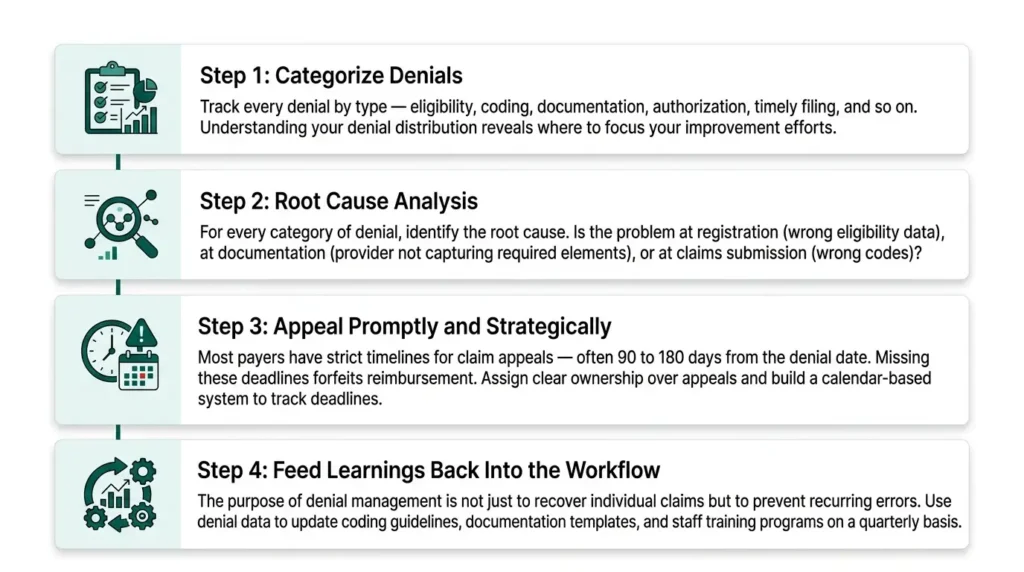
Even with the best preventive practices in place, some claims will be denied. The difference between high-performing and struggling practices is what happens next. A structured denial management process is essential.
Steps to Effective Denial Management
Technology’s Role in Cleaner Telemedicine Claims
Modern practice management and revenue cycle management (RCM) platforms offer powerful tools to reduce claim rejections before they happen.
Claims Scrubbing Software
Automated claims scrubbers review every claim against a database of payer-specific rules before submission. They flag missing modifiers, mismatched diagnosis and procedure codes, and incorrect POS codes in real time. Incorporating this step into your workflow is one of the fastest ways to improve first-pass claim acceptance rates.
Real-Time Eligibility Verification
Integrated eligibility verification tools check patient coverage directly within your scheduling or EHR platform. When staff can see coverage details — including telehealth benefits — at the time of scheduling, they can address issues proactively rather than reactively.
Analytics and Reporting Dashboards
Revenue cycle analytics tools give practice managers visibility into claim performance trends. When denial rates spike for a specific payer or service line, dashboards make it easy to identify the issue quickly and respond.
Special Considerations: Behavioral Health Telehealth Billing
Behavioral health is one of the most rapidly growing areas of telemedicine, and it carries its own billing nuances. Many payers, including CMS, have expanded audio-only coverage for mental health services — recognizing that not all patients have reliable video access.
When billing behavioral health telehealth services, consider:
- Whether the patient’s plan covers audio-only mental health visits
- Which modifier to apply (FQ for audio-only under CMS)
- State-specific requirements, as behavioral health parity laws vary significantly by jurisdiction
- Documentation of patient consent and the clinical appropriateness of the virtual format
Practices that serve high volumes of behavioral health patients should ensure their telemedicine billing protocols specifically address these distinctions.
Key Performance Metrics to Track
Managing telemedicine billing effectively requires measuring the right things. Practices that track these key performance indicators consistently are better positioned to identify problems early and demonstrate billing performance improvements over time.
| Metric | Target Benchmark |
|---|---|
| First-pass claim acceptance rate | 95% or higher |
| Claim denial rate | Below 5% |
| Average days in A/R | Under 30 days |
| Net collection rate | 95–98% |
| Appeals success rate | 50% or higher |
If your current performance falls short of these benchmarks, it may be time to reassess your internal processes or explore whether a specialized medical billing service could improve outcomes.
Conclusion: Precision in Telemedicine Billing Protects Your Revenue
Reducing claim rejections in telemedicine is not a single-step fix — it is a continuous discipline. Every touchpoint in the revenue cycle, from patient scheduling and eligibility verification to clinical documentation and claim submission, plays a role in whether a telehealth claim gets paid the first time.
Practices that invest in staff education, adopt the right technology, and partner with a knowledgeable telemedicine billing service consistently outperform those that treat billing as an afterthought. The rules governing telehealth reimbursement will continue to evolve, and staying ahead of those changes is what separates thriving virtual-care practices from those struggling with cash flow.
Whether you are building your telemedicine billing protocols from the ground up or refining an existing system, the principles outlined here provide a solid foundation. Cleaner claims, fewer denials, and faster reimbursements are achievable goals — and they start with understanding exactly what proper telemedicine billing requires.