
Medical billing errors cost the U.S. healthcare industry billions of dollars annually. Whether it’s a misplaced diagnosis code, an upcoded procedure, or a simple data entry mistake, billing inaccuracies lead to claim denials, delayed reimbursements, regulatory penalties, and damaged patient trust. The solution lies in a professional, precision-driven medical coding service that serves as the backbone of an accurate and compliant medical billing service.
The Critical Link Between Medical Coding and Medical Billing
Medical coding and medical billing are two distinct but deeply interconnected processes in the healthcare revenue cycle. Understanding how they interact is essential to pinpointing where errors originate and how to prevent them.
Medical coding is the process of translating clinical documentation, such as diagnoses, procedures, treatments, and services into standardized alphanumeric codes like ICD-10-CM, CPT, and HCPCS Level II. Medical billing, on the other hand, is the process of submitting those codes to insurance payers and patients to collect payment for services rendered.
When coding is inaccurate, the entire billing chain breaks down. A single incorrect CPT code can trigger a denied claim, spark an audit, or create a compliance violation. This is why a high-quality medical coding service is not just a back-office function. It is a strategic asset for every healthcare organization.
Most Common Medical Billing Errors and Their Coding Root Causes
Before understanding how professional coding reduces errors, it helps to identify the most prevalent billing mistakes and trace them back to their coding origins.
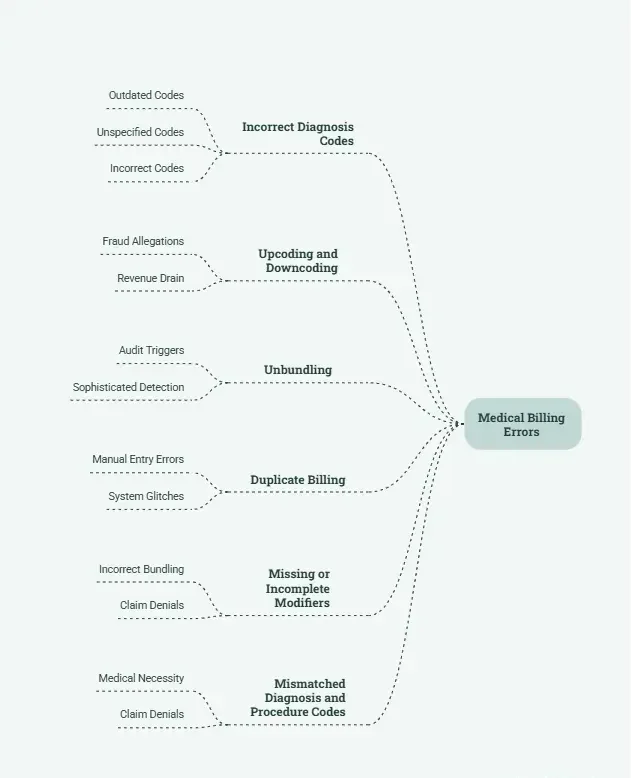
1. Incorrect Diagnosis Codes (ICD-10 Errors)
The ICD-10-CM system contains over 70,000 diagnosis codes. Using an outdated, unspecified, or incorrect code is one of the most frequent causes of claim denial. For example, billing a general code for “Type 2 diabetes” when clinical notes clearly specify “Type 2 diabetes with diabetic chronic kidney disease, stage 3” leaves significant reimbursement uncollected and misrepresents the patient’s actual condition.
2. Upcoding and Downcoding
Upcoding refers to billing for a higher-complexity service than was actually provided, while downcoding means underbilling out of excessive caution. Both are problems. Upcoding exposes practices to fraud allegations under the False Claims Act, while downcoding quietly drains revenue over time. Neither reflects the goal of accurate medical coding.
3. Unbundling
This occurs when separate codes are used for procedures that should be billed together under a single bundled code. Payers are increasingly sophisticated at detecting unbundling, and it can quickly trigger a full audit.
4. Duplicate Billing
Submitting the same claim more than once, often due to manual entry errors or system glitches, wastes administrative time and creates compliance risks that can escalate quickly.
5. Missing or Incomplete Modifiers
CPT modifiers clarify the specific circumstances of a procedure. A missing modifier such as 25, 59, or 51 can cause a payer to incorrectly bundle or outright deny a claim that should have been fully reimbursed.
6. Mismatched Diagnosis and Procedure Codes
When a diagnosis code does not support the medical necessity of the procedure being billed, payers will deny the claim. Billing a knee replacement (CPT 27447) without an appropriate supporting diagnosis such as primary osteoarthritis of the knee will almost always result in a denial.
How a Professional Medical Coding Service Reduces These Errors
Certified, Specialized Coders
Reputable medical coding services employ credentialed professionals including Certified Professional Coders (CPCs), Certified Coding Specialists (CCSs), and Certified Inpatient Coders (CICs) credentialed through organizations like AAPC and AHIMA. These experts are trained in specialty-specific coding, whether in cardiology, orthopedics, oncology, or behavioral health.
Specialization genuinely matters. A coder who exclusively handles ophthalmology claims is far less likely to miscategorize a retinal detachment procedure than a generalist with broad but shallow knowledge across dozens of specialties.
Real-Time Code Validation and Auditing
Advanced medical coding services use technology-assisted auditing tools that cross-check codes against current payer-specific guidelines, NCCI (National Correct Coding Initiative) edits, Local and National Coverage Determinations, and annual ICD-10 and CPT coding updates.
This multi-layered validation process catches errors before claims are ever submitted, dramatically reducing denials and the rework burden on billing staff.
Continuous Education and Regulatory Compliance
Coding guidelines change every single year. The AMA updates CPT codes, CMS revises ICD-10 codes, and payers issue new coverage policies on a rolling basis. A dedicated medical coding service invests continuously in staff education, ensuring that every code applied to your claims reflects the most current and accurate standards available.
This ongoing training is especially critical for maintaining compliance with HIPAA, the Stark Law, and the Anti-Kickback Statute, all of which carry implications rooted in accurate clinical documentation and billing practices.
Thorough Documentation Review
Professional coders do not simply assign codes mechanically. They review physician documentation for completeness and accuracy, flagging ambiguities or gaps that could affect claim outcomes. This process, widely known as clinical documentation improvement (CDI), ensures that every code billed is fully supported by the medical record.
For example, if a physician’s note documents “pneumonia” without specifying the causative organism, a skilled coder will query the physician to determine whether Streptococcal pneumonia (J13) or another specific code applies. That level of specificity leads to higher accuracy, better reimbursement, and meaningfully reduced audit risk.
Streamlined Communication with Billing Teams
The best medical coding services work in close coordination with billing departments. When coding and billing operate in alignment, the workflow becomes clean and predictable. The physician documents the encounter, the coder reviews documentation and assigns accurate codes, the coded claim is validated against payer requirements, the billing team submits a clean claim, and payment is received with far fewer denials and follow-ups along the way.
This integrated approach eliminates the back-and-forth that so often causes delays and compounding errors throughout the revenue cycle.
The Financial Impact of Accurate Medical Coding on Medical Billing
The return on investment from professional coding services is well-documented across the healthcare industry. Claim denial rates in practices with certified coders average between 5 and 7 percent, compared to the industry-wide average of 10 to 15 percent. First-pass resolution rates, meaning claims paid without rework on the first submission, increase significantly when professional coding services are in place. Revenue leakage due to downcoding or missed charges can account for 3 to 5 percent of total practice revenue, and professional coding can recapture that loss.
For a mid-sized specialty practice billing $5 million annually, even a 3 percent improvement in coding accuracy translates to $150,000 in additional recovered revenue per year.
Case Study: Orthopedic Practice Reduces Denials by 40%
Consider a busy orthopedic practice with 8 physicians generating approximately 3,000 claims per month. Before engaging a professional medical coding service, the practice was dealing with a denial rate of 14 percent, significant revenue held up in appeals, and growing staff burnout from manual rework.
After transitioning to a specialized orthopedic coding service with CPC-certified coders and integrated claim scrubbing technology, the practice reduced its denial rate to 8 percent within just 60 days, improved its clean claim rate to 94 percent, reduced its appeals workload by 60 percent, and saw faster reimbursement cycles that meaningfully improved overall cash flow.
This outcome is far from isolated. Practices across specialties consistently report significant improvements in medical billing performance after adopting expert coding services.
Key Benefits of Outsourcing Medical Coding Services
Many healthcare organizations are choosing to outsource their medical coding functions because accurate medical coding enhances medical billing efficiency, rather than maintain in-house teams. The reasons are compelling across the board.
Cost efficiency is one of the most immediate advantages. Outsourcing eliminates the overhead of full-time salaries, benefits, ongoing training, and coding software licensing for in-house staff.
Scalability is another major benefit. Volume fluctuates with seasonal patient loads, new provider onboarding, and practice expansions. Outsourced services flex with your needs rather than requiring new hires or layoffs.
Access to subspecialty expertise is particularly valuable for complex fields like oncology, interventional radiology, or neurosurgery, where highly specialized coding knowledge is essential and difficult to maintain internally.
Reduced compliance risk comes from working with external coding services that maintain robust compliance programs and stay ahead of regulatory changes, reducing your exposure to audits and penalties.
Faster turnaround times keep the revenue cycle moving. Most professional coding services deliver coded records within 24 to 48 hours, accelerating the entire medical billing process.
Data security and HIPAA compliance are non-negotiable. Reputable coding partners invest in secure, HIPAA-compliant infrastructure with role-based access controls, data encryption, and full audit trails to protect every piece of protected health information.
What to Look for in a Medical Coding Service Provider
Not all coding services are created equal. When evaluating a partner for your medical billing service, the following criteria matter most.
| Criteria | What to Look For |
|---|---|
| Credentials | AAPC or AHIMA-certified coders (CPC, CCS, CIC) |
| Specialty Experience | Proven track record in your specific specialty |
| Technology | Code scrubbing tools, EMR integration, analytics dashboards |
| Compliance Program | Active compliance monitoring, HIPAA safeguards, audit readiness |
| Turnaround Time | Standard 24 to 48 hour SLA for chart completion |
| Transparency | Regular reporting on coding accuracy, denial rates, and KPIs |
| Client References | Verifiable outcomes from practices of similar size and specialty |
The Role of Technology in Modern Medical Coding
The integration of AI-assisted coding tools and natural language processing is actively transforming the accuracy and efficiency of medical coding services. These technologies auto-suggest codes based on clinical documentation, flag potential compliance risks before submission, learn from historical denial patterns to improve future accuracy, and integrate directly with popular EHR platforms including Epic, Cerner, and Athenahealth.
That said, technology remains a tool rather than a replacement for human judgment. The most effective medical coding services combine AI-assisted workflows with expert human review, ensuring both speed and the kind of precision that protects your practice.
Conclusion: Invest in Accurate Coding to Protect Your Billing Performance
The connection between medical coding service quality and medical billing service performance is direct, measurable, and financially significant. Every error that enters your billing workflow through inaccurate or incomplete coding costs time, money, and credibility with payers, patients, and regulators alike.
By investing in certified, specialized, and technology-empowered medical coding, healthcare organizations can dramatically reduce claim denials, accelerate reimbursement cycles, minimize compliance risk, recover lost revenue, and free clinical staff to focus on what matters most: patient care.
Whether you manage a solo practice, a multi-specialty group, or a large hospital system, the foundation of a healthy revenue cycle is accurate, compliant medical coding. It is not just about getting paid faster. It is about getting paid correctly, every time.
Ready to reduce errors in your medical billing process? Partner with a certified medical coding service that combines credentialed expertise, cutting-edge technology, and an unwavering commitment to compliance.