

Introduction: The Revenue Backbone of Modern Healthcare
Running a successful healthcare practice today involves far more than delivering exceptional patient care. Behind every consultation, diagnosis, and treatment lies an intricate financial infrastructure that determines whether a practice thrives or struggles. At the heart of this infrastructure is medical billing — a complex, ever-evolving process that directly impacts revenue, compliance, and operational efficiency.
For practices across the United States, partnering with a professional medical billing service has become not just a convenience, but a strategic necessity. From small independent clinics to large multi-specialty groups, healthcare providers are increasingly recognizing that outsourcing billing operations to specialized experts yields measurable financial and administrative benefits.
This article explores why medical billing services are indispensable for modern healthcare practices, what sets the best medical billing service providers apart, and how choosing the right medical billing service USA partner can transform your practice’s financial performance.
What Is a Medical Billing Service?
A medical billing service manages the end-to-end process of submitting and following up on claims with health insurance companies to receive payment for services rendered by a healthcare provider.
This process encompasses:
- Patient registration and eligibility verification
- Medical coding (ICD-10, CPT, HCPCS)
- Claim submission to insurers and payers
- Payment posting and reconciliation
- Denial management and appeals
- Patient billing and collections
- Compliance monitoring and reporting
Rather than managing these complex tasks in-house, many practices delegate them to a dedicated medical billing partner — freeing clinical staff to focus on patient care.
The High Cost of Inefficient Medical Billing
Before understanding the value of professional billing services, it’s important to appreciate the scale of the problem they solve.
According to the American Medical Association (AMA), physician practices spend an estimated $82,975 per physician per year on administrative costs related to billing and insurance interactions. Furthermore, studies consistently show that:
- Up to 80% of medical bills contain errors, leading to claim denials and delayed reimbursements
- Healthcare providers lose an estimated $125 billion annually due to improper medical billing practices
- The average claim denial rate hovers between 5% and 10%, with many practices lacking the resources to appeal effectively
These figures underscore a critical reality: inefficient medical billing doesn’t just drain administrative time — it directly erodes the financial health of a practice.
7 Core Reasons Medical Billing Services Are Essential
1. Maximizing Revenue Collection and Clean Claim Rates
The primary function of any medical billing service is to ensure that every dollar a practice earns is actually collected. Professional billing companies deploy certified coders and billing specialists who maintain clean claim rates above 95%, significantly outperforming in-house teams that may lack dedicated training.
Key advantages include:
- Accurate coding that minimizes underbilling and overbilling
- Proactive eligibility verification before appointments
- Systematic follow-up on outstanding claims
- Efficient denial management workflows
For a mid-size practice billing $2 million annually, improving clean claim rates by just 5% can translate into $100,000 or more in recovered revenue per year.
2. Navigating Complex and Ever-Changing Regulations
Healthcare regulations in the United States are among the most complex in any industry. From HIPAA compliance to CMS rule updates, from ICD-10 code revisions to payer-specific billing requirements — staying current demands constant vigilance.
The best medical billing service providers invest heavily in:
- Ongoing staff training and certification (CPC, CCS, RHIA)
- Real-time monitoring of regulatory changes
- Regular internal audits and compliance checks
- HIPAA-compliant data handling and secure patient information management
For individual practices, maintaining this level of compliance expertise in-house is both costly and logistically challenging. Outsourcing to a specialized medical billing service USA provider ensures compliance is never compromised.
3. Reducing Administrative Burden on Clinical Staff
One of the most underappreciated benefits of professional medical billing services is the relief they provide to clinical and administrative staff.
When front-desk staff and nurses are burdened with billing follow-ups, claim submissions, and payer phone calls, patient care invariably suffers. Research from the New England Journal of Medicine has found that physicians spend nearly 2 hours on administrative tasks for every hour of direct patient care.
By delegating billing operations to a dedicated medical billing service, practices enable their teams to:
- Focus fully on patient engagement and care quality
- Reduce staff burnout and turnover
- Eliminate the costs associated with billing-focused employee training
- Scale operations without proportionally increasing headcount
4. Accelerating Cash Flow and Reducing Days in AR
Days in Accounts Receivable (AR) is one of the most critical financial metrics for any healthcare practice. High AR days indicate slow cash flow, which can create operational strain — particularly for smaller practices.
Professional medical billing companies employ dedicated AR management teams who:
- Proactively follow up on unpaid claims within defined timelines
- Identify patterns in payer denials and address root causes
- Escalate unresolved claims through appeals processes
- Provide regular AR aging reports and financial dashboards
Industry benchmarks suggest that practices using outsourced medical billing services consistently achieve AR days 20–30% lower than those managing billing in-house.
5. Access to Advanced Technology and Billing Infrastructure
Top-tier medical billing service providers operate sophisticated billing platforms that most individual practices could not afford to implement independently. These include:
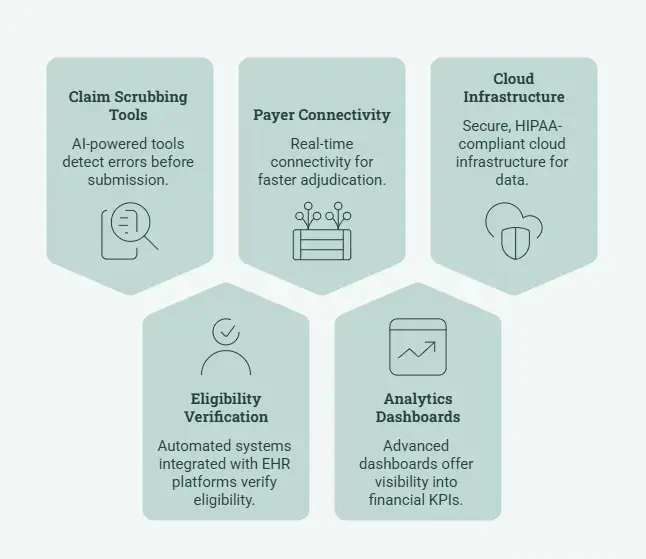
- AI-powered claim scrubbing tools that detect errors before submission
- Automated eligibility verification systems integrated with EHR platforms
- Real-time payer connectivity for faster adjudication
- Advanced analytics dashboards offering visibility into financial KPIs
- Secure, HIPAA-compliant cloud infrastructure for data storage and transmission
For practices seeking the best medical billing service, technology capability is a critical differentiator. A billing partner with robust infrastructure ensures faster reimbursements, fewer errors, and greater financial transparency.
6. Scalability for Growing Practices
As a healthcare practice grows — adding providers, specialties, or locations — billing complexity grows exponentially. Managing this complexity in-house typically requires hiring additional billing staff, investing in new systems, and navigating multi-payer contract management across markets.
A professional medical billing service USA partner scales seamlessly with your practice. Whether you’re onboarding a new physician or expanding into a new state, your billing operations remain consistent, compliant, and optimized without the operational friction of internal scaling.
This scalability is particularly valuable for:
- Multi-specialty group practices
- Telehealth providers expanding across state lines
- Urgent care chains with high patient volume
- Hospital-affiliated physician groups
7. Data Security, Privacy, and HIPAA Compliance
Patient financial data is among the most sensitive information a healthcare practice manages. Data breaches in healthcare can result in devastating HIPAA penalties, reputational damage, and loss of patient trust.
The best medical billing service providers maintain enterprise-grade security protocols, including:
- End-to-end encryption for all data transmissions
- Role-based access controls limiting data exposure
- Regular third-party security audits and penetration testing
- Business Associate Agreements (BAAs) ensuring shared compliance responsibility
- Disaster recovery and business continuity planning
When evaluating a medical billing service, privacy and security infrastructure should be non-negotiable criteria — particularly for practices serving high-profile clientele where discretion is paramount.
What to Look for in the Best Medical Billing Service
Not all billing companies are created equal. When selecting a medical billing service USA partner, consider the following criteria:
| Criteria | What to Look For |
|---|---|
| Certifications | AAPC or AHIMA-certified coders; compliance-trained staff |
| Specialty Experience | Proven track record in your specific specialty |
| Technology Stack | EHR integrations, claim scrubbing, real-time reporting |
| Transparency | Clear fee structures; no hidden charges |
| Communication | Dedicated account managers; responsive support |
| Security | HIPAA compliance; BAA availability; data encryption |
| Performance Metrics | Reported clean claim rates, denial rates, AR days |
| References | Verifiable client testimonials and case studies |
Case Study: How Outsourced Medical Billing Transformed a Multi-Specialty Practice
Background: A 12-physician multi-specialty practice in the Southeast United States was struggling with a 14% claim denial rate, 52 AR days, and significant staff turnover in their in-house billing department.
Solution: The practice partnered with a full-service medical billing service specializing in multi-specialty revenue cycle management. The transition included full EHR integration, dedicated coding specialists per specialty, and weekly financial reporting.
Results (12 months post-implementation):
- Claim denial rate reduced from 14% to 4.2%
- AR days dropped from 52 to 31
- Net collections increased by 18%
- Administrative staff were redeployed to patient-facing roles
- Annual billing costs reduced by $210,000
This case illustrates the tangible, measurable impact that the right medical billing service can have on a practice’s financial and operational health.
The Future of Medical Billing: Trends Shaping the Industry
As healthcare evolves, so does the medical billing landscape. Forward-thinking practices and billing service providers are already adapting to:
- AI and Machine Learning: Automated coding suggestions, predictive denial management, and intelligent claim routing are reducing human error and accelerating reimbursements.
- Value-Based Care Models: Shifting from fee-for-service to value-based reimbursement requires billing sophistication around quality metrics and risk adjustment coding.
- Telehealth Billing Complexity: The post-pandemic expansion of telehealth has introduced new billing codes, payer policies, and multi-state licensing considerations.
- Price Transparency Regulations: CMS price transparency rules require practices to publish clear cost information — adding a new layer of billing and compliance management.
Partnering with a medical billing service provider that actively invests in these emerging capabilities ensures your practice remains competitive and financially resilient.
Conclusion: The Strategic Value of Professional Medical Billing Services
In today’s complex healthcare environment, professional medical billing services are far more than an administrative convenience — they are a strategic asset that directly impacts a practice’s revenue, compliance posture, staff satisfaction, and patient experience.
Whether you are a solo practitioner looking to streamline operations, a growing group practice seeking scalable billing infrastructure, or a large healthcare organization demanding enterprise-grade revenue cycle management, choosing the best medical billing service is one of the most consequential decisions you will make.
The right medical billing service partner brings certified expertise, advanced technology, rigorous compliance standards, and a relentless focus on maximizing your revenue — so you can focus on what matters most: delivering exceptional patient care.