
Medical coding is the backbone of every successful medical billing service. Without it, healthcare providers cannot get reimbursed, insurance claims cannot be processed, and patients cannot receive accurate bills. Yet for many healthcare professionals and practice managers, the relationship between medical coding and medical billing remains unclear.
This comprehensive guide explains what medical coding is, how it functions within a medical billing service, and why getting it right is mission-critical for your healthcare practice’s financial health.
Understanding Medical Coding: A Foundation of Healthcare Finance
Medical coding is the process of translating clinical documentation — including diagnoses, procedures, medical services, and equipment — into standardized alphanumeric codes. These universal codes are used by healthcare providers, insurance companies, and government agencies to communicate healthcare information consistently and accurately.
Every patient encounter generates a set of codes. When a physician examines a patient, diagnoses a condition, or performs a procedure, each of those clinical events is assigned a specific code drawn from standardized code sets.
The Three Primary Code Sets in Medical Coding
Professional medical coders rely on three major coding systems.
- ICD-10-CM (International Classification of Diseases, 10th Revision, Clinical Modification) is used to report diagnoses, symptoms, and medical conditions. The current version contains over 70,000 diagnostic codes.
- CPT Codes (Current Procedural Terminology), developed and maintained by the American Medical Association (AMA), describe medical, surgical, and diagnostic services rendered by healthcare providers.
- HCPCS Level II Codes (Healthcare Common Procedure Coding System) are used primarily for Medicare and Medicaid billing and cover equipment, supplies, and non-physician services.
Expert Insight: According to the American Academy of Professional Coders (AAPC), errors in medical coding cost the U.S. healthcare system billions of dollars annually in denied and delayed claims.
What Is a Medical Billing Service?
A medical billing service is a professional operation, either an in-house department or a third-party company, responsible for submitting and following up on claims with health insurance companies to receive payment for healthcare services rendered.
The workflow of a medical billing service includes the following steps:
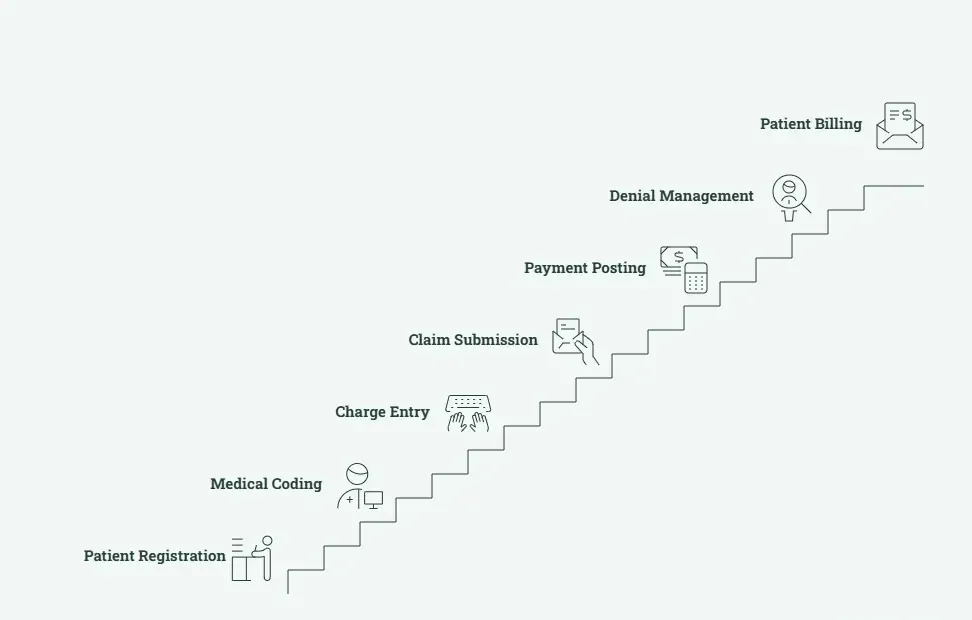
- Patient registration and insurance verification
- Medical coding of diagnoses and procedures
- Charge entry and claim scrubbing
- Claim submission to payers
- Payment posting and reconciliation
- Denial management and appeals
- Patient billing and collections
Medical coding sits at the very heart of this process. Without accurate codes, none of the downstream billing steps can succeed.
The Critical Role of Medical Coding in Medical Billing Service
Medical coding and medical billing are deeply interconnected, yet they are distinct functions. Understanding how they work together is essential for any healthcare practice aiming to maximize revenue and minimize compliance risks.
How Medical Coding Feeds Into the Billing Process
The process typically works as follows. A clinician documents a patient encounter in the Electronic Health Record (EHR) or paper chart. A certified medical coder then reviews the documentation and assigns appropriate ICD-10, CPT, and HCPCS codes. These codes are entered into the billing system as a superbill or charge sheet. The medical billing service uses these codes to build and submit an insurance claim. Finally, the payer adjudicates the claim based on the codes and reimburses accordingly.
A single coding error, whether a wrong digit, an incorrect modifier, or a missing diagnosis code, can result in a claim denial, delayed reimbursement, or in serious cases, allegations of healthcare fraud.
Common Medical Coding Errors That Affect Medical Billing
Understanding these pitfalls helps practices choose the right medical billing service.
| Coding Error | Impact on Billing |
|---|---|
| Upcoding (billing for a higher-level service than provided) | Legal liability, audits, recoupment |
| Undercoding (billing for lower-level services) | Revenue loss |
| Unbundling (billing separately for bundled services) | Claim denials, compliance risk |
| Missing or incorrect modifiers | Automatic claim rejection |
| Diagnosis and procedure code mismatch | Claim denial |
| Using outdated code sets | Rejection by payers |
Types of Medical Coding Specialties
Medical coding is not a one-size-fits-all discipline. Different healthcare settings require specialized coding expertise, and a high-quality medical billing service employs coders with experience across multiple specialties.
Inpatient vs. Outpatient Coding
Inpatient coding involves hospital stays and uses MS-DRG (Medicare Severity Diagnosis-Related Groups) coding to determine reimbursement. Outpatient coding covers office visits, ambulatory surgery centers, and clinics using CPT and ICD-10-CM codes.
Specialty-Specific Coding
Cardiology coding involves complex procedures, including interventional services, stress tests, and echocardiograms. Oncology coding covers chemotherapy administration, radiation therapy, and drug infusion services. Orthopedic coding addresses fracture care, joint replacements, and rehabilitation procedures. Mental health coding includes psychotherapy sessions, psychiatric evaluations, and substance abuse treatment. Emergency medicine coding involves Evaluation and Management (E&M) levels, critical care, and trauma codes.
Each specialty carries its own payer-specific rules, bundling edits, and documentation requirements, making specialty expertise a crucial differentiator when selecting a medical billing and coding service.
Why Accurate Medical Coding Is a Revenue Imperative
For healthcare practices, from independent physicians to multi-specialty groups and hospital systems, the financial stakes of medical coding accuracy cannot be overstated.
The Revenue Cycle Impact
Revenue Cycle Management (RCM) depends entirely on the accuracy and completeness of medical coding. Here is how coding quality directly affects your bottom line.
Claim acceptance rates: Accurate coding results in clean claims that get paid on first submission. Industry benchmarks suggest that high-performing practices achieve a first-pass claim acceptance rate of 95% or higher.
Reimbursement rates: Proper use of diagnosis codes supports medical necessity, which justifies the level of service billed and directly affects what payers reimburse.
Denial rates: Poor coding is the leading cause of claim denials. The average cost to rework a denied claim ranges from $25 to $180, according to the Medical Group Management Association (MGMA).
Audit risk: The Office of Inspector General (OIG) and payers conduct regular audits. Inaccurate coding, even when unintentional, can trigger costly investigations.
Case Study: How Coding Accuracy Transformed a Mid-Size Practice
A 12-physician internal medicine group was experiencing a 22% claim denial rate and significant revenue leakage. After partnering with a professional medical billing service that deployed certified coders, the practice reduced denial rates from 22% to 6% within six months, recovered over $340,000 in previously underbilled services through a retrospective coding audit, and cut average days in accounts receivable from 47 days to 28 days.
This example illustrates the transformative power of expert medical coding within a comprehensive medical billing service.
Medical Coding Compliance: Protecting Your Practice
Compliance is not optional in healthcare. Medical coding must adhere to HIPAA (Health Insurance Portability and Accountability Act), which governs the privacy and security of health information transmitted during billing. It must also follow the False Claims Act, which prohibits submitting fraudulent claims to federal healthcare programs, and align with the OIG Work Plan, which provides annual guidance identifying high-risk billing and coding areas under scrutiny.
A trustworthy medical billing service builds compliance into every step of the coding process through regular coding audits and quality reviews, ongoing coder education and credential maintenance, up-to-date knowledge of payer-specific guidelines, and transparent documentation and reporting.
Choosing the Right Medical Billing Service for Your Coding Needs
When evaluating a medical billing service, coding quality should be your primary consideration. Here is a checklist of what to look for.
Key Qualifications to Demand
Certified coders are essential. Look for CPC (Certified Professional Coder), CCS (Certified Coding Specialist), or RHIA (Registered Health Information Administrator) credentials.
Specialty-specific experience ensures that coders understand your practice’s clinical workflows and the unique coding requirements of your specialty.
Technology integration means the billing service should work seamlessly with your EHR and practice management system, reducing manual errors.
Transparent reporting gives you regular visibility into claim submission rates, denial rates, and coding accuracy metrics.
A formal compliance program should include audit schedules, staff training, and documented OIG adherence policies.
HIPAA-compliant data security protects all patient and billing data with enterprise-grade security protocols and strict access controls.
Questions to Ask a Prospective Medical Billing Service
Before signing any contract, ask these critical questions:
- What is your average first-pass claim acceptance rate?
- How do your coders stay current with annual ICD-10 and CPT code updates?
- What is your denial management and appeals process?
- How do you handle coding for my specific specialty?
- Can you provide references from similar practices?
The Future of Medical Coding in Healthcare
The landscape of medical coding and medical billing services is evolving rapidly. Several key trends are shaping what comes next.
Computer-Assisted Coding
Artificial intelligence and Natural Language Processing (NLP) are being deployed to analyze clinical documentation and suggest codes automatically. While computer-assisted coding increases coder productivity, human oversight remains essential to ensure accuracy, context, and compliance.
Transition to Value-Based Care
As healthcare moves from fee-for-service to value-based reimbursement, coding must capture not just procedures but outcomes, chronic conditions, and social determinants of health. This requires increasingly sophisticated coding expertise from billing professionals.
Telehealth Billing
The post-pandemic expansion of telemedicine has introduced new CPT codes, modifiers, and payer-specific policies that demand specialized knowledge from billing and coding professionals.
Conclusion: Medical Coding Is the Cornerstone of Every Medical Billing Service
Medical coding is far more than a technical back-office function. It is the critical bridge between clinical care and financial reimbursement — the language that translates a physician’s work into the revenue that sustains a healthcare practice.
A high-performing medical billing service treats coding with the seriousness it deserves by deploying certified specialists, investing in continuous education, building robust compliance programs, and leveraging technology to maximize accuracy and efficiency.
For healthcare practices that want to protect their revenue, minimize compliance risk, and deliver accurate bills to patients and payers alike, investing in expert medical coding within a comprehensive medical billing service is not a cost. It is a strategic imperative.