
Introduction: The Accuracy Imperative in Healthcare Revenue Cycle Management
In today’s complex healthcare landscape, accuracy is not optional — it is the foundation of financial stability. Every claim submitted, every diagnosis documented, and every procedure recorded carries financial and legal consequences. Yet, errors in medical billing and coding remain one of the leading causes of claim denials, revenue leakage, and compliance penalties across healthcare organizations.
A professional medical coding service plays a transformative role in bridging the gap between clinical documentation and reimbursement outcomes. When coding is precise, medical billing becomes streamlined, compliant, and profitable. When it is flawed, the entire revenue cycle suffers.
This article explores exactly how a dedicated medical coding service enhances the accuracy of medical billing services, why this relationship is critical for healthcare providers, and what practices distinguish high-performing revenue cycle operations from those that consistently underperform.
Understanding the Connection Between Medical Coding and Medical Billing
Before diving into impact, it is essential to understand how medical coding and medical billing function as interdependent systems.
What Is Medical Coding?
Medical coding is the process of translating clinical documentation — including diagnoses, procedures, treatments, and medical services — into standardized alphanumeric codes. The three primary coding systems used in healthcare include:
- ICD-10-CM (International Classification of Diseases, 10th Revision, Clinical Modification) — for diagnoses
- CPT (Current Procedural Terminology) — for outpatient procedures and services
- HCPCS Level II — for equipment, supplies, and non-physician services
Certified medical coders review physician notes, operative reports, discharge summaries, and other clinical records to assign accurate codes that reflect what occurred during a patient encounter.
What Is Medical Billing?
Medical billing is the process of submitting and following up on claims with health insurance companies to receive payment for services rendered. It begins where coding ends — taking the assigned codes and translating them into insurance claims that are submitted to payers for reimbursement.
The relationship is simple: accurate coding feeds accurate billing. Errors in one directly contaminate the other.
6 Key Ways Medical Coding Services Enhance Accuracy in Medical Billing
1. Eliminating Upcoding and Undercoding Errors
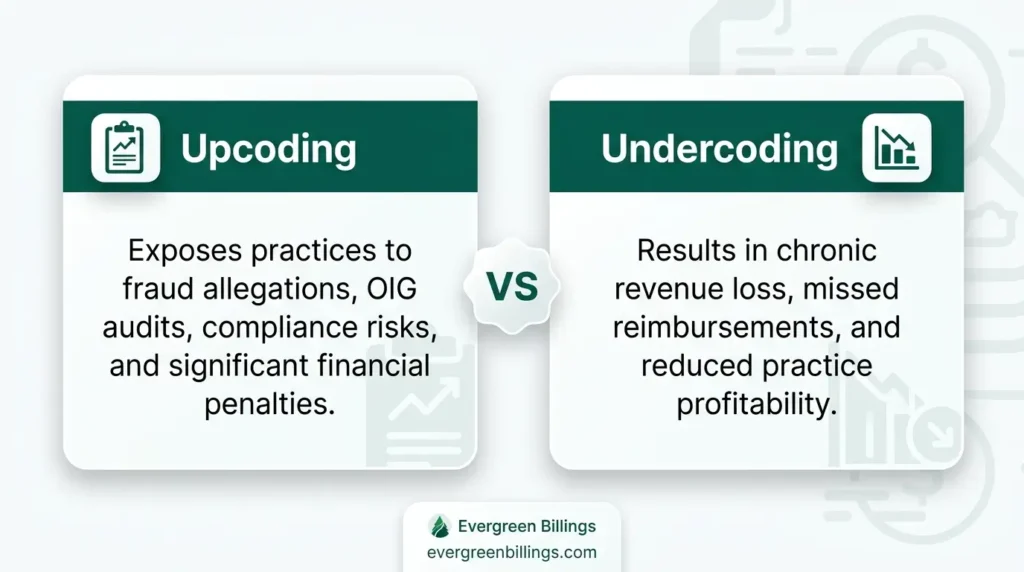
One of the most consequential accuracy challenges in medical billing is the risk of upcoding (assigning codes for higher-complexity services than were actually rendered) and undercoding (assigning lower-level codes that result in under-reimbursement).
Both errors are costly:
A professional medical coding service employs certified coders — typically holding CPC, CCS, or RHIA credentials — who are trained to assign codes that accurately reflect medical necessity and documentation specificity. This precision directly protects your medical billing operation from compliance risk and revenue leakage simultaneously.
2. Reducing Claim Denials Through Code-Level Precision
Claim denials are the single most damaging outcome of poor coding accuracy. Industry data from the American Medical Association (AMA) consistently shows that claim denial rates average between 5–10% for most practices — and that the majority of these denials are preventable.
Common coding-related denial triggers include:
- Incorrect or missing diagnosis codes that don’t support medical necessity
- Mismatched CPT and ICD-10 code pairings that fail payer edits
- Duplicate billing arising from coding inconsistencies
- Unbundling errors where separately billed codes should be combined
- Modifier misuse that misrepresents the nature of the service
A specialized medical coding service applies rigorous pre-submission code audits and scrubbing processes to catch these issues before claims are transmitted. The result is a measurable reduction in denial rates and a corresponding improvement in first-pass claim acceptance — a key benchmark in medical billing service performance.
3. Ensuring Compliance With Payer-Specific Coding Guidelines
Healthcare payers — including Medicare, Medicaid, and commercial insurers — each maintain their own local coverage determinations (LCDs), national coverage determinations (NCDs), and coding policies. What is reimbursable under one plan may be denied under another.
Experienced medical coding services maintain ongoing knowledge of:
- Medicare and Medicaid coding guidelines
- Payer-specific bundling edits
- State-level Medicaid program requirements
- Annual CPT and ICD-10 code updates published by the AMA and CMS
This payer-specific expertise ensures that your medical billing team submits claims that align with each payer’s rules — reducing rejections, accelerating reimbursement cycles, and protecting the practice from compliance gaps.
4. Improving Documentation Quality Through Coder-Clinician Collaboration
A frequently overlooked benefit of professional medical coding services is their role in improving clinical documentation quality at the source.
When coders identify documentation deficiencies — such as vague diagnoses, missing specificity, or undocumented procedures — they communicate these gaps back to clinicians through query processes. This feedback loop, known as Clinical Documentation Improvement (CDI), creates a continuous improvement cycle that benefits every future claim.
Better documentation means:
- More specific, defensible codes
- Stronger medical necessity justification
- Higher reimbursement rates for complex cases
- Reduced risk during payer audits
This CDI integration is where a high-quality medical coding service transcends transactional code assignment and becomes a strategic partner in the revenue cycle.
5. Accelerating the Revenue Cycle Through Clean Claims Submission
Speed and accuracy are not mutually exclusive — in fact, they reinforce each other when coding workflows are optimized.
When a medical coding service operates at peak efficiency, it dramatically reduces the time between patient encounter and claim submission — a metric known as days in accounts receivable (AR). Faster, cleaner submissions mean:
- Quicker reimbursement from payers
- Reduced rework from correcting denied or rejected claims
- Lower administrative burden on in-house medical billing staff
- Improved cash flow for the healthcare organization
For high-volume practices and health systems processing thousands of claims monthly, even a 10–15% improvement in clean claims rate translates to significant financial impact.
6. Supporting Audit Readiness and Regulatory Compliance
Healthcare is one of the most heavily regulated industries in the world. Organizations face audits from:
- CMS Recovery Audit Contractors (RACs)
- Office of Inspector General (OIG)
- Zone Program Integrity Contractors (ZPICs)
- Commercial payer post-payment audits
A professional medical coding service maintains meticulous documentation trails, audit logs, and coding rationale records that are essential during regulatory reviews. When every code is properly supported by documented clinical evidence, your medical billing service is insulated against allegations of fraudulent or improper billing.
The Real Cost of Inaccurate Coding on Medical Billing Performance
To appreciate the value of precision coding, consider what inaccurate coding actually costs healthcare organizations:
| Issue | Direct Impact | Secondary Impact |
|---|---|---|
| Claim denials | Revenue delay or loss | Increased administrative cost |
| Compliance violations | Financial penalties | Reputational damage |
| Undercoding | Chronic revenue leakage | Underestimated practice value |
| Upcoding | Fraud investigation risk | Legal liability |
| Documentation gaps | Audit failures | Payer contract renegotiation |
These costs are not hypothetical. The U.S. Government Accountability Office (GAO) estimates that improper Medicare payments alone exceed $25 billion annually — a significant portion attributable to coding and billing errors.
What to Look for in a High-Quality Medical Coding Service
Not all coding vendors deliver the same level of accuracy. When evaluating a medical coding service to support your medical billing operations, prioritize the following:
- Certified and Credentialed Coders
Look for coders holding CPC (Certified Professional Coder), CCS (Certified Coding Specialist), or RHIA (Registered Health Information Administrator) credentials from AAPC or AHIMA.
- Specialty-Specific Expertise
Medical coding is not one-size-fits-all. Coders with expertise in your specific specialty, whether cardiology, orthopedics, oncology, or behavioral health — bring nuanced knowledge of specialty-specific code sets and payer rules.
- HIPAA-Compliant Technology Infrastructure
Patient data security is non-negotiable. Your medical coding service partner should demonstrate robust HIPAA compliance, including encrypted data transmission, role-based access controls, and documented security protocols.
- Transparent Quality Assurance Processes
Look for services that conduct regular internal audits, maintain coding accuracy rates above 95%, and provide detailed performance reporting tied to your medical billing service KPIs.
- Scalability and Turnaround Guarantees
The best medical coding services offer flexible capacity scaling and documented turnaround time commitments — typically 24–48 hours for standard claims — ensuring your billing pipeline never stalls.
Case Study Perspective: How Outsourced Medical Coding Transforms Billing Accuracy
Consider a mid-sized multispecialty practice processing approximately 3,000 claims per month. Prior to engaging a professional medical coding service, the practice experienced:
- A 12% claim denial rate — nearly double the industry benchmark
- An average AR days figure of 52 days — significantly above the 30–35 day target
- Recurring OIG compliance concerns around modifier usage
Following engagement with a certified medical coding service with specialty-specific expertise:
- The denial rate dropped to 4.2% within six months
- AR days improved to 34 days, recovering substantial cash flow
- Internal audits confirmed coding accuracy above 97%
- Modifier usage was standardized, eliminating the compliance exposure
This type of measurable outcome is replicable across healthcare organizations of all sizes when medical coding quality and medical billing execution are aligned.
The Future of Medical Coding Services: AI-Assisted Accuracy
The evolution of medical coding services increasingly incorporates AI-assisted coding technology — tools that analyze clinical documentation and suggest appropriate codes, which certified coders then review and validate.
This human-in-the-loop model delivers the best of both worlds:
- Speed and consistency from AI-driven code suggestion
- Clinical judgment and compliance oversight from credentialed human coders
As the healthcare industry transitions toward value-based care models, medical coding will also evolve to capture quality measures, hierarchical condition categories (HCCs), and risk adjustment data — all of which have profound implications for both reimbursement and population health management.
Organizations that invest in advanced medical coding services today are positioning themselves for long-term revenue cycle resilience.
Conclusion: Precision Coding Is the Cornerstone of Billing Excellence
The evidence is clear: a professional medical coding service is not a back-office function — it is a strategic asset that directly determines the accuracy, compliance, and profitability of your medical billing operation.
From eliminating claim denials and reducing AR days to ensuring regulatory compliance and supporting clinical documentation improvement, expert medical coding services touch every dimension of revenue cycle performance.
For healthcare providers committed to operational excellence — particularly those serving high-complexity patient populations or operating in competitive specialty markets — investing in a best-in-class medical billing service backed by precision medical coding is one of the highest-return decisions available.
The accuracy of your medical billing begins and ends with the quality of your medical coding. Choose your coding partner with the rigor your revenue cycle demands.