

Introduction
Running a small medical practice is no easy feat. Between seeing patients, managing staff, and staying compliant with ever-changing regulations, the last thing you need is a billing process that leaks revenue and eats up your team’s time.
That’s exactly where medical billing services for small practices come in. Outsourcing your billing to professionals isn’t just a cost-saving move, it’s a strategic decision that can transform how your practice operates. Whether you’re dealing with denied claims, slow reimbursements, or overwhelmed front-desk staff, the right medical billing service can solve all of these problems at once.
In this guide, we’ll walk you through everything you need to know, from what these services actually do, to the real benefits they bring, and how to choose the right partner for your practice.
What Are Medical Billing Services?
Medical billing is the process of submitting and following up on insurance claims so that healthcare providers receive payment for the services they render. It sounds straightforward, but in practice it involves a complex chain of steps that requires specialized knowledge, consistent attention, and the right tools.
A professional medical billing service handles all of these tasks on your behalf so your team can focus on what they do best: caring for patients.
Here is what a full-service billing company typically manages for you:
- Patient registration and insurance verification
- Medical coding (ICD-10, CPT, HCPCS)
- Claim submission to payers
- Payment posting and reconciliation
- Denials management and appeals
- Patient billing and collections
Why Small Practices Struggle with In-House Billing
Many small practices start with in-house billing because it feels more controllable. But over time, the cracks begin to show. Here is why in-house billing often becomes a bottleneck for smaller healthcare providers.
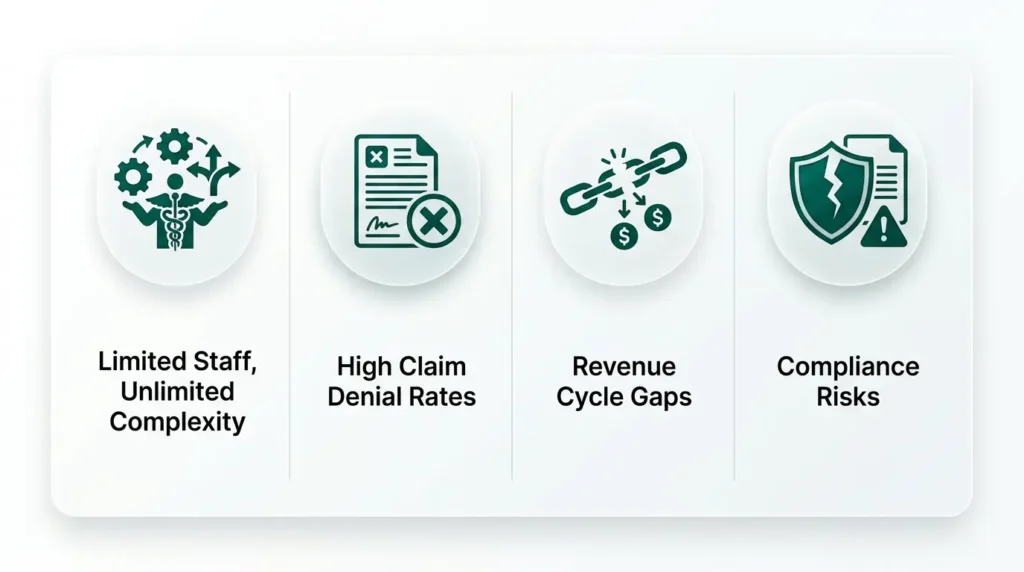
Limited Staff, Unlimited Complexity
A small office might have one or two people handling billing alongside their other duties. But medical billing is a full-time job on its own, and one that demands constant training as coding rules and payer policies change year after year.
When your front desk coordinator is also your biller, something always gets deprioritized. More often than not, it is the billing.
High Claim Denial Rates
Without dedicated billing professionals, claim errors are common. Incorrect codes, missing documentation, or missed filing deadlines can lead to denials that cost your practice thousands of dollars per year. And when no one has time to chase those denied claims, that money simply disappears.
Revenue Cycle Gaps
In-house teams often lack the tools or bandwidth to proactively follow up on unpaid claims. The result is long accounts receivable (AR) days and revenue sitting uncollected for weeks or even months at a time.
Compliance Risks
Healthcare billing regulations are strict. HIPAA violations, incorrect coding, or billing errors — even when unintentional — can result in audits, penalties, or loss of licensure. Keeping up with these regulations requires ongoing education that small teams rarely have time for.
Top Benefits of Outsourcing Medical Billing Services for Small Practices
Outsourcing your medical practice billing service isn’t just about offloading work. It is about partnering with experts who are solely focused on maximizing your revenue while keeping you fully compliant. Here is a closer look at the key benefits.
1. Improved Cash Flow and Faster Reimbursements
One of the most immediate benefits practices notice after outsourcing is faster payments. Professional billing companies have streamlined workflows and experienced coders who submit cleaner claims the first time around.
Fewer rejected claims means fewer delays. Dedicated follow-up teams proactively chase unpaid claims rather than waiting for payers to act. Most practices see a measurable reduction in AR days within the first few months of making the switch.
2. Reduced Claim Denials Through Expert Denials Management
Claim denials are one of the biggest revenue killers for small practices. A professional denials management service doesn’t just resubmit denied claims — it analyzes why denials happen and works to fix the root cause so the same mistakes don’t repeat.
This includes tracking denial trends by payer and billing code, identifying documentation gaps before claims go out, appealing denials with proper supporting documentation, and helping your clinical staff understand which coding habits are triggering rejections. The result is a steady decline in your overall denial rate and more money recovered from previously rejected claims.
3. Lower Operational Costs
Hiring, training, and retaining a qualified in-house billing team is expensive. When you factor in salaries, benefits, software subscriptions, and ongoing certifications, the costs add up quickly. Outsourcing removes most of that overhead.
| Cost Factor | In-House Billing | Outsourced Billing |
|---|---|---|
| Staff Salaries | High (full-time employees) | Included in service fee |
| Software and Tools | Separate subscription | Included |
| Training and Certifications | Ongoing cost | Handled by vendor |
| Billing Errors and Rework | Frequent and costly | Minimized |
| Scalability | Requires hiring | Flexible |
Most medical billing services charge a percentage of collections, typically between 4% and 9%. This means you only pay when you get paid, which aligns the billing company’s incentives directly with your revenue goals.
4. Access to Specialized Billing Expertise
Billing companies work across multiple specialties and payers every single day. They stay current on CPT and ICD-10 code updates, payer-specific billing requirements, CMS rule changes and fee schedule updates, and prior authorization trends that affect reimbursement timelines.
This depth of expertise is nearly impossible to replicate with a small in-house team, especially in a practice where billing is just one of many competing responsibilities.
5. More Time for Patient Care
When your staff isn’t bogged down with claim follow-ups and billing disputes, they can redirect their energy toward what truly matters. Better patient satisfaction scores, more time for patient education, and reduced staff burnout are all common outcomes practices report after outsourcing their billing.
This isn’t just good for your team. It directly impacts the patient experience and the long-term reputation of your practice.
6. Scalability as Your Practice Grows
As you add providers, expand services, or open a new location, your billing needs grow too. Outsourced medical practice billing services scale with you naturally. There is no need to hire additional staff, purchase new software, or rebuild internal systems from scratch.
7. Better Compliance and Reduced Audit Risk
Reputable medical billing companies invest heavily in compliance training and audit readiness. They follow HIPAA guidelines strictly and maintain documentation practices that protect your practice in the event of a payer audit. That peace of mind alone is worth a great deal for a busy small practice owner.
Key Features to Look for in a Medical Billing Service
Not all billing companies are created equal. When evaluating a medical billing service for your small practice, here is what to prioritize.
Specialty-Specific Experience
Make sure the company has experience billing for your specific specialty. Family medicine, behavioral health, physical therapy, and cardiology all have unique coding requirements. A generalist billing company may not have the depth your practice needs.
Transparent Reporting and Analytics
You should always know how your revenue cycle is performing. Look for services that offer monthly or weekly performance dashboards, denial rate tracking, AR aging reports, and collection rate benchmarks. If a vendor can’t show you your numbers clearly, that’s a red flag.
Dedicated Denials Management Services
A strong denials management team is non-negotiable. Ask prospective vendors what percentage of denied claims they successfully appeal, and how long the process typically takes. This single metric often separates average billing companies from great ones.
EHR Integration
Your billing service should integrate seamlessly with your existing electronic health record (EHR) system. This reduces manual data entry errors and speeds up the entire billing cycle from documentation to reimbursement.
Responsive Communication
You need a billing partner who picks up the phone. Poor communication is one of the most common complaints practices have about their billing vendors. Before signing anything, make sure you know exactly who your account manager is and what their typical response time looks like.
Common Misconceptions About Outsourcing Medical Billing
Let’s clear up a few myths that keep some practice owners from making the switch.
Lose control of billing: This is the most common concern, and it’s understandable. But reputable services provide full transparency through real-time reporting and give you complete visibility into your accounts receivable at any time.
Only for large practices: Actually, small practices often benefit the most. They tend to have fewer billing resources in-house, which makes the expertise gap, and the revenue impact far more significant.
Outsourcing means slower billing: The opposite is usually true. With dedicated billing professionals working on your claims full time, most practices see faster submissions and quicker reimbursements than they had with in-house staff.
Too expensive: When you calculate the cost of claim denials, uncollected revenue, and the staff hours spent on billing tasks each week, outsourcing is almost always more cost-effective than maintaining an in-house team.
Practical Tips for a Smooth Transition
If you’re ready to move forward with outsourcing your medical practice billing service, a little preparation goes a long way. Here are five tips to make the transition as smooth as possible.
- Audit your current billing performance: Know your current denial rate, AR days, and collection rate before you start. This gives you a clear baseline to measure improvement against.
- Involve your clinical staff: Billing accuracy starts at the point of care. Make sure your providers understand that better documentation leads to cleaner claims and faster payments.
- Define your expectations upfront: Put key performance indicators in the contract, such as a minimum clean claim rate or maximum AR days, so both sides are accountable.
- Plan a parallel transition period: For the first 30 to 60 days, consider running both your in-house team and the new service simultaneously to catch any transition issues before they become problems.
- Review reports regularly: Don’t set it and forget it. Review your monthly billing reports and hold your vendor accountable to the performance benchmarks you agreed on.
Conclusion
Managing a small medical practice is already a full-time challenge. Your billing process shouldn’t make it harder.
Outsourcing to a professional medical billing service gives your practice access to dedicated billing experts, proven denial management systems, and the technology to optimize every step of your revenue cycle — without the overhead of building that capability in-house.
The result is less administrative stress, fewer denied claims, faster reimbursements, and more time for you and your team to focus on delivering exceptional patient care.
If you are ready to stop leaving money on the table, now is the time to explore your options. Start by auditing your current billing performance, then reach out to a few billing companies that specialize in your area of practice. The right partner can make a measurable difference — not just to your bottom line, but to the overall health of your practice.
FAQ:
Q1: How much do medical billing services cost for small practices?
Most medical billing services charge between 4% and 9% of monthly collections. Some may offer flat-fee pricing for very small practices. The right structure depends on your volume and specialty, so it’s worth getting quotes from two or three vendors before deciding.
Q2: Will I lose HIPAA compliance by outsourcing my billing?
No, as long as you sign a Business Associate Agreement (BAA) with your billing vendor, which is standard practice. Reputable companies are fully HIPAA-compliant and take data security seriously as part of their core operations.
Q3: How long does it take to see results after outsourcing?
Most practices begin to see improvements in denial rates and cash flow within the first 60 to 90 days. Full optimization of your revenue cycle typically takes around three to six months as the billing team learns the nuances of your payers and patient population.
Q4: What is denials management, and why does it matter?
Denials management is the process of identifying, appealing, and preventing claim denials from insurance payers. It matters because denied claims directly reduce your revenue. A good denials management service doesn’t just fix the problem after the fact — it works to stop denials from happening in the first place.
Q5: Can I outsource billing even if I use a specific EHR system?
Yes. Most professional billing companies work with all major EHR platforms, including Epic, Athenahealth, eClinicalWorks, Practice Fusion, and others. Always confirm compatibility before signing a contract, and ask how data is transferred between systems.